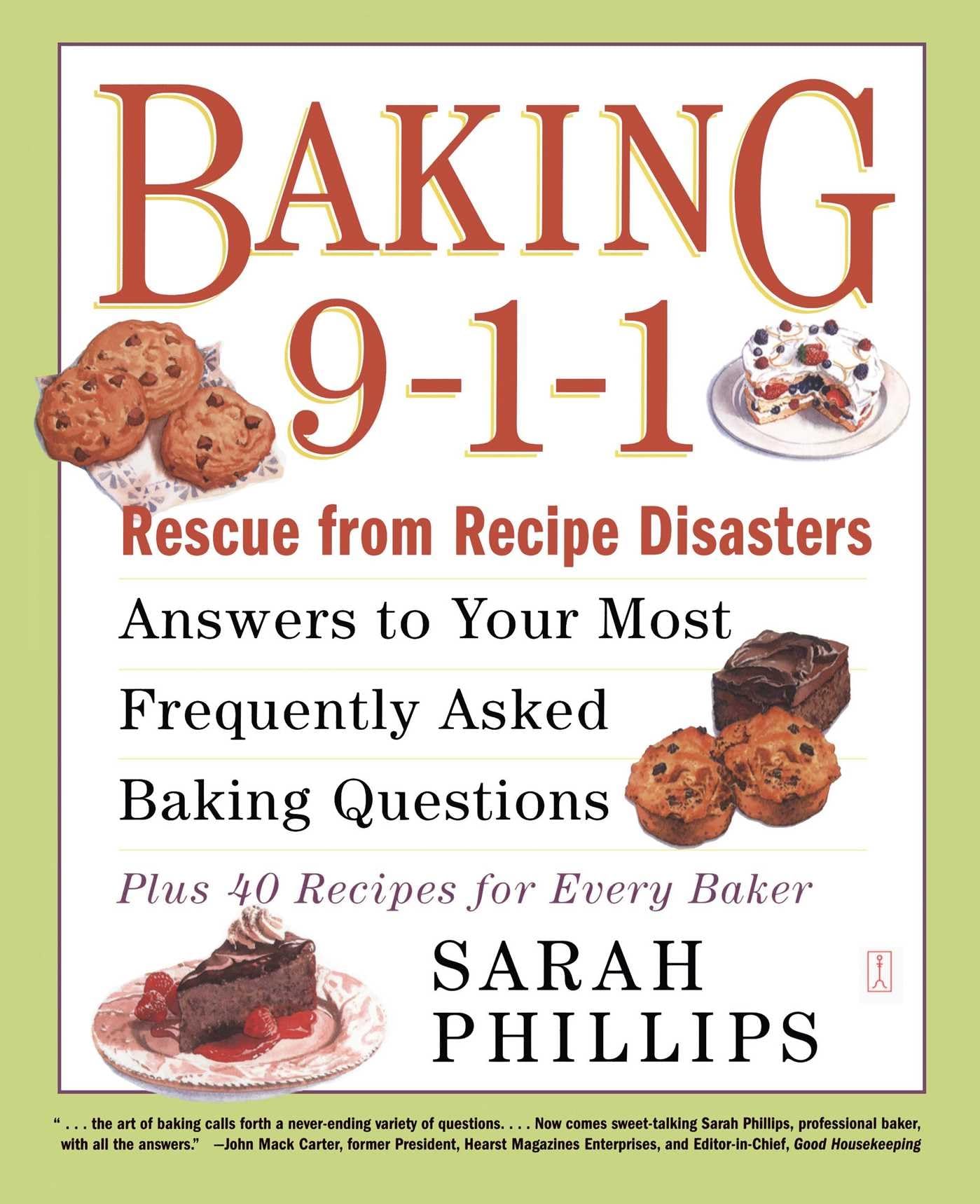
Baking 9-1-1: Rescue from Recipe Disasters; Answers to Your Most Frequently Asked Baking Questions; 40 Recipes for Every Baker
$11.49
by Sarah Phillips



Baking is a science. But who wants to spend hours in the kitchen experimenting? Thankfully, Sarah Phillips does. She has discovered what causes baking disasters and shows bakers at all levels of expertise how to avoid them. With unique tips and exhaustively tested recipes, Baking 9-1-1 takes the guesswork out of baking and explains: How to make a cake that won't fall in the middle - What it takes to bake a flaky piecrust - The easiest way to prevent a cheesecake from cracking - How to make the perfect chocolate chip cookie that's thick and chewy - The trick to storing baked goods - The answers to niggling questions such as "Does butter really need to be room temperature?" and "What is the difference between one cup flour sifted and one cup sifted flour?" among many others. The recipes in Baking 9-1-1 solve bakers' most frustrating problems. They include an all-purpose pie dough, a lemon meringue pie that doesn't sweat, thick and rich chocolate ganache fudge sauce, no-fuss buttermilk biscuits, and dozens more. Baking 9-1-1 is the source for foolproof answers that simply can't be found anywhere else. John Mack Carter former President, Hearst Magazines Enterprises, and Editor-in-Chief, Good Housekeeping ...the art of baking calls forth a never-ending variety of questions....Now comes sweet-talking Sarah Phillips, professional baker, with all the answers. Reese Schonfeld Founding CEO, Food Network The go-to guide for baking emergencies....Keep this one close by your oven. Toba Garrett author of Creative Cookies and The Well-Decorated Cake , and Chef/Instructor, The Institute of Culinary Education The perfect companion to a baker's library. Sarah guides you step-by-step in solving your baking needs. Her great ideas will help you achieve great results. Sarah Phillips is the founder of www.baking911.com. Formerly the baking expert at iVillage, Phillips develops recipes for the bakeware company Chicago Metallic. Her recipes have been published in Prevention magazine. She lives in New York. Chapter One: Sarah's Kitchen Pantry So, what's in your kitchen, Sarah? ...the inside story on equipment I can't live (or at least bake) without. The baker must work within the parameters of a recipe to produce a baked good that will rise, set, and taste the way he or she intends. Important in your ability to achieve that is having the right equipment and an accurate oven, and by avoiding overmixing or overbaking. Recipes don't have to be followed dead on, but if you stray by more than about 20 percent, you risk disappointment. Keep in mind, too, that not all recipes work in the first place, and it's hard to tell that in advance! What every baker should have Nested metal dry measuring cups: Measure dry ingredients, solid fats, brown sugar, peanut butter, honey, molasses, corn syrup, sour cream, yogurt, applesauce, and flaked coconut. I use them in sets in 1/8, 1/4, 1/3, 1/2 and 1 cup sizes. Heatproof glass measuring cups for liquid ingredients: Measure all liquids such as water, milk, buttermilk, and oil, in amounts at or above G cup; for less than G cup use measuring spoons. I have the basic 1-, 4-, and 8-cup sizes. Larger sizes (4-cup or more) are perfect to use as mixing bowls as well. Measuring spoons: They come in different sizes. They are used to measure both dry and liquid ingredients. Don't try to measure with spoons meant for table use. Ruler and tape measure: I always keep a ruler and a tape measure in my kitchen drawer and use them all the time. They measure the size of pans and parchment paper, cookie dough, pie crusts, ready-made pastry, etc. A ruler is handy when scoring dough; place it on the dough as a guide for the knife. A recipe will bake more evenly if divided equally. Scale: When more than doubling a recipe, I recommend weighing dry ingredients to ensure accuracy. Make sure the scale measures up to several pounds in G-ounce (5-gram) increments. Thermometers: These come in different types for different purposes. They are essential to accurate baking and chocolate work. When you get a new thermometer, always place in it boiling water for about five minutes to test whether or not it reads 212 degrees F (100 degrees C) at the boiling point. This way you will know your exact thermometer reading, and you can make adjustments if necessary or return it. Instant read thermometer: A small and thin thermometer with a gauge or digital readout on top. I use mine all the time to check the doneness of breads, temperature of ingredients, and the temperature of the warm water used to dissolve yeast. You'll notice that chefs have them clipped on their jackets all the time. Candy or deep-fat thermometer: A handy kitchen gadget necessary for testing temperature when making candy, syrups, jams, jellies, and when deep-frying, in order to get the food to exactly the right temperature. Mercury-gauge chocolate thermometer: Used when melting and tempering chocolate; is