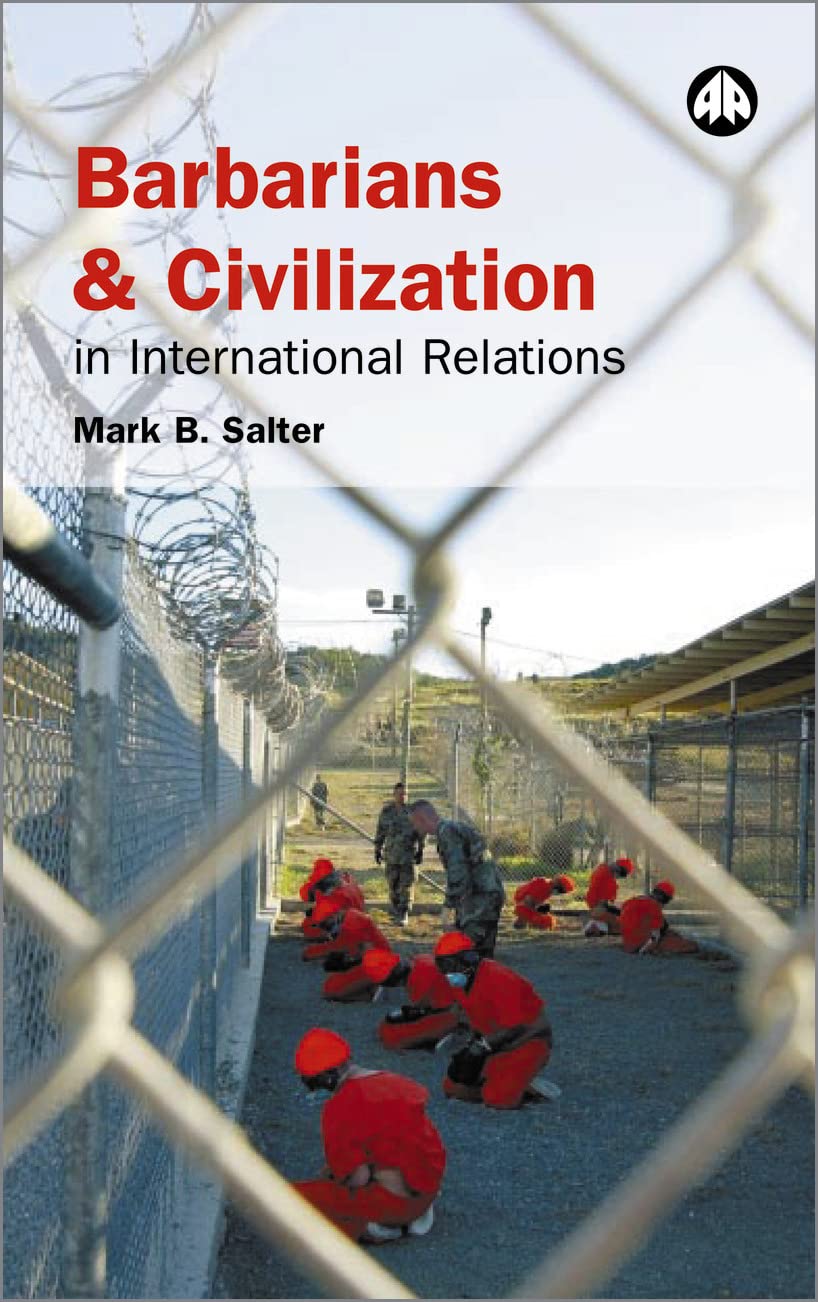



The terrorist attacks in New York and Washington have led to popular conceptions of Muslims as terrorists. Some commentators have harked back to the 'Clash of Civilizations' argument outlined by Samuel Huntington which has become a touchstone in postcolonial studies. Huntington argued that, after the collapse of the Cold War, culture would become the main axis of conflict for civilizational alliances. Mark Salter takes issue with Huntington's theory and explains how the terms of his argument are part of an imperialist discourse that casts other civilizations as essentially barbarian.Although many commentators have engaged with Huntington's claims, few have pursued the political implications of his argument. Barbarians and Civilisation offers a decisive exploration of the colonial rhetoric inherent in current political discourse. Charting the usefulness of concepts of culture and identity for understanding world politics, Salter brilliantly illustrates the benefits and the limitations of the civilized/barbarian dichotomy in international relations. "Salter aims to trace the evolution and impact of barbarian-civilizational discourse in international relations. Using a postmodern, constructivist perspective, the author describes and critiques past efforts to classify nations by relying on a dualistic conceptual approach--or what he terms a "two world" model. His analysis focuses on European imperialism, European wartime atrocities, decolonization, and the post-Cold War debate over cultural conflict. Salter's analysis challenges the use of concepts that oversimplify political reality and offer a simplistic, normative orientation that presumptively favors Western culture. After tracing different manifestations of this dualistic model over the past two centuries, Salter critiques the ideas of contemporary thinkers, including Samuel Huntington, Paul Kennedy, Robert Kaplan, and James Barber." -- M. Amstutz, Wheaton College in CHOICE Mark B. Salter is Assistant Professor at The American University in Cairo. He is currently working on a history of the passport in world politics. Barbarians and Civilization in International Relations By Mark B. Salter Pluto Press Copyright © 2002 Mark B. Salter All rights reserved. ISBN: 978-0-7453-1902-5 Contents Acknowledgements, ix, 1. Introduction, 1, 2. Civilization and Barbarians, 8, 3. Empire of Barbarians, 28, 4. A Civilized/Barbaric Europe, 64, 5. New Barbarians, 91, 6. Decolonizing the Discipline: Forgetting the Imperial Past and the Imperial Present, 114, 7. New Barbarians, Old Barbarians: Post-Cold War IR Theory. 'Everything Old is New Again', 128, 8. Conclusion: The Return of Culture, Identity, Civilization and Barbarians to International Relations, 156, Epilogue: New Barbarians, New Civilizations and No New Clashes, 163, Notes, 168, Bibliography, 202, Index, 221, CHAPTER 1 Introduction On the Corniche, along the Nile, just outside the Luxor temple, is a traffic sign that reads 'Obeying the traffic light is a sign of civilization'. After five years of noting each invocation of the discourse of 'civilization', the traffic sign – in English – seemed to illustrate the end of the road. This exhortation, directed at the English-speaking tourists rather than the Arabic-speaking inhabitants, seemed to signify exactly what was at stake in the 'clash of civilizations' debate in International Relations. What I found in Luxor was not only the assertion of an Islamic identity against the continual flow of Western influences or the rejection of globalization. Rather, at Luxor, I found refutation of the inevitable 'clash' of civilizations, cultures or Islam and the West. Luxor is a site that has gained prominence several times in its history. Luxor temple in particular is an excellent example of civilizational dialogue: it was started by Amenhotep III (1414 BC), added to by the Tutankhamun (1333–23 BC), defaced by the famous Ramses II (1290–24 BC), invaded by the Assyrians in the seventh century BC, and later by Alexander the Great (332–23 BC). Copts converted the inner sanctum into a church, defacing the hieroglyphics with Christian iconography in AD 200–300. After the Muslim invasion, a mosque was built into the structure of the pharaonic temple in the thirteenth century. And the temple is the source of the obelisk that now stands in the heart of Paris, the Place de la Concorde. More recently, in 1997, Luxor was the site of a terrorist attack against tourists at the temple of Queen Hatshepsut. Currently, one might point as signs of globalization to the obligatory McDonald's, innumerable cruise boats continuing the flow of tourists that began with the French invasion and Thomas Cook, or the multilingual shopkeepers hawking copies of the artifacts that grace the Louvre, the Metropolitan Museum of Art and the British Museum. What is notable in Luxor (and in Egypt generally) is their complex relationship to the West and to Islamic extremism.