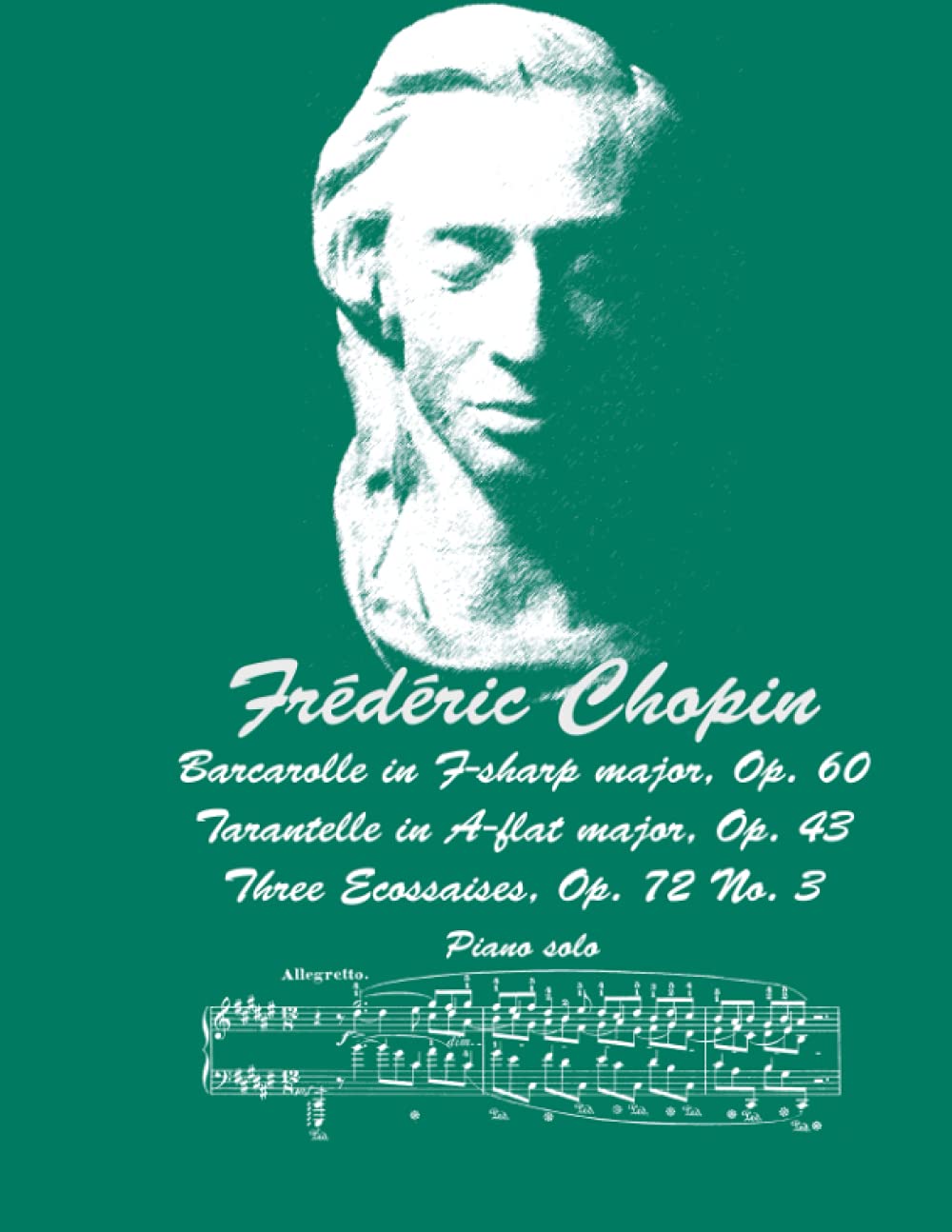
Barcarolle in F-sharp major, Op. 60; Tarantelle in A-flat major, Op. 43; Three Ecossaises, Op. 72 No. 3: Piano solo
$9.95
by Frédéric Chopin



The Barcarolle in F-sharp major, Op. 60, is a piece for solo piano by Frédéric Chopin, composed between autumn of 1845 and summer 1846, three years before his death. Based on the barcarolle rhythm and mood, it features a sweepingly romantic and slightly wistful tone. Many of the technical figures for the right hand are thirds and sixths, while the left features a very long reach over an octave. Its middle section is in A major, and this section's second theme is recapitulated near the piece's end in F-sharp. This is one of Chopin's last major compositions, along with his Polonaise-Fantasie, Op. 61. It is often considered to be one of his more demanding compositions. Performance times average 7–9 minutes. The Tarantelle in A-flat major, Op. 43 is a short piano piece in tarantella form, written by Frédéric Chopin in June 1841 and published in October 1841 It takes about 3 minutes to play. It is a moto perpetuo marked Presto and requires an advanced technique. It was inspired by Gioachino Rossini's song La Danza, also written in the tarantella's characteristic 6/8 rhythm. Chopin went to some lengths to ensure the time signature was the same as Rossini's and enlisted his friend Julian Fontana to check the best editions of Rossini's work for this detail. The manuscript shows Chopin changed his time signature from 12/8 to 6/8. There is no evidence the work was commissioned, nor was it dedicated to anyone. Robert Schumann described it as being in "Chopin's most extravagant manner; we see before us the dancer, whirling as if possessed, until our senses reel. To be sure, nobody could call this music lovely, but we willingly forgive the master of his wild fantasy. For is he not once in a while permitted to display the dark side of his soul?..." Chopin himself said, "I hope I won't write anything as dreadful too soon". Despite this self-criticism, it has become a recording favourite, although it is less frequently performed in recitals. Frédéric Chopin composed this set of three Ecoissaises for piano solo in 1826. They were published after his death, in 1855, as no. 3 of Op. 72 (a posthumous release which also included a nocturne and a funeral march). The Ecoissaises are lively contradances, inspired in the tradition of the Scottish dances that were popular in the continent.