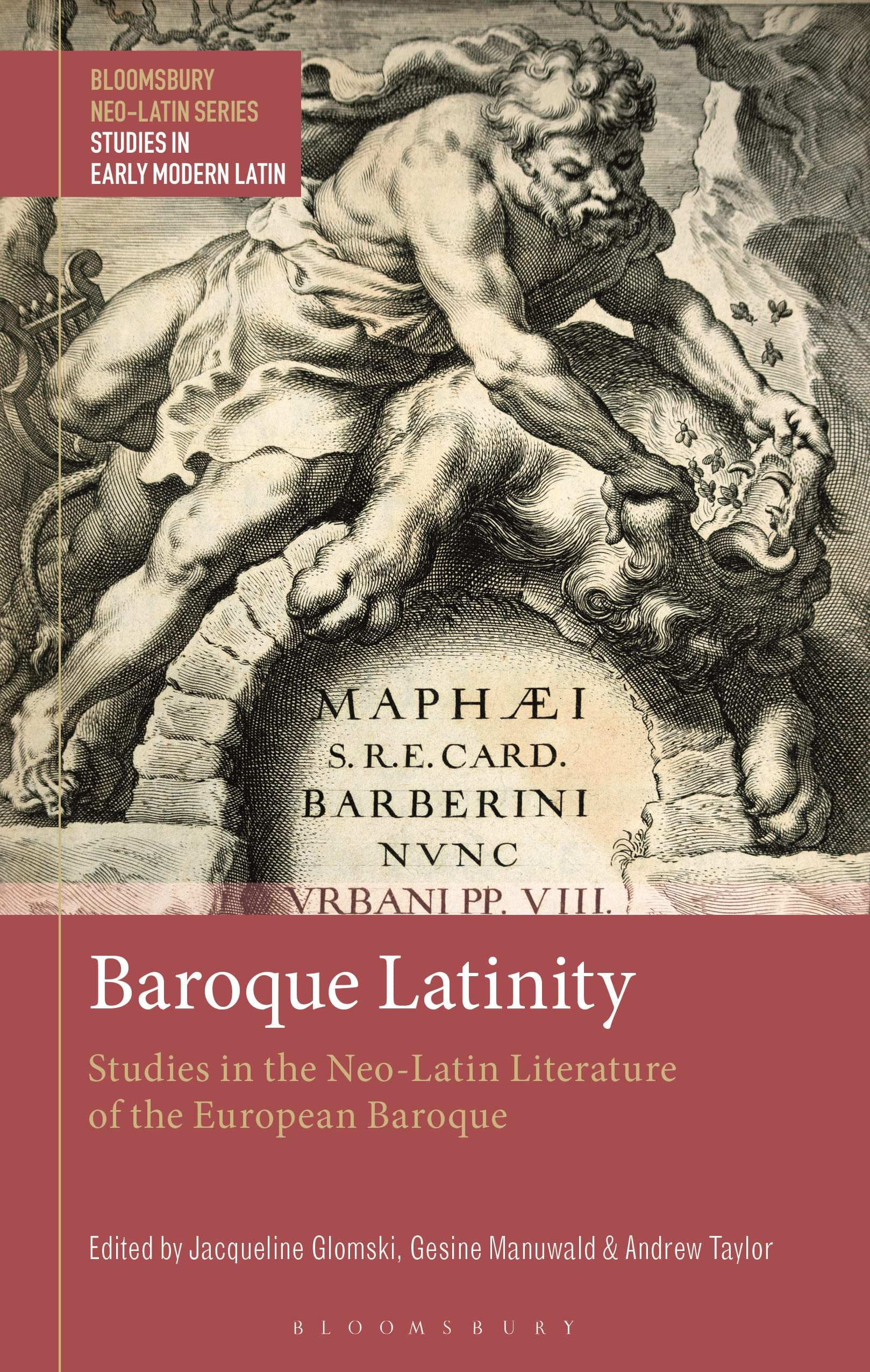
Baroque Latinity: Studies in the Neo-Latin Literature of the European Baroque (Bloomsbury Neo-Latin Series: Studies in Early Modern Latin)
$39.95
by Jacqueline Glomski



This volume addresses the idea of the Baroque in European literature in Latin. With contributions by scholars from various disciplines and countries, and by looking at a range of texts from across Europe, the volume offers case studies to deepen scholarly understanding of this important literary phenomenon and inspire future research. A key aim of the volume is to address the distinctiveness of these texts by interrogating the usefulness and specificity of the term ‘Baroque’, especially in relation to the classical rules it transgresses to produce effects of grandeur, richness, and exuberance in a range of secular and sacred arts (e.g. music, architecture, painting), as well as various forms of literature (e.g. prose, poetry, drama). The contributors consider how and why Latin writing mutated from earlier humanist paradigms, thus exploring how ideas of ‘early modern’ and ‘Baroque’ are related, and examine the interplay of the theory and practice of the ‘Baroque’, including its debts to and deviations from ancient models, and its limits and limitations. “I have nothing but praise for this extremely fine collection of studies on various aspects of the Baroque. It is a book that fills a major gap in the literature” ― Sun News Austin “Is it a style, a period, a way of expressing grandeur or channeling emotions? Baroque Latinity tackles the complex question of what it is that makes a Neo-Latin text 'baroque'. This will no doubt become key reading for anyone else interested in Neo-Latin writings from the late sixteenth to the early eighteenth century.” ― Ingrid De Smet, Professor of French and Neo-Latin Studies, University of Warwick, UK Jacqueline Glomski is Honorary Senior Research Fellow at University College London (UCL), Vice-President of the Society for Neo-Latin Studies (SNLS), and a fellow of the Royal Historical Society. She has co-edited the collected volumes Acta Conventus Neo-Latini Monasteriensis: Proceedings of the Fifteenth International Congress of Neo-Latin Studies (2015), Seventeenth-Century Fiction: Text and Transmission (2016), and Seventeenth-Century Libraries: Problems and Perspectives (forthcoming). Gesine Manuwald is Professor of Latin at University College London, UK, and President of the Society for Neo-Latin Studies (SNLS). She has published a number of articles on early modern Latin literature and edited the collected volume Neo-Latin Poetry in the British Isles (2012) with Luke Houghton. Stephen Harrison is Professor of Latin Literature, Corpus Christi College, University of Oxford, UK. His research interests are in Augustan Poetry, the Ancient Novel, esp. Apuleius, Classical Reception (especially 19th and 20th century UK). Among many books and articles he is author of: Vergil: Aeneid 10 (1991), Homage to Horace (ed., 1995), Apuleius: A Latin Sophist (2000) Generic Enrichment in Vergil and Horace (2007). Andrew Taylor is Senior Lecturer, Fellow and Director of Studies in English at Churchill College, University of Cambridge, UK. He has published widely on Renaissance literature and has edited Neo-Latin and the Pastoral (2006) and The Early Modern Cultures of Neo-Latin Drama (2013), both with Philip Ford, and Neo-Latin and Translation in the Renaissance (2014). William Barton is Assistant Professor at the Institute of Classical Philology and Neo-Latin Studies, University of Innsbruck, Austria. He is a co-editor of the Bloomsbury Neo-Latin Series.