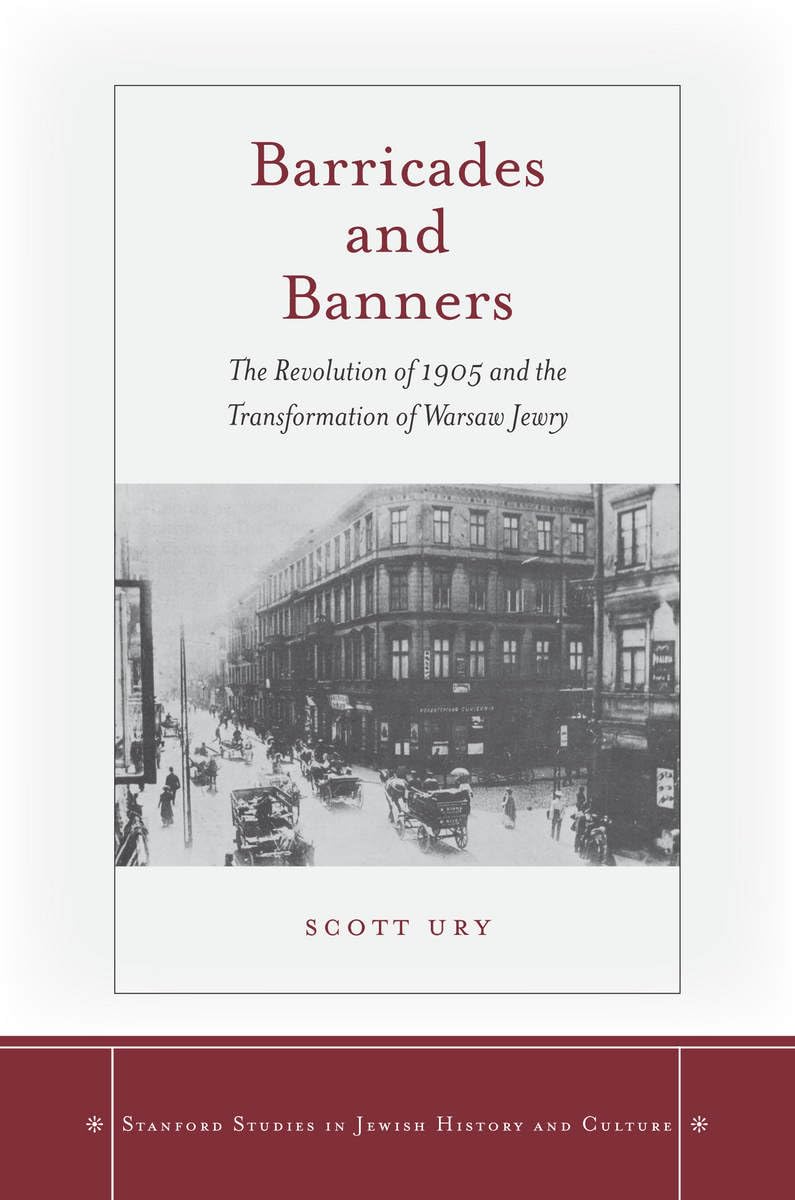



This book examines the intersection of urban society and modern politics among Jews in turn of the century Warsaw, Europe's largest Jewish center at the time. By focusing on the tumultuous events surrounding the Revolution of 1905, Barricades and Banners argues that the metropolitanization of Jewish life led to a need for new forms of community and belonging, and that the ensuing search for collective and individual order gave birth to the new institutions, organizations, and practices that would define modern Jewish society and politics for the remainder of the twentieth century. Barricades and Banners received the Reginald Zelnik Book Prize for outstanding monograph published on Russia, Eastern Europe or Eurasia in the field of history from the Association for Slavic, East European and Eurasian Studies (ASEEES). A manuscript version of the book was awarded a commendation for the Fraenkel Prize in Contemporary History for an outstanding work of twentieth-century history from the Wiener Library for the Study of the Holocaust and Genocide, London. "Sometimes , historians are able to place their hands on particular historical moments that reflect social, political and intellectual processes that end up shaping an entire era. This is exactly what the historian Scott Ury does in his book Barricades and Banners . . . The author doesn't just tell the story of Jews and Poles in Russian-occupied Warsaw, but through this account he also gives a brief history of the twentieth century in Eastern and Central Europe." Dimitry Shumsky, The Hebrew University of Jerusalem, Haaretz "With his impressive debut book, Ury has firmly established himself as a worthy heir to [Jacob] Katz's legacy. It is essential reading for historians of the Russian, Polish, and Jewish experiences." Jeffrey Veidlinger, The University of Michigan, H-Judaic "This major study is a valuable account of the emergence of mass politics in the Polish lands and how this greatly complicated the problem of finding an appropriate place for Poland's large, unassimilated Jewish minority.” Antony Polonsky, Brandeis University, Russian Review "Scott Ury has written a fascinating book, long in coming, that contributes to a number of different discussions among historians of modern Jewish politics, Polish-Jewish relations, and the role of the city of Warsaw in the transformation of political culture and discourse in the early twentieth century. Ury's premise is that the Jewish encounter with modernity occurred in the heart of modernity itself, the big city, and not through the conduits of religious and intellectual change or community institutions…but through the lived experience of ordinary Jews, many of them recent arrivals to a rapidly developing metropolis. As Jews encountered, struggled with, and attempted to master this dynamic and chaotic world, revolution in the Russian Empire created conditions for the emergence of a public sphere and participatory politics whereby a 'discourse on order' promoted the rise and ultimate victory of Jewish nationalists over their socialist and liberal rivals...Since the same could be said of the development of Polish political culture in the shared urban space, Ury views Polish and Jewish histories in Warsaw as parallel, interrelated and interacting parts of a larger cultural-political phenomenon which ultimately divided the city's residents into two separate camps, those of 'Poles' and 'Jews.'" Robert Blobaum, University of West Virginia, POLIN online "The main innovative claim...is that the streets of big cities like Warsaw were not only the principal arena for Jewish politics in Poland but in many ways the cause for the formation of those movements as young people sought to understand and adjust to the bustling life of the metropolis....Ury makes an important contribution to the history of Polish politics and Polish antisemitism through his insight that the political changes engendered by the revolution of 1905 and the development of Jewish politics were crucial factors in the growth of Polish antisemitism..." Gershon Bacon, Bar-Ilan University, Slavic Review "Scott Ury is one of the brightest and most gifted of the younger historians of Jewish Eastern Europe. His new book on Jewish Warsaw is full of fresh perspectives that show the important impact of urbanization on the development of Polish Jewry."-- Samuel Kassow, Trinity College For more information, see Scott Ury's faculty website: humanities.tau.ac.il/segel/scottury/ Scott Ury is Senior Lecturer in Tel Aviv University's Department of Jewish History, where he is also Director of the Eva and Marc Besen Institute for the Study of Historical Consciousness and Senior Editor of the journal, History and Memory: Studies in Representation of the Pas t. Scott Ury is also co-editor of several volumes dedicated to various aspects of modern Jewish history and society, including: Jews and Their Neighbours in Eastern Europe since 1750 (Littman, 2012), Cos