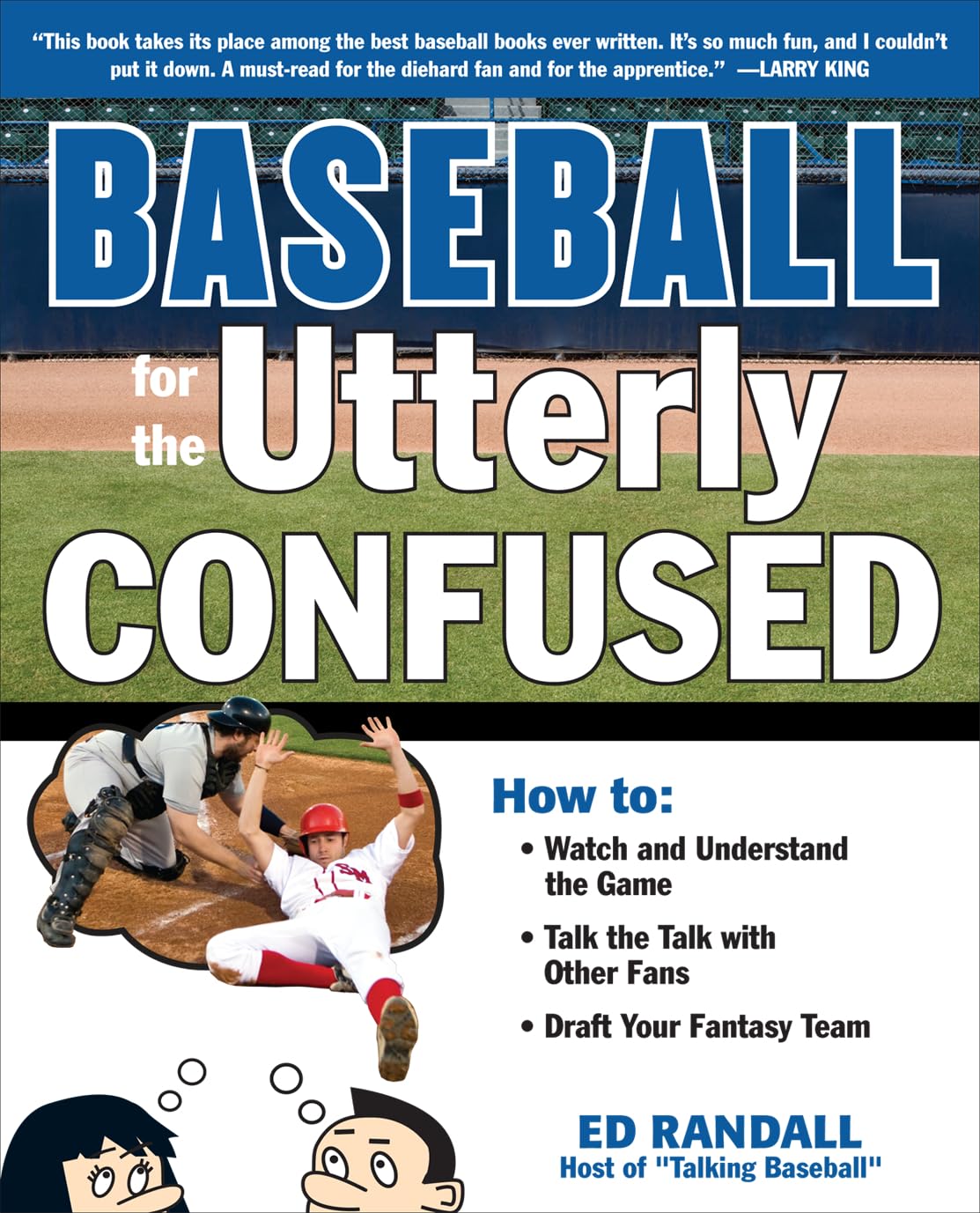



Play Ball! Everything baseball―from the popular Utterly Confused Series What's a foul ball? Or a swinging third strike? New fans, parents, and first-time coaches need no longer be Utterly Confused about baseball, as the popular series introduces the basics of the sport in a fun and easy-to-follow guide. Peppered with big league interviews and examples, Baseball for the Utterly Confused cuts through the jargon and history to deliver a complete guide to everything baseball. From little league to the majors, this informative guide brings the most casual fan up to speed on what's going on on the field and off of it. Provides a foundation for understanding the game through strategy, rules and scoring, statistics, major league players and more - Includes easy-to-reference icons throughout the book that walk you through the basics and highlight key situations - Features interviews with major league notables and a special chapter on baseball history: The Golden Age, Divisional Baseball, The Dead Ball Era and more From the intricacies of the game, its rules, rivalries, strategies, and standings, those new to the game won't feel like they're in over their heads. This book will break it all down. Ed Randall is the host of “Talking Baseball”each Sunday morning on WFAN and is the author of MoreTales From the Yankee Dugout. Baseball for the Utterly CONFUSED By Ed Randall The McGraw-Hill Companies, Inc. Copyright © 2010 The McGraw-Hill Companies, Inc. All right reserved. ISBN: 978-0-07-163474-8 Contents Chapter One Rules of the Game Let's start with the basics. Two teams of at least nine players, led by a manager (usually dressed in uniform, in charge of the players and several supporting coacheshitting, pitching, bullpen, first-base, and third-base, among others), will play each other for a minimum of five innings. Each team's objective is to win the game by outscoring its opponent. (Hello! Please tell me you already knew this and weren't that utterly confused!) Sounds simple, right? Three things to consider right off the bat: 1. That team of 9 is sometimes a team of 10, as the designated hitter has unfortunately taken root in much of the baseball world outside of the National League (more on the atrocity that is the DH later). Major-league rosters also have a bench, a rotation, and a bullpen, for 25 total players in uniform and eligible to play. A typical alignment would include nine position players, five starting pitchers, and six to seven relief pitchers (including a long man, capable of pitching several innings; specialists for lefty and righty batters; a closer, charged with shutting the door on the opposing team in its final at bat; and, ideally, one or two setup men, capable of maintaining a lead and acting as a bridge between the starter and the closer). The other five players might include a DH or power bat to come off the bench in key moments, a backup catcher (squatting for nine-plus innings as foul balls and barreling base runners bounce off your body takes a toll on the starting catcher, making backup a mustespecially for day games after night games), a utility infielder (capable of playing multiple positions), and a fourth outfielder (in case of injury, as a defensive replacement, or as an additional pinch hitter). Of those four to five bench spots, general managers will try to ensure that among them they have both lefty and righty bats, to counter the pitching moves of opposing managers, as well as a player with speed, in case a pinch runner is called for. 2. The number of innings played is dependent on the level of play, the score, and the weather. Everyone knows that a major-league baseball game is nine innings long (eight and a half if the home team is winning going into the bottom of the ninth), but Little League games can be six to seven innings. Tie games usually go extra innings (more on that in a moment). Then there's the matter of an official game. In major-league baseball, a game is official after five innings (four and a half if the home team has a lead going into the bottom of the fifth). So, if the heavens open up after five innings have been played, and there's no sign of the rain's ever ending, the team with the lead can get the win. If fewer than five innings are in the books, and there's no chance of the game's being resumed, then it's a do-over, to be played again some other day (meaning that the stats recorded during those first four innings will never find their way into the record bookjust ask Roger Maris ... more on him later). It gets complicated when rain or some other circumstance either stops a tied game or stops a game in which a tie has just been broken. If, let's say, after five innings of play the visiting team pulls ahead in the top of the sixth, and before the home team can play three outs' worth of baseball in the bottom half of the same inning, Noah gets on the PA system to tell the lucky fans in attendance that his a