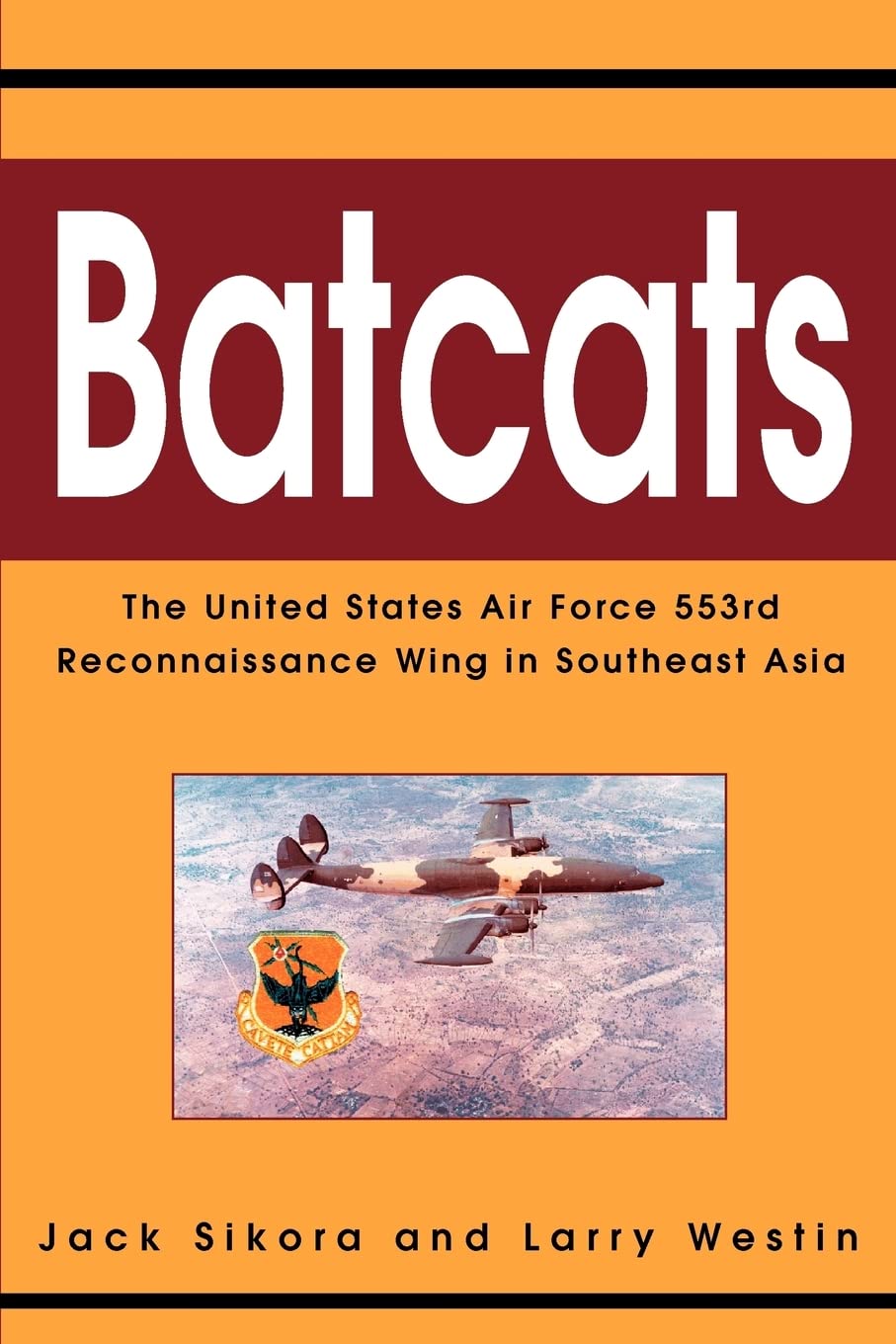
Batcats: The United States Air Force 553rd Reconnaissance Wing in Southeast Asia
$14.15
by John Sikora



Written by men who flew the missions and gathered together the recollections of their comrades, this is an account of the political, social, cultural, technical and combat context of an extraordinary side of the Vietnam conflict. An account touching on topics ranging from Thai supernaturalism to high tech warfare, it is also the very human story of American airmen obliged to keep heady secrets and perform demanding tasks under menacing conditions. A good read for aviation enthusiasts, students of the Vietnam War, veterans and those wishing to learn more about Southeast Asia, this book is more than a history. It is a holistic portrait of a little known and less understood aspect of the Vietnam "era." CHAPTER 1 SOMEWHERE IN THE BEGINNING "Before getting to Korat I remember the fear I felt about flying over there . After all is said and done it was my greatest adventure and one I will never forget." Ed Richey, Batcat The EC-121R aka Super Constellation ("Connie") appears to some to go reluctantly into the air. It starts in fits complete with smoking billows and the roar of a hacking, hoarse dragon. Once all four engines are finally cajoled and harnessed, the great machine shudders, trembles with anticipation, and declares itself awake and ready with a throaty rumble that runs a gambit from a discordant panoply to a harmonious choir of powerful motors. When it rolls along for takeoff the choir reaches a crescendo to coax and cheer the lumbering machine into a graceful bird of flight and prey. Watching a single Connie take to the sky is an arresting sight, but observing a cluster of them can quicken one s pulse and help one to perhaps understand why God in His goodness allowed men to fly. In the autumn of 1967 late season vacationers and some lucky locals looked skyward to follow with their eyes the drone of strong engines. What they were privileged to see was one or more EC-121 model Connies, their white bellied sleek bodies and graceful tank-tipped wings plumed in green and brown camouflage, the formal dress of jungle combat, ascending and winging Westward in an ordained migration from their Cape Cod roost at Otis Air Force Base toward a rendezvous with the undeclared yet bloody war in Southeast Asia. By October the "Speckled Bugs" had arrived at Korat Royal Thai Air Force Base, Thailand, and the Batcats began to fly their long, round the clock hide and seek missions in the new age of high tech warfare and political micro-management. Aboard one of the lead aircraft was a young airman named Ron DeGroff. DeGroff s deployment to Korat took him first to California and McClellan Air Force Base where Colonel Gus Weiser regrouped the seven Connies under his command and led them into the Sacramento sky and West over the wide Pacific. The journey traced some of the great landmarks of World War II linked in a rosary of battle sites burnished with past peril, unspeakable suffering, and gallantry. The significance and sacramentality of these places was not lost on DeGroff, his comrades, nor on many of the Batcats who were to follow in his footsteps tracing the same route to Korat. Perhaps what DeGroff and the others saw provided a sense of continuity linking them to a previous generation of warriors and helped to inspire a sense of purpose in an otherwise turbulent and uncertain time in which many questioned America s direction and some, like DeGroff, elected to serve anyway. Ron Degroff was, like each of the Batcats, a volunteer. Weiser landed the Flight at Hickham Air Force Base, Hawaii, and DeGroff paused to appreciate his surroundings and the emotions that places like Pearl Harbor evoke in an American s psyche, but what really burrowed into his soul was the layover on Wake Island. DeGroff was struck by the small size of the airstrip at Wake. The tiny island was a refueling point for numerous military and civilian aircraft carrying personnel and materials to Southeast Asia and beyond. Because the Batcat crews needed rest and their aircraft required attention, DeGroff was obliged to bunk overnight in a tent pitched near the ocean s edge where he reclined on his cot and watched the waves breaking on the moonlit shore; however, it was more than the natural beauty of the island that captured his fascination. He was much taken by the DC 8 commercial airliners making fuel stops whose mighty engines thundered in the night and provided a spectacular light show in the otherwise placid sky. But there was more to Wake, and DeGroff touched upon it as he explored the island s artifacts of war. He stood on the shore and gazed in wonder at the rusting hulk of a Japanese supply ship, crawled around a collection of "pill boxes," and gathered up for his collection some ammunition cases. He discovered that he could see wrecked American aircraft under the clear water of the lagoon, and perhaps he found himself lost in time in a place somewhere between the fury of a past war and the present one. By the time he returned to the flight li