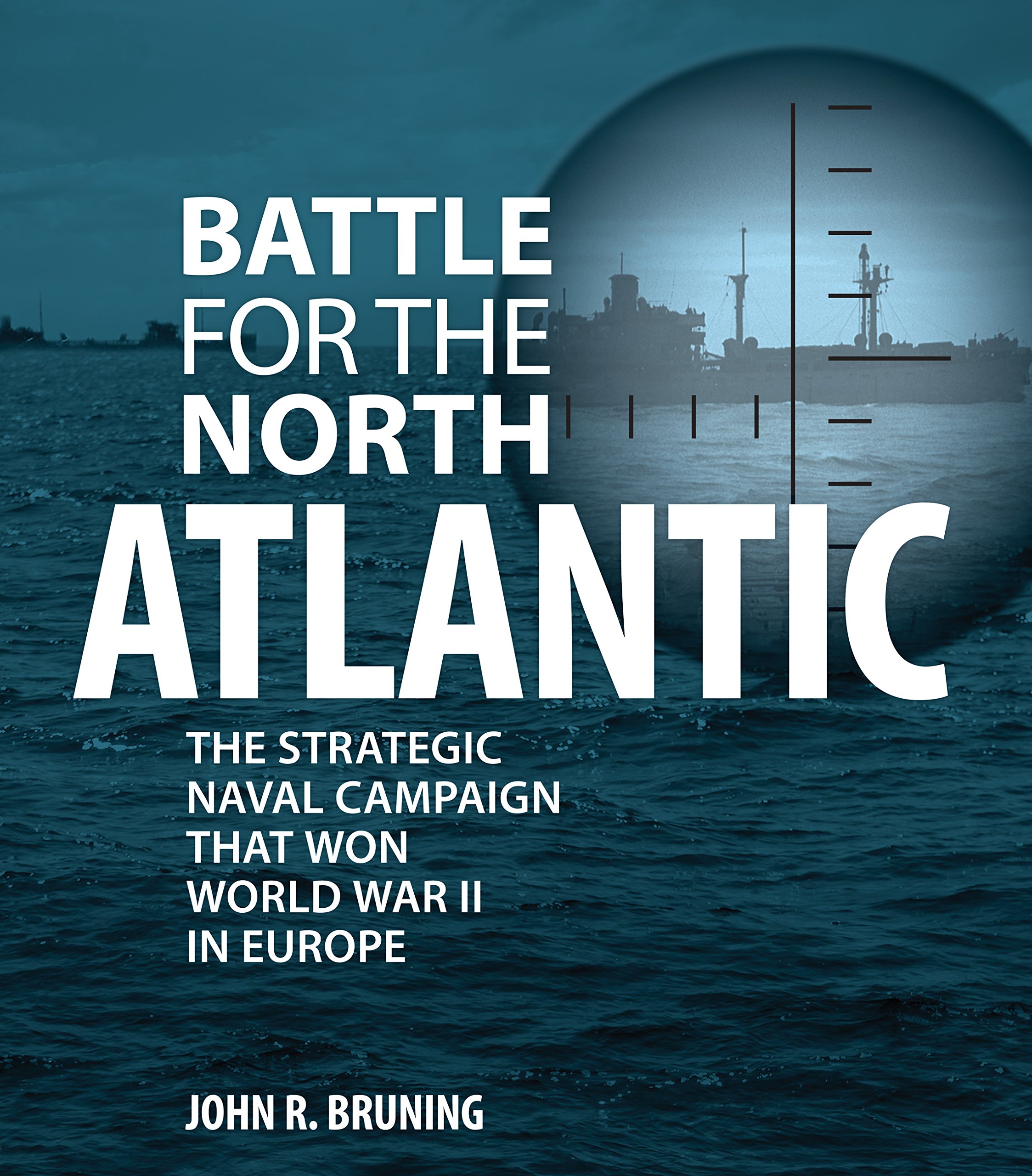
Battle for the North Atlantic: The Strategic Naval Campaign that Won World War II in Europe
$20.99
by John Bruning



The Battle of the North Atlantic was the longest continuous military campaign of World War II, running from 1939 until the defeat of Nazi Germany in 1945, though it reached its peak from mid-1940 through the end of 1943. The Battle of the North Atlantic pitted German U-boats and other warships of the German navy against Allied merchant shipping. Initially, convoys of merchant ships were protected for the most part by the British and Canadian navies and air forces. Starting in the early fall of 1941, before Pearl Harbor, these forces were aided by ships and aircraft of the United States. The Battle for the North Atlantic began on the first day of the European war and lasted for six years, involving thousands of ships and stretching over hundreds of miles of the vast ocean and seas in a succession of more than a hundred convoy battles and as many as a thousand single-ship encounters. Tactical advantage switched back and forth over the six years as new weapons, tactics, and countermeasures were developed by both sides. The Allies gradually gained the upper hand, driving the German surface raiders from the ocean by the end of 1942 and decisively defeating the U-boats in a series of convoy battles between March and May 1943. "Few images of the Second World War are more iconic than a U-boat awash on the broad Atlantic, or a torpedoed merchant ship, burning furiously as she slips below the waves. If you like that kind of stuff, ou will like John Bruning's illustrated book Battle for the North Atlantic. In the language of booksellers, it's a beautiful book. Bruning writes well and has eye for a story." - Naval History "This is a beautiful book for the mind as well as the eye. Bruning ?" an adept historian and agile writer ?" has wonderfully addressed the vast and complex combat which took place in the North Atlantic during World War II. This book will give the reader a comprehensive knowledge of the Battle for the North Atlantic beyond simple numbers and dates, addresses all aspects of the years long battle, transgresses national bias and gives an excellent understanding of the events as they unfolded. John Bruning has written a remarkable book." - Travel For Aircraft (The Seattle Post-Intelligencer) "The author does a splendid job of presenting the campaign in all of its facets. This book is well laid out and illustrated with photos, maps and drawings that capture the participants, technology and events of the campaign." - Sea Power The Battle of the Atlantic began on the first day of World War II in Europe and lasted throughout the six long years of the war. Between 1939 and 1945, several thousand ships, both civilian and military, were involved in the conflict that encompassed thousands of miles of ocean. While Allied merchant vessels brought much-needed materiel from the Americas to Great Britain, they were hounded by U-boats and other warships of the German navy and were defended, at first, by British and Canadian forces. But even before the attack on Pearl Harbor brought the United States officially into the war, American forces began taking part in convoy defense in September 1941. The German campaign began in earnest in mid-1940, when the defeat of France gained Germany access to naval bases on the Atlantic coast. Evolving British tactics early in 1941, combined with new short-wave radar, turned the tide for the Allies for a while. Tactical and technological advances continued to swing the overall advantage between the Allied and Axis powers. The formal entrance of the United States into the war in December 1941 eventually shifted the power back to the Allies, and from late 1942 through early 1943, the Germans were largely driven from the Atlantic. Battle for the North Atlantic covers the mostly civilian crews of the U.S. Merchant Marine as well as the Allied and German military crews involved in this life-and-death struggle on the high seas. More than three hundred photos, including many rare color photographs, document the cramped and dangerous conditions endured by both sides of the long and often ruthless campaign. This engaging, informative text by John R. Bruning captures all the action of the battles and serves as a tribute to the wartime sacrifices made by civilian mariners. Author bio: John R. Bruning has been a professional military historian and writer since 1990. He is the author of Crimson Sky: The Air Battle for Korea , The Battle of the Bulge: The Photographic History of an American Triumph , Ship Strike Pacific , Bombs Away! , and The Devil s Sandbox: With the 2nd Battalion, 162nd Infantry at War in Iraq . He served as an embedded civilian historian with the 2/162 during Operation Southern Comfort, the post Hurricane Katrina relief operation in New Orleans. Bruning also has numerous articles, documentaries, multimedia computer programs, flight simulators, and museum displays to his credit. He lives in Independence, Oregon. The Battle of the Atlantic started with the war in E