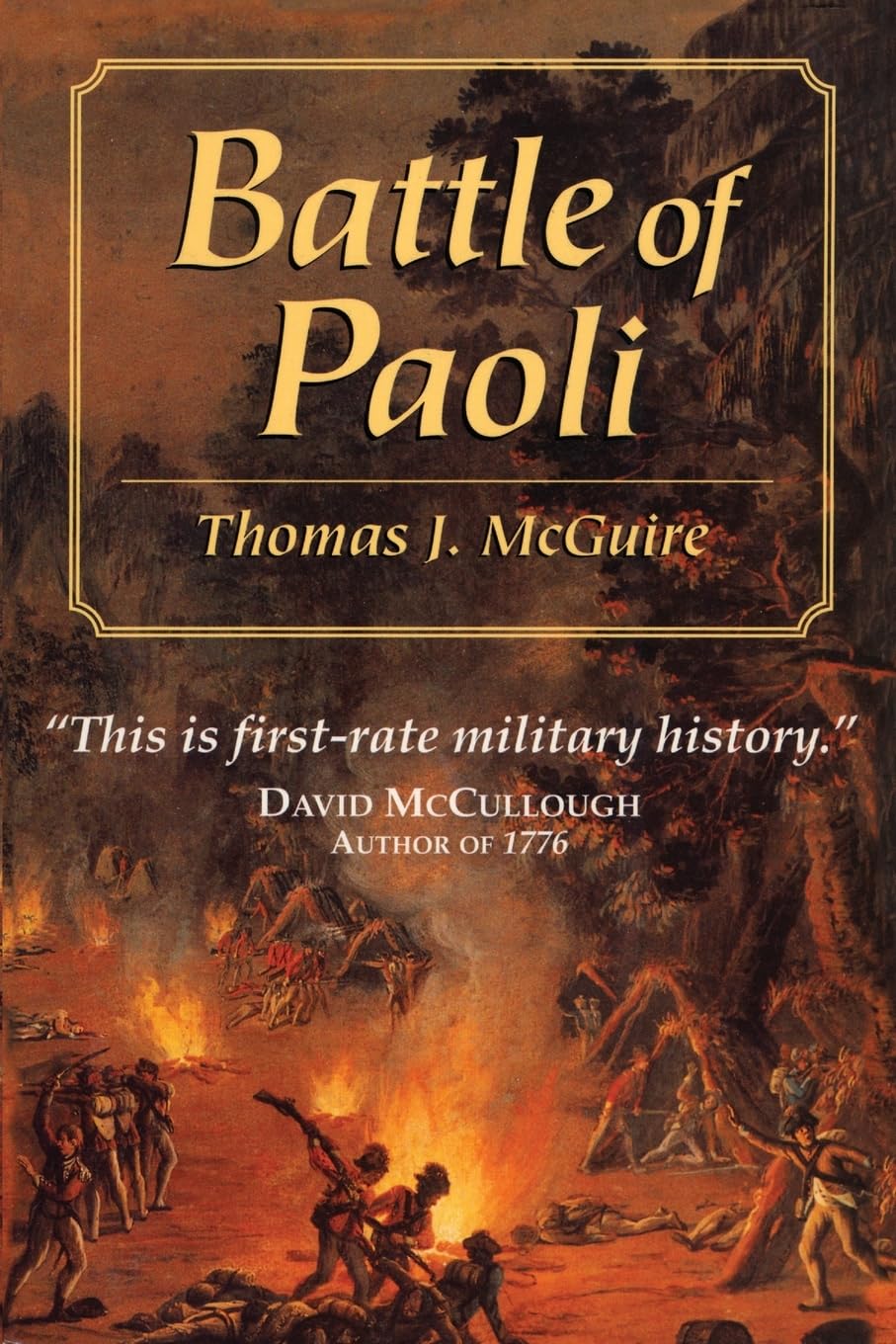



This first full-length treatment of the Revolutionary War battle recounts British general Charles Grey's brutal attack on Anthony Wayne's division of 1,500 Continentals in September 1777. The detailed account follows the action from the arrival of Wayne's division south of the Schuylkill River, near Paoli Tavern, to defend Philadelphia against Howe's encroaching troops to Grey's discovery of Wayne's position, the bloody battle that ensued, and the subsequent court-martial of Wayne, who had been accused of negligence. "It will be required reading for a long time to come." -- Thomas Fleming, author of Washington s Secret War The important Battle of Paoli has a vivid chronicler at last. -- David McCullough, Pulitzer Prize-winning author of John Adams and 1776 Thomas McGuire teaches American history at Malvern Preparatory School near Paoli, Pennsylvania, and is the author of Battle of Paoli and Stop The Revolution. Battle of Paoli By Thomas J. McGuire Stackpole Books Copyright © 2006 Thomas J. McGuire All right reserved. ISBN: 9780811733373 Chapter One Philadelphia Friday Morning, September 26, 1777 It was a cool, crisp morning after a night of rain, and the crimson glowof an early-autumn sunrise gradually gave way to hues of scarlet andgold against a brilliant blue sky. A light breeze from the north gently carriedfresh country air into the city of Philadelphia, along with the rumbleof drums approaching from the north, across the green meadows and paleamber fields along Germantown Road. Above the rhythmic throbbing ofthe distant drums could be heard the shrill chirp of fifes playing a vaguelyfamiliar tune. As the sounds reached the Northern Liberties, the citizenscould make out the ancient melody: "God save great George our king." Brick red coats reflected in the shimmering windows of buildings alongSecond Street as nearly 200 horsemen from the 16th or Queen's OwnLight Dragoons trotted south across the muddy lane called Vine Street andofficially entered the city proper. After a month of hard campaigning, thesemounted warriors presented to civilian eyes a curious mixture of weather-beatenbut picturesque pageantry: well-mended, fading crimson coats facedwith washed-out dark blue lapels and cuffs laced white; sword belts pipe-clayeda dazzling white; shining black leather tack and saddlery with brassesburnished to a glow; black leather helmets surmounted by rows of chains, afur crest, and a cloth turban painted to resemble leopard skin. No oneobserving this procession could miss the ominous, awe-inspiring weaponsdrawn and carried at the shoulder?dragoon broadswords, nearly 3 feet ofsteel gleaming in the morning sun, capable of intimidating even the mosthardened veteran. The windows of Second Street now reflected coats of many colors asthe column behind the horsemen entered the city. Above the large Palladianwindow of Christ Church, the cameo sculpture of King George IIgazed down upon several rows of fifers and drummers in shades of yellow,black, green, red, and white. Each coat was heavily decorated with lace andwas faced with red, following the British Army regulation of reversed coatcolors for musicians. Excepted from this rule were the musicians of royalregiments, such as the 42nd or Royal Highland Regiment, who wore redcoats with dark blue facings and special royal livery lace of blue and yellow.All the fifers and drummers wore tall, black bearskin caps bearing ornamentalfront plates of silver and black metal. The red-rimmed woodendrums, their fronts brilliantly painted in regimental colors with the king'scypher "GR" surmounted by a crown, swayed rhythmically as the drummersbeat the cadence, their arms raising the sticks to eye level withmechanical precision. The red-faced fifers puffed and strained, lips pursed. Another group of horsemen came into view, quite different in appearancefrom the dragoons. At the head of the infantry, brilliant scarlet coatsfaced with dark blue velvet and a profusion of glittering gold lace proclaimedthe arrival of the Right Honourable Lieutenant General Charles Earl Cornwallis,together with Brigadier General Sir William Erskine, and a host ofaides and staff officers. Lord Cornwallis embodied those qualities that nobilityand generalship required: an ancient and aristocratic family, a soldierlyreputation, and a dignified bearing that commanded awe and respect. Hispresence announced that law and order had returned to Philadelphia?"tothe great relief of the inhabitants who have too long suffered the yoke ofarbitrary Power; and who testified their approbation of the arrival of thetroops by the loudest acclamations of joy," wrote seventeen-year-old LoyalistRobert Morton. Less conspicuous by their appearance, but certainly not by reputation,were a number of familiar Philadelphia faces accompanying Lord Cornwallis.These included the Allen brothers, William, John, and Andrew, sons ofthe prominent Philadelphia merchant and politician Judge Willia