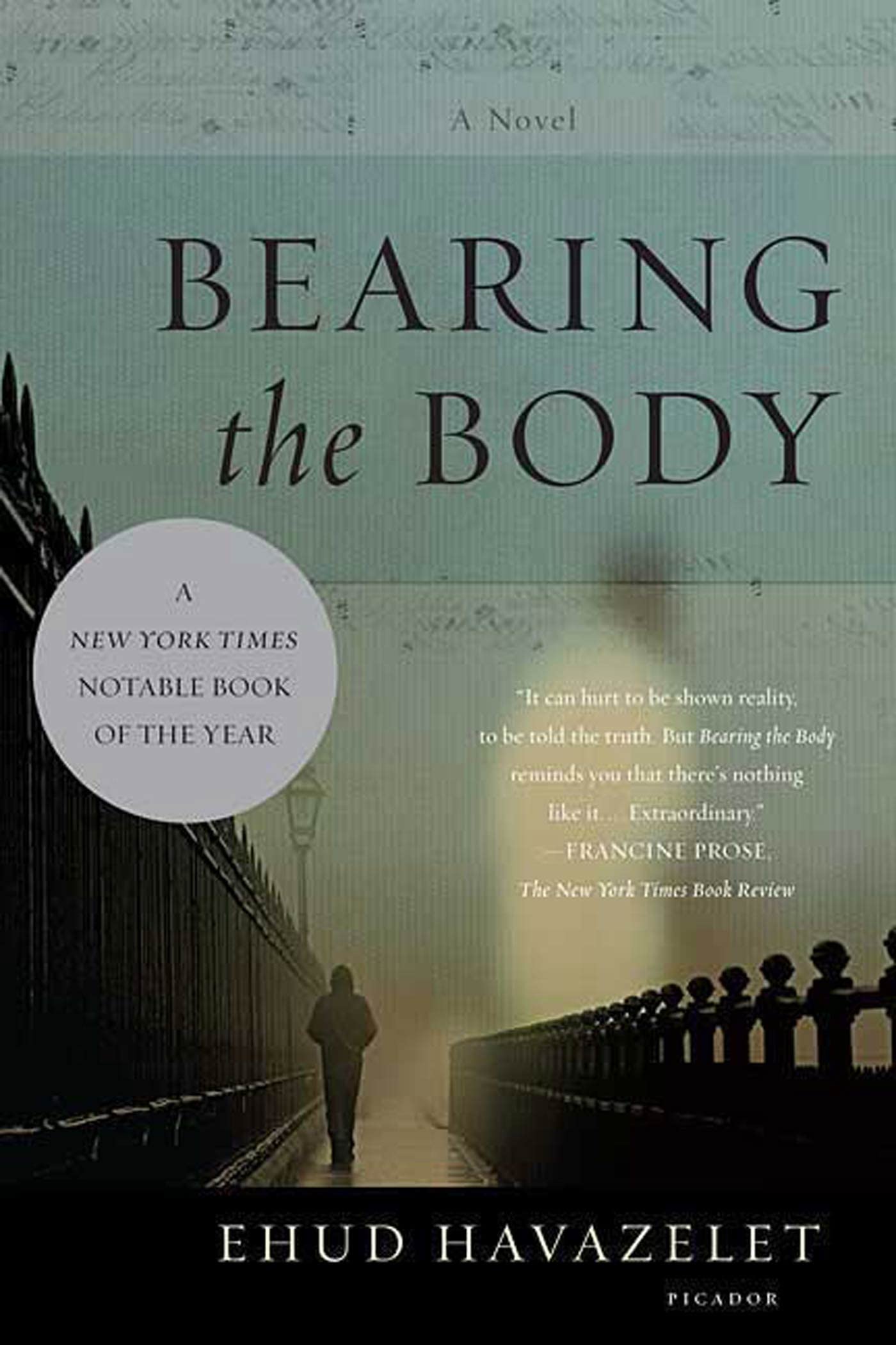



A New York Times Notable Book of the Year At the start of Bearing the Body , Nathan Mirsky learns that his older brother has died in San Francisco, apparently murdered after years of aimlessness. On the spur of the moment, Nathan leaves his job as a medical resident and heads west from Boston to learn what he can about Daniel's death. His father, Sol--a quiet, embittered Holocaust survivor--insists on coming along. Piecing together Daniel's last days, Nathan and Sol are forced to confront secrets that have long isolated them from each other and to being a long process of forgiveness. “It can hurt to be shown reality, to be told the truth. But Bearing the Body reminds you that there's nothing like it. . . . Extraordinary.” ― Francine Prose, The New York Times “An ambitious novel driven by a wonderfully talented writer's sense of history, coupled with a deep compassion for his characters, every one of which is rendered fully and with great wisdom.” ― Richard Russo “An impressive achievement from a highly gifted writer . . . This sorrowful but beautiful work is richly layered.” ― Chicago Tribune “Beautifully, meticulously structured . . . A reader is also forced to notice, with particular acuity, the heavy inadequacy of human relationships.” ― Los Angeles Times “The characters in Bearing the Body are riveting. They try and fail, they resist and accept, they survive and feel real.” ― The Oregonian “Riveting . . . This novel, more than any I have read in decades, is a masterful meditation on the immorality of familial silence.” ― The Jerusalem Post Ehud Havazelet is the award-winning author of two story collections, What Is It then Between Us? and Like Never Before , which was a New York Times notable book and a Los Angeles Times Best Book. He has been awarded fellowships from the Guggenheim, Whiting, and Rockefeller foundations. He teaches in the Creative Writing Program at the University of Oregon, and at the Warren Wilson MFA Program for Writers. He lives in Corvallis, Oregon. Bearing the Body By Ehud Havazelet Picador Copyright © 2007 Ehud Havazelet All rights reserved. ISBN: 978-0-312-42750-4 Contents Title Page, Copyright Notice, Dedication, Epigraphs, Part One, Prologue, 1968, Chapter 1: 1995, Part Two, Prologue, 1995, Acknowledgments, About the Author, Also by Ehud Havazelet, Copyright, CHAPTER 1 1995 The letter sat before him, unopened, propped against a coffee mug. He had known it was there, somehow, even before he found it among the wad of junk mail, bills, and offers of credit cards he neither wanted nor could afford that plugged the brass box in the lobby. He had paused with the tiny key in his hand but then opened the box and reached in, not because suspicions were silly — the opposite, if anything, was true — but because whatever was there had arrived, was already unavoidable. There was a letter for Janet also, from her mother, and he placed it on the bench by the door where they left each other's mail before discarding the rest under the sink and filling the pot for coffee. He hadn't slept in thirty hours and he didn't want more coffee, he wanted a drink. But he didn't want a drink, either. He had two cups, making repeated circuits from the kitchen, where the letter lay on the table, to the living room that sloped east toward Mass. Ave., to their bedroom in back, where the sheets were still twisted and hanging to the floor. He thought of lying on the bed, pulling the stale warm darkness of the room over his head with the blankets, but returned to the kitchen with the dull resignation he had felt opening the mailbox, nothing else to do. The lamp with its weighted cord shifted in the draft of the floor heater, marking circles of pale light on the table. Across the street a man came out of his house, looked around him, zipped a bright blue parka over his stomach, and began walking toward the avenue. Idly, Nathan leaned in his chair to see which direction he turned at the corner. The letter, in the emphatic, slashing hand that could only be Daniel's, was addressed to His Holiness Msgr. Nathaniel Mirsky, SJ, DDS, LSD, and had been mailed six days ago from San Francisco. The postmark was smudged, off kilter, but he could make out the city and date. There was no return address. He was still at the table when Janet arrived. He heard her kick off her shoes, heard her open her letter and sit on the bench in the hall, and over the next few minutes heard her laugh and exclaim to herself. His head felt exactly as if two hands pressed hard behind the temples, something in his chest darted and clenched, a pulled muscle, heartburn, early signs of infarction. A brief hope had flared when she came in; now he was even more alone. Across the street the man had returned, wearing a Hogan's Heroes hat, fleece-lined with flaps that could be pulled down over the ears. He was a portly gentleman in a blue parka, which also looked new, and he stopped a