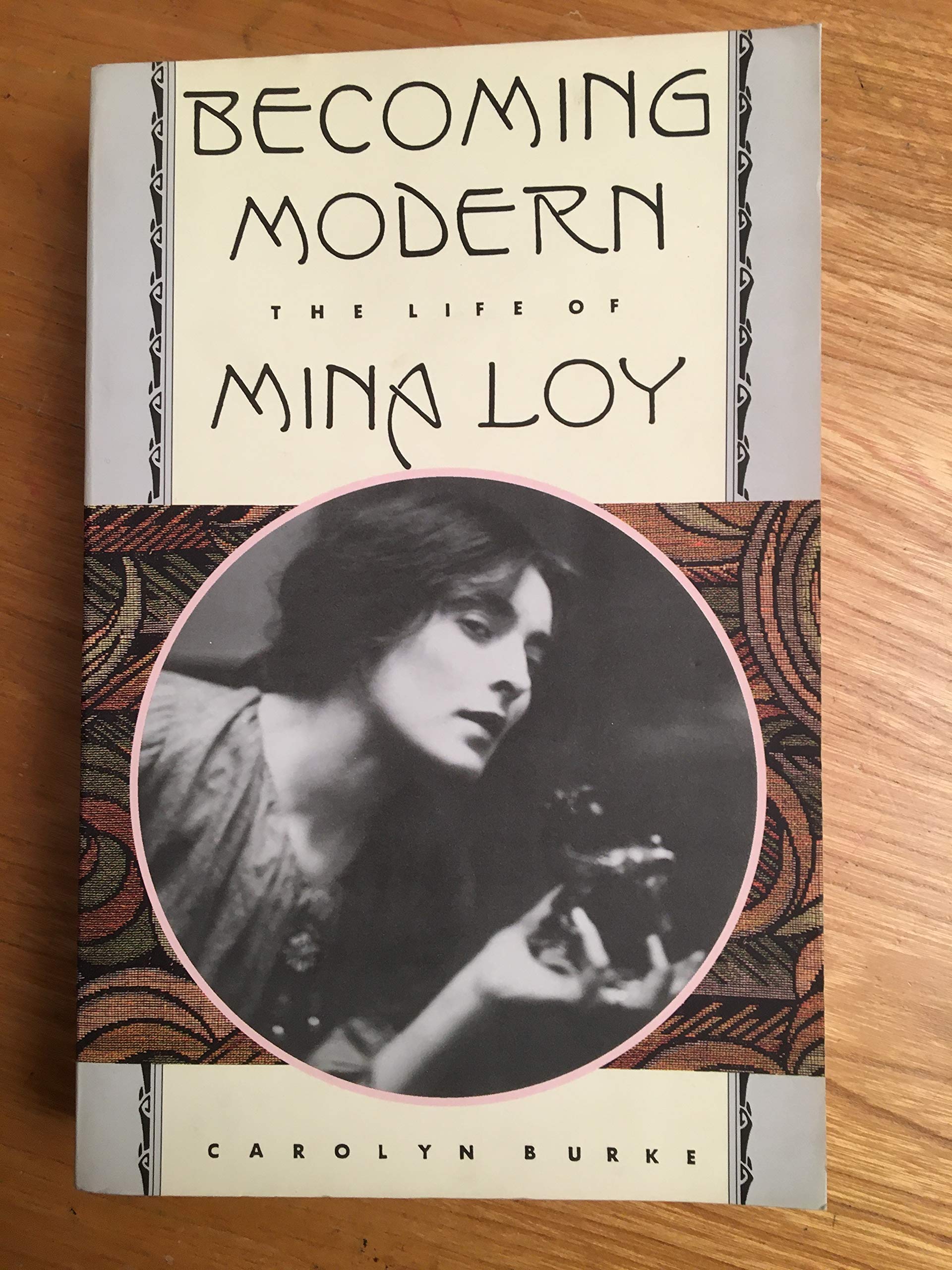



The poet and visual artist Mina Loy (1882-1966) has long had an underground reputation as an exemplary avant-gardist. Born in London of mixed Jewish and English parentage, and a much photographed beauty, she moved in the pivotal circles of international modernism - in Florence as Gertrude Stein's friend and Marinetti's lover; in New York as Marcel Duchamp's co-conspirator and Djuna Barnes's confidante; in Mexico with her greatest love, the notorious boxer-poet Arthur Cravan; in Paris with the Surrealists and Man Ray. Carolyn Burke's riveting, authoritative biography brings this highly original and representative figure wonderfully alive, in the process giving us a new picture of modernism - and one woman's important contribution to it. Altering her family name, wearing the clothes she wanted (which she designed herself), encouraging nudity among her children, writing about sex, and befriending derelicts were among the life achievements of English poet Mina Loy (1882-1966). Loy emerged out of a tortured childhood into the age of free love and expression in Europe and America with irrepressible force. Though her behavior was at times reproachable, such as when she dumped her children in Florence to go gallivant among the elite in New York, her story is always interesting. Biographer Carolyn Burke tells it in generous detail in Becoming Modern . Burke (English, Univ. of California-Santa Cruz) has written a comprehensive biography of poet and visual artist Mina Loy. Burke sees Loy (1882-1966) as the prototypical New Woman of the 20th century, experimenting in free verse, in fashion and design, and in creating a life in a world where Victorian values no longer applied. Loy lived in the company of major shapers of international modernism, such as Gertrude Stein, Djuna Barnes, Marcel Duchamp, Man Ray, Ezra Pound, William Carlos Williams, and Mabel Dodge, in Florence, Paris, and New York for most of her adult life. Though little known today, she was widely published in American literary magazines between the two world wars. Burke is objective and insightful in her use of Loy's letters, manuscripts, and personal papers and of autobiographical interpretations of Loy's poetry. She has also used the letters, biographies, and critical writing of others who knew Loy. Highly recommended for comprehensive literature and modernism collections.?Judy Mimken, Boise P.L., Id. Copyright 1996 Reed Business Information, Inc. Burke's chatty, admirably detailed biography tells the story of Loy's friendships with such writers as Djuna Barnes, Gertrude Stein, Hart Crane, and Kenneth Rexroth, making it clear just how difficult it was for a woman poet to overcome stereotypes during the modernist period. Loy was an inventive writer -- and also a painter, designer, and actress -- whose work offered a deliberate challenge to established gender roles. Readers interested in description, analysis, and discussion of Loy's poetry and poetics will not find them here, but this capacious biography should help prepare the way for the reprint of her work the same publisher has promised. Copyright © 1996, Boston Review. All rights reserved. -- From The Boston Review This brave soul had the courage and wit to be an original. Mina Loy may never be more than a vaguely familiar name, a passing satellite, but at least she sparkled from an orbit of her own choosing. -- The New York Times Book Review, Nicholas Fox Weber