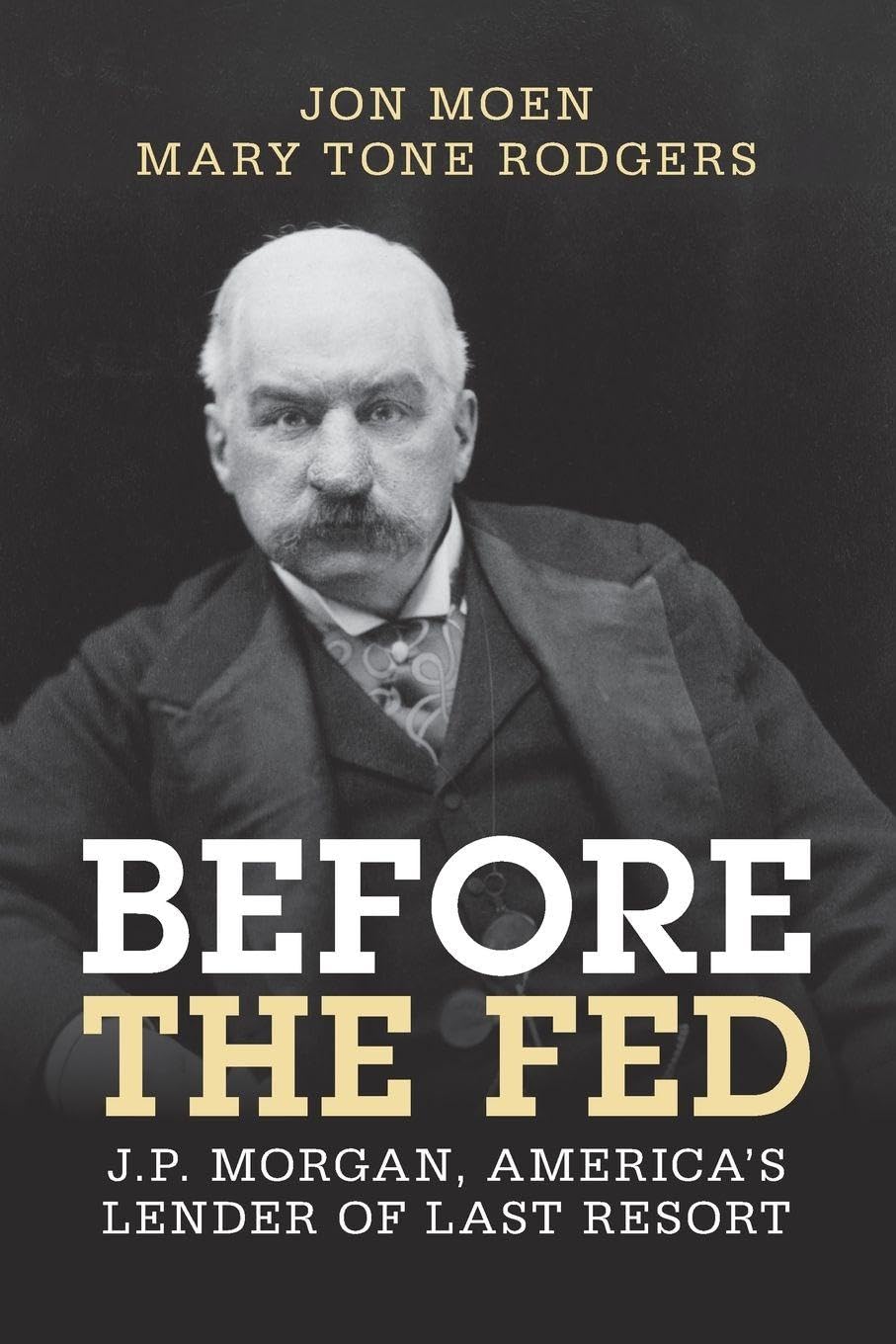



In the 19th century the United States had no formal central bank or lender of last resort, but it did have J. P. Morgan. His unique knowledge of financial markets gave him almost omniscient knowledge for crafting solutions to financial crises. Before the Fed examines Morgan's unusual role in resolving the National Banking Era crises in the U. S., exploring the rocky relationships and ultimatums he used to settle financial panics. It traces how he learned crisis management lessons from his father, passing it along to his son in turn. Citing his own ledgers, telegrams and testimony, Jon Moen and Mary Tone Rodgers detail how Morgan applied and modified routine business practices to solve non-routine crises, managing risk and reward in emergency lending. Analyzing forty last resort loans made over his fifty-year career, the authors challenge the invincibility folklore surrounding Morgan, uncovering how he stabilized American markets when others could not. ‘This outstanding book offers fresh insights on financial crises, J. P. Morgan, and business history. Its research exploits long-neglected archives, novel analysis, and masterful synthesis of events. And it highlights the impacts of information, collective action, social networks, tactics, precedents, and the willingness of leaders to risk private loss - all in combatting financial crises. The lessons are bracing and highly relevant to the present day.’ Robert F. Bruner, Professor Emeritus and Dean Emeritus, University of Virginia, and co-author of The Panic of 1907: Heralding a New Era of Finance, Capitalism, and Democracy ‘While a long shelf of books detail J. P. Morgan’s contributions to the formation of the modern American economy, Moen and Tone Rodgers elucidate another essential but underappreciated contribution. Digging into unexploited archives, they show how Morgan used the techniques he pioneered to finance large corporations to create the pools of liquidity needed to quash financial crises before the foundation of the Federal Reserve. Their findings not only enrich the historical literature but also provide novel insights for containing future crises.’ Eugene White, Distinguished Professor of Economics Emeritus, Rutgers University ‘Moen and Rodgers provide the first full account of Pierpont Morgan's lender-of-last-resort activities on behalf of financial stability when the US lacked a central bank. They were far more extensive over some five decades than most of us have known. This is a splendid contribution to financial history.’ Richard E. Sylla, Professor Emeritus of Economics and the former Henry Kaufman Professor of the History of Financial Institutions and Markets at New York University Stern School of Business Discover how J. P. Morgan averted financial catastrophes 100 years ago and how his actions are still relevant today. Jon Moen is a Professor of Economics at the University of Mississippi. He has published papers on US slavery, retirement, and bank panics during the National Banking Era. He is a member of the Economic History Association, the Economic History Society, and the Cliometrics Society. Mary Tone Rodgers is an Adjunct Instructor of Finance and Economics at the State University of New York. She enjoyed a 30-year career at Merrill Lynch before moving to academia where she received the 2022 Chancellor's Award for Excellence in Teaching.