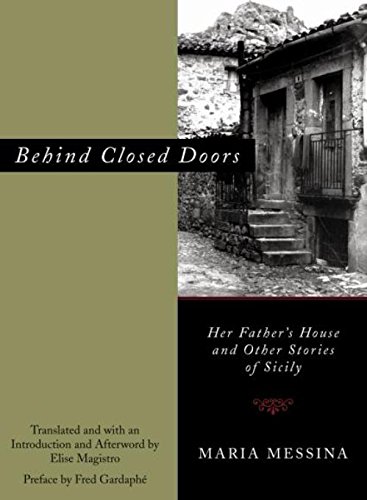
Behind Closed Doors: Her Father's House and Other Stories of Sicily
$24.21
by Maria Messina



Ten stories of impoverished Sicilian women in the early 20th century—“honed, polished, devastatingly direct . . . verismo at its unsentimental best” ( Kirkus Reviews ). The Sicilian writer Maria Messina’s captivating and brutal stories of the women of her home island are presented in a “lyrical and immediate” English translation by Elise Magistro ( Publishers Weekly ). Messina, who died in 1944, was the foremost female practitioner of verismo—the Italian literary realism pioneered by fellow Sicilian Giovanni Verga. Published between 1908 and 1928, Messina’s fiction represents the massive Sicilian immigration to America occurring at that time. The individuals in these stories are caught between the traditions they respect and a desire to move beyond them. Women are shuttered in their houses, virtual servants to their families, left behind while working men immigrate to the United States in fortune-seeking droves. A cultural album that captures the lives of peasant, working-class, and middle-class women, “Messina’s words will leave their mark. Their power makes them impossible to forget” ( The Philadelphia Inquirer ) . Praise for Behind Closed Doors “[T]hese ten persuasive tales offer stark, finely drawn portraits of poor and middle-class Sicilian women in the early years of the twentieth century.” — The New York Review of Books “A window into another time and another culture... We understand the emotions of [the] characters, simultaneously victims and heroines... Messina’s words will leave their mark. Their power makes them impossible to forget.” — The Philadelphia Inquirer “Virtually the only great Italian fiction about the massive Sicilian immigration to America written while it was happening... honed, polished, devastatingly direct—verismo at its unsentimental best.” — Booklist Maria Messina (18871944) was born in Palermo, Sicily. She taught herself to read and write, eventually finding a mentor in the famed Italian realist Giovanni Verga, who encouraged her to begin writing seriously. Her works include novels, short stories, and children's tales. In 1910, she received the Medal of Gold for her first book of stories, Pettini-fini ( Fine Combs ). Fred Gardaphe is the director of Italian American Studies at the State University of New York at Stony Brook and the president of MELUS (The Society for the Study of the Multi-Ethnic Literature of the US). Elise Magistro holds a doctorate in Italian from UCLA and is a lecturer in Italian at Scripps College in Claremont, California. Behind Closed Doors Her Father's House and Other Stories of Sicily By Maria Messina, Elise Magistro Feminist Press Copyright © 2007 Fred Gardaphé All rights reserved. ISBN: 978-1-55861-553-3 Contents Preface by Fred Gardaphé, Introduction, Grace (Grazia), America 1911 (La Mèrica), Dainty Shoes (Le scarpette), Grandmother Lidda (Nonna Lidda), America 1918 (La Mèrica), I Take You Out (Ti-nesciu), Her Father's House (Casa paterna), Ciancianedda, Red Roses (Rose rosse), Caterina's Loom (Il telaio di Caterina), Glossary, Afterword, Translator's Acknowledgments, CHAPTER 1 Grace * * * Grazia The women were out enjoying the sun. Gna ' Basila, who was crossing red and turquoise sock yarns, and Elena la Mottese, hands folded behind her neck, had their kerchiefs pulled low over their eyes to shield them from the light. They were sitting on an old log propped against the wall that had been there for who knows how many years, worn smooth by water and dried by the sun. Grace, her head uncovered, was sitting a little further off on her doorstep, carefully mending a worn-out shirt. She didn't dare put a kerchief on for fear the neighbor women would make fun of her. She'd already gotten so much sun washing at Buscardo that by now her face and neck, naturally thin and dark, were just like the old log, eroded by water and dried out by the sun. "You just get drowsy and feel like sleeping in this heat!" said gna ' Basila, scratching her head with the tip of her knitting needle. "It's no weather to be working in ..." replied Elena, yawning. She picked up the piece of mirror she had brought along with a comb, removed her kerchief, and began to slowly undo her long, thick, chestnut braids, looking at herself in the mirror that she now held tightly between her knees. Once the braids were undone, she shook them loose and began to comb her beautiful hair — slowly — dividing it into two sections, bending her head to the side with every stroke of the comb. And her hair, so smooth and shiny, shimmered in the sun like gold. Grace mended the shirt without saying a word, stealing glances at Elena whenever she threaded her needle. "Is everything in your life as good as it looks in that mirror?" asked gna ' Basila. "I'm doing just fine, thank you very much," replied la Mottese, gripping the teeth of the comb between her thumb and index finger to remove the hair and bits of dandruff that had accumulated.