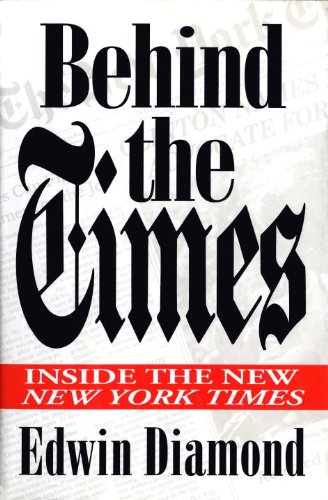



The media columnist for New York Magazine examines the changes in the way the New York Times has covered key current events since 1970 and profiles such Times staffers as Anna Quindlen, Tom Wicker, and William Safire. 30,000 first printing. Those people who enjoy the tiny classified ads on the front page of the New York Times will relish all the minutiae media-watcher Diamond sees fit to print in this history of the venerable newspaper. Whether others want the blow-by-blow, day-in-the-life commentaries that run throughout the book is another question (Do we care when columnist Anthony Lewis reports to work?). Still, Diamond, the media columnist at New York magazine, has obviously had amazing access to the inner workings of the "Gray Lady," and though he was a past contributor to the Times magazine section, he is certainly more objective--and more critical--than Times men Russell Baker and James Reston, both of whom have penned more avuncular, rose-colored histories. Diamond convincingly indicts the paper's recent sellouts to the bottom line and the lowest-common denominator, the most egregious being the "little wild streak" reporting in the William Kennedy/Patricia Bowman rape case. An essential update to all serious journalism collections, this will be news for serious scholars and the ever-growing legions of media buffs. - Judy Quinn, formerly with "Library Journal" Copyright 1993 Reed Business Information, Inc. As Corry and Nan Robertson (in Girls in the Balcony , 1991) carry on the tradition of the Times person's testimonial, so media writer Diamond addresses the newspaper's external performance and internal politics. Over the past 20 years, the span of his autopsy, the Ochs Sulzburger dynasty turned out old horses and installed a new set of editors to whom it appeared that hard news attracted fewer readers. Their come-hither solution for colorizing the gray lady? Lifestyle, fashion, and gustatory pieces for the sybarites of society; more op-ed pieces for professional bloviators; and a middle-brow elevation to page one of trashy ideas, such as the now-notorious review of Kitty Kelly's book on Nancy Reagan. Diamond disdains this as "enticement journalism," dedicated to snaring "omnidirectional yuppies." The snappy new dispensation extended to the Times ' culture sections, including that "Tweedy Backwater," the weekly Book Review . Bibliophiles will relish the routine blurb-swapping and a classic in cronyism, a gusher review for first-time author Eric Lax, Sulzburger's son-in-law. Diamond also sates the aficionados of personnel intrigue with a mountain of anecdotes, and for devotees of the day-to-day news cycle, he narrates the newsroom activity on February 28, 1989. Diamond is a standout in the crowded field of journalism's scolds, and his studied objectivity and head-shaking commiseration on the decline of the Times will inspire wide interest--especially on that insular isle of Manhattan. Gilbert Taylor Gossipy, albeit exhaustive and substantive, status report on the New York Times from a perceptive observer of major media who teaches journalism at NYU. Diamond (The Media Show, 1991; The Spot, 1984, etc.) offers a shrewd appraisal of a once-august icon of the fourth estate that appears to have reached several crossroads. In his informed opinion, the world-class daily is attempting (with as yet ambiguous results) to reconcile the often conflicting demands of management's national aspirations with the realities of a marketplace now peopled by upscale nonreaders rather than the intelligent, well- educated elites who long read the paper as a matter of course. Among other consequences, the author notes, the Times has not only rediscovered its N.Y.C. roots but has attempted to enhance its appeal for affluent members of a generation raised on TV--by, among other measures, stressing service-oriented features. In probing the efforts of a news-gathering institution to make itself user- friendly in a brave new tuned-in, switched-on, real-time environment, Diamond dishes up generous measures of both name- dropping chat and hard-hitting analysis. In recounting how some individuals made it to the top of the editorial and business ladders, for instance, he doesn't shy from discussing what kept less successful rivals on lower rungs or, in certain circumstances, drove them from the company. The author also evaluates the paper's critical biases; suggests ways that the Book Review's bestseller lists could be rigged; provides tips on getting an op-ed piece published; explains how the Times makes sociology of sensational crime stories; supplies anecdotal evidence on the collegial gravity with which political endorsements are bestowed; and relates the pains the parent organization has taken to ensure cultural/gender diversity within its ranks. The times, they are a-changin'...but Diamond manages to capture the varied anxieties and discontents besetting a great newspaper as it tries to keep pace. -- Copyright ©1993,