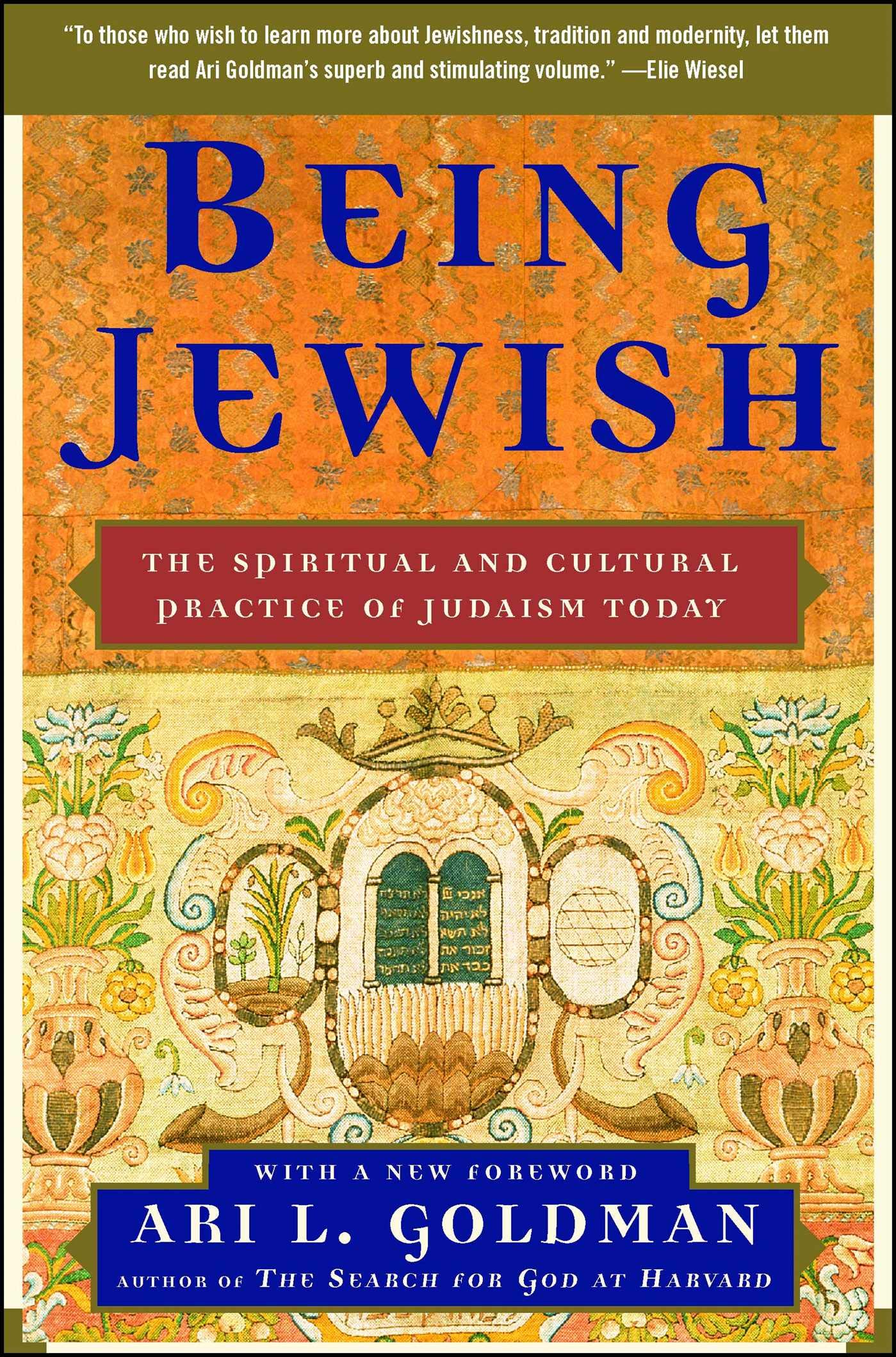
Being Jewish: The Spiritual and Cultural Practice of Judaism Today
$14.81
by Ari L. Goldman



Increasing numbers of Jews are returning to their religious roots in a search for meaning, eager to explore a heritage that is deeply embedded in history and at the same time rapidly changing. But what is Judaism today? And what does it mean -- culturally, spiritually, and ritually -- to be Jewish in the twenty-first century? In Being Jewish , Ari L. Goldman offers eloquent, thoughtful answers to these questions through an absorbing exploration of modern Judaism. A bestselling author and widely respected chronicler of Jewish life, Goldman vividly contrasts the historical meaning of Judaism's heritage with the astonishing and multiform character of the religion today. The result will be a revelation for those already involved with Judaism and a fascinating introduction for those whose interests are newly minted or rekindled. This inspiring volume encourages us to find our own place within the tradition and leads us into a deeper understanding not just of the details of the religion but, ultimately, of what it means to be Jewish. "To those who wish to learn more about Jewishness, tradition and modernity, let them read Ari Goldman's superb and stimulating volume." -- Elie Wiesel "Ari Goldman gives us a marvelous guide to being Jewish, emphasizing the joy rather than the 'oy.' Goldman speaks to the heart as well as the mind and provides an eclectic road map through the diversity of Jewish life." -- Alan M. Dershowitz ARI L. GOLDMAN , one of the nation's leading religion journalists, was a reporter for The New York Times for twenty years. He left the Times in 1993 to teach journalism at Columbia University, where he has trained a new generation of religion writers. Professor Goldman was educated at Yeshiva University, Columbia, and Harvard. He is the author of the bestselling memoir The Search for God at Harvard and the widely acclaimed Living a Year of Kaddish . Goldman has been a Fulbright Professor in Israel and a Skirball Fellow at Oxford University in England. He lives in New York with his wife and their three children. INTRODUCTION Gabriel's Helper There is a medieval Jewish legend, "Gabriel and the Infants," that goes like this: In the months before a Jewish child is born, it is visited in the womb by the Angel Gabriel. There, in the warmth and Silence of the mother's body, the angel teaches the baby all of Jewish learning -- the Torah, the rituals, the holidays, the deepest truths of Jewish wisdom. The baby absorbs it all, just as it takes nourishment from its mother. But suddenly, as the baby is about to be thrust into the world to eat and breathe on its own, the angel presents it with a similar intellectual challenge. Right before birth, Gabriel strikes the Child on the upper lip, and all the teachings are instantly forgotten. I loved hearing this story as a child. For one thing, it explained that otherwise useless indentation above my upper lip. For another, it gave me a timeless relationship with all Jewish knowledge. The process of living a Jewish life seemed to have more to do with remembering what is inherently mine rather than learning anew. As I encountered Jewish rituals and holidays, Jewish ideas and philosophies, they seemed to have a familiar ring. Sometimes the image of Gabriel flashed before my eyes. The legend of Gabriel also provided me with something else: company, I knew that as a Jew I was not alone, From my earliest beginnings, there was someone there -- teaching, coaxing, and guiding. This notion of a Gabriel in one's life is built into virtually all of the Jewish life cycle events. At the first initiation rite, the brit, there is the sandek, the man who holds the baby during the cutting. A bar or bat mitzvah cannot take place without a teacher who passes on the ancient words and melodies to a new generation. At a wedding, the bride and groom are traditionally given shomrim, or royal guards, who escort them to the wedding canopy, And even in death, Jewish law ensures that the body is not left alone from the time of death until the moment of burial. It is customary for family members or friends to take turns standing watch at the bier. Judaism provides community. It does so in the major life cycle events as well as in the more mundane moments of the day, the week, the month, and the year. Daily, Sabbath and festival services ring out from synagogues across America and the world in a variety of styles and beliefs. Home rituals, from Sabbath candle lighting to Passover seder meals, connect the individual with the Jewish community at large and with practices both ancient and modern. In American society, there is no coercion to be a religious person. Freedom of religion means that we are as free to do with religion as we are to do without. Those who convert to Judaism are nowadays called Jews by choice. But, as has often been said, every Jew today is, in fact, a Jew by choice. We can go to synagogue or not go to synagogue, pray or not pray, mark the life c