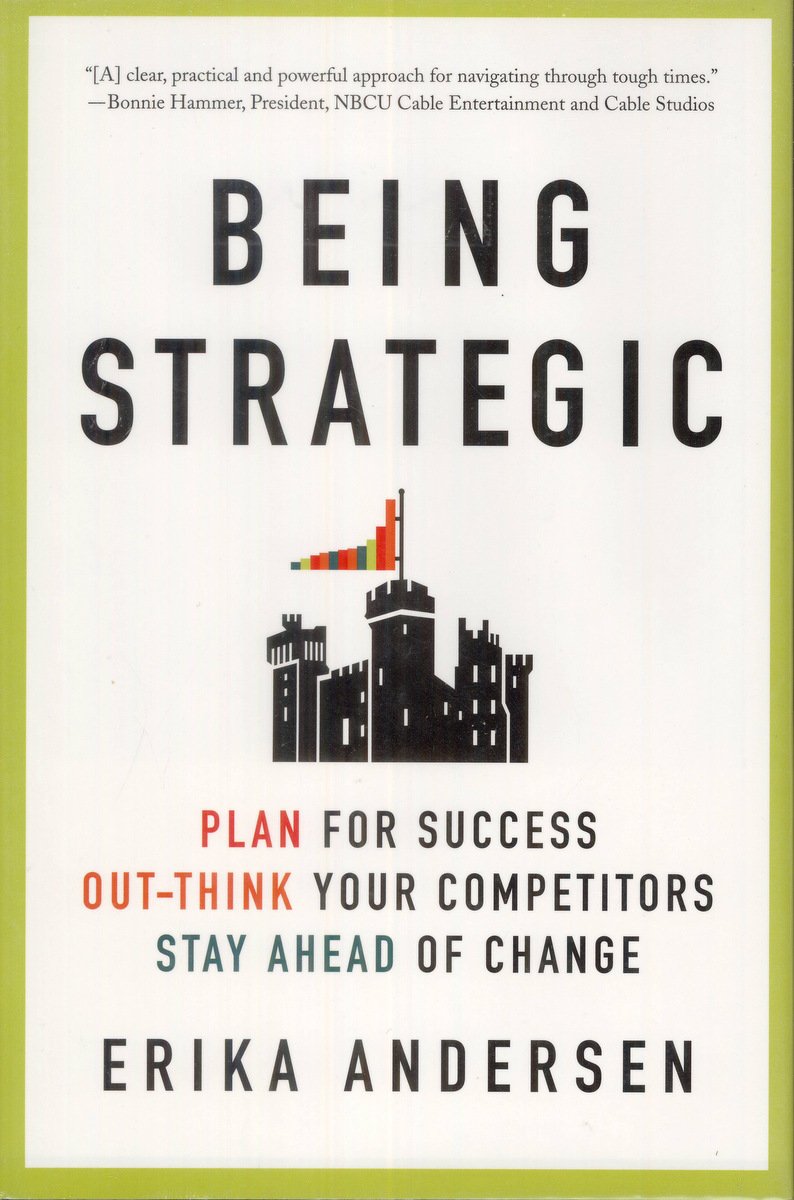
Being Strategic: Plan for Success; Out-think Your Competitors; Stay Ahead of Change
$32.00
by Erika Andersen



STRATEGY? TACTICS? CONFUSED? How many times have you sat in a meeting and heard someone use the word “strategic?” As in: “We’re not being very strategic about X.” or “We need a strategic plan for project Y.” And, if your organization is like most, everyone in the meeting nods wisely, the meeting drones on, people endlessly debate how to approach the situation at hand, with – generally – no one the wiser as to what “strategic” really means. Next time, respond: “Being strategic means consistently making those core directional choices that will best move us toward our hoped-for future. Is this what we’re doing?” Everybody talks about strategy, but there is a big gap between discussing strategy, defining strategy and actually being strategic -- so you can accomplish something. This book helps you approach business—and life—strategically, explaining what strategy is, why it's important, and how to do it. Being Strategic offers you a step-by-step model and skills for strategic thought and action that are broadly applicable and thoroughly practical: • First, get clear about the problem you’re trying to solve • Then, figure out where you’re starting from • Now, imagine your “castle on the hill,” the future you want to create. • Identify the “trolls under the bridge”; the obstacles in your path • Next, outline the path to the castle: your core strategies and the tactics for implementing them. • Re-evaluate your strategy and your tactics as conditions change Framed around the story of 13th-century Welsh nobles building an actual castle, and weaving in dozens of real-life examples from her practice, which has helped restaurateur Danny Meyer and many others, noted consultant Erika Andersen offers a complete course in turning around a business, or a life. Erika Andersen is the founding partner of Proteus International, a coaching, consulting and training firm that helps client organizations clarify and move toward their hoped-for-future. She has served as coach and advisor to the senior executives of such companies as MTV Networks, GE, Rockwell Automation, NBC Universal, Union Square Hospitality Group, and Cablevision Corporation. Erika lives in New York’s Hudson Valley, in her very own castle on a hill. Chapter One The Castle on the Hill I'm fascinated by castles. It's one of the many reasons I love Wales, a quirky, ancient little country with more castles per square mile than any other country in Europe. I'm fascinated by them at least partly because they provide such a grand metaphor for the idea of thinking strategically. There's a castle of which I'm especially fond: it sits up on a hill, tucked away in the far northwest corner of Wales, with the little village of Criccieth spread out around it. There's not much left of the castle now—parts of two gate house towers and some low stone walls—but you can squint your eyes and see what it would have looked like eight hundred years ago, high on its promontory overlooking both Cardigan Bay and the surrounding countryside. (For more about Criccieth and its castle, go to www.beingstrategic.com.) Imagine what must have been required to create such an edifice, all those hundreds of years ago. Not just the building of it—the months or years of grueling labor in all kinds of weather; people and animals, tools and stone—but more than that. Thinking through the idea and then pulling together the diverse resources and support needed to make it a reality—all without benefit of modern machines, modern technology, or modern communication. And I realize it could only have arisen from a very clear intention, sustained over time: consistently making those core directional choices that will best move you toward your hoped-for future. In short, successfully building a castle, especially on a cliff over the sea in the wild northwest of Wales in 1230, called for someone to be very strategic. That someone was a guy named Llewellyn Fawr (pronounced "Thloo-ell in Vahr"), Prince of North Wales at the time. "Fawr" means roughly "the Great" in Welsh, so you can see what folks thought of him (and his castles) even then. Let's follow him around for a little while in our imagination, just to get a feel for him being strategic. Llewellyn stands on the beach, looking out at the Irish raiders in their boats. He and his men have just beaten them back into the sea, and he's wondering yet again how he can keep his lands intact and thriving, how he can fend off not only the Irish but also the Normans, the Danes, and whoever else wants a piece of his domain. He thinks to himself: How can we best protect and defend ourselves from our enemies? He thinks about all his resources and difficulties. On the one hand, the Welsh are brave and tough, good fighters and loyal to their prince. They know the land and how to best live on it and work it. Their farms and hunters provide enough to feed and clothe them, and they're not dependent on outsiders for necessities. On the other hand