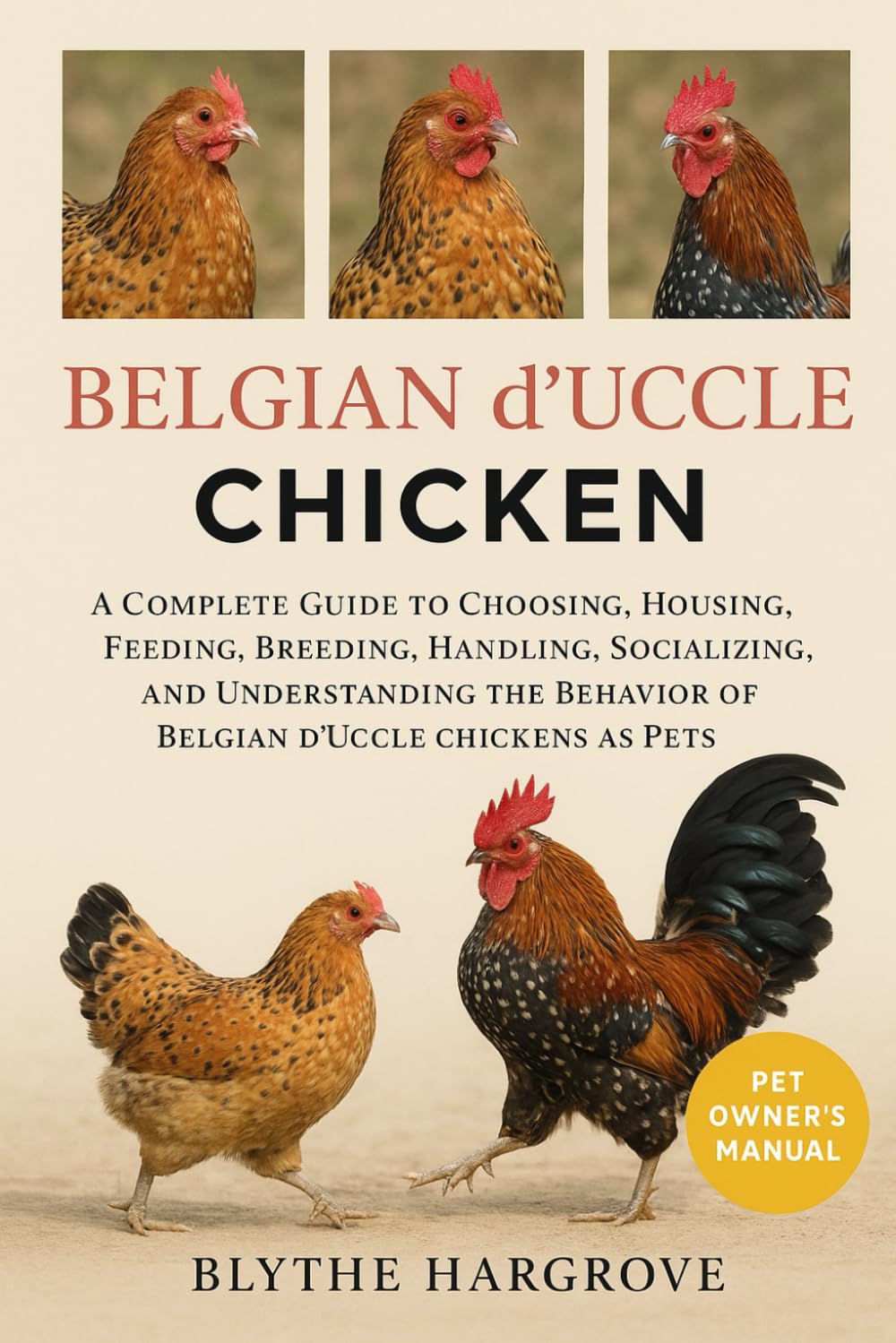
Belgian d’Uccle: A Complete Guide to Choosing, Housing, Feeding, Breeding, Handling, Socializing, and Understanding the Behavior of Belgian d’Uccle
$14.76
by Blythe Hargrove



In The Belgian d’Uccle: A Jewel in Feathers , author Blythe Hargrove invites readers into a world where history, culture, and care for animals converge in the figure of a small but extraordinary chicken. The Belgian d’Uccle, with its Mille Fleur plumage that looks like “a thousand flowers,” becomes the lens through which Hargrove tells a larger story—about heritage, resilience, and the way beauty sustains communities across generations. The book opens in Uccle, Belgium, where the breed was first developed at the turn of the twentieth century. Hargrove describes how local breeders, guided by both artistry and practicality, shaped this tiny bantam into a living jewel. In a country often overshadowed by larger European neighbors, the Belgian d’Uccle became more than poultry—it became a cultural emblem, proof that small things can carry immense meaning. This sense of symbolism carries throughout the book, giving readers the impression that the bird is not only a creature of feathers but also of memory and pride. Hargrove then turns her gaze outward, situating the d’Uccle within the wider world of bantams. Unlike miniature versions of larger chickens, true bantams exist only in their small size, and the Belgian d’Uccle belongs to this rare class. She compares it to other bantams like the Sebright and the Dutch Bantam, highlighting how each has its own story but how the d’Uccle stands apart because of its feathered legs, muffed face, and dazzling Mille Fleur pattern. These details remind the reader that the bird’s uniqueness lies not only in its appearance but in the intentional vision of breeders who saw poultry as art. Beauty is given its full due in Hargrove’s narrative. She lingers over the details of the breed standard, describing beards, muffs, and feathered feet as though she were sketching a portrait. The Mille Fleur, with its speckled, flower-like plumage, emerges as both the defining trait of the breed and a metaphor for abundance. Other color varieties appear—Porcelain, Mottled, and more—but Mille Fleur remains the crown jewel, the variety that has carried the breed into legend. Here, Hargrove shows how show standards and exhibition culture preserve this beauty across generations, ensuring that heritage is not diluted but celebrated. Yet the Belgian d’Uccle is not only a bird for admiration. It is also a companion. Hargrove captures the temperament of the breed with affection: gentle, calm, and often described as “lap chickens.” Roosters bring a bit more spirit, but even they are seldom aggressive. She tells of children who grow up with d’Uccles as backyard friends, of elderly keepers who find daily comfort in their soft clucking, and of urban families who discover in these birds a connection to nature that city life often obscures. The bird’s small size makes it ideal for backyards and urban homesteads, where space is tight but beauty and companionship are priceless. From this point, Hargrove shifts into practical guidance, yet her tone never loses its warmth. She describes feeding regimens tailored to bantams, the importance of protein for feather health, and common mistakes to avoid. She explains how coops must be designed with the bird’s small size and feathered legs in mind, balancing protection from predators with opportunities for fresh air and foraging. Climate considerations appear too, as feathered feet may struggle in wet conditions, while small bodies need care in both heat and cold. But even in these sections, Hargrove maintains her reflective style, reminding readers that building coops or mixing feeds is not just science—it is stewardship, a way of expressing care and respect. The cycle of life runs through the book in the chapters on breeding and raising chicks. Here Hargrove shows how every new generation is both a joy and a responsibility.