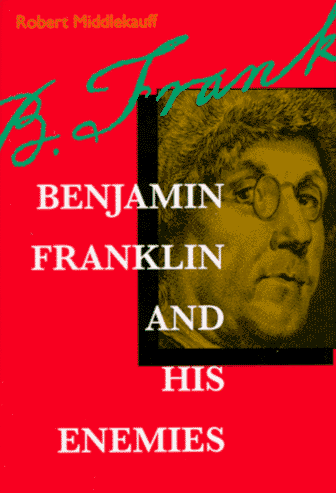



In this engaging study of the much-loved statesman and polymath, Robert Middlekauff uncovers a little-known aspect of Benjamin Franklin's personalityhis passionate anger. He reveals a fully human Franklin who led a remarkable life but nonetheless had his share of hostile relationshipspolitical adversaries like the Penns, John Adams, and Arthur Leeand great disappointmentsthe most significant being his son, William, who sided with the British. Utilizing an abundance of archival sources, Middlekauff weaves episodes in Franklin's emotional life into key moments in colonial and Revolutionary history. The result is a highly readable narrative that illuminates how historical passions can torment even the most rational and benevolent of men. Who could have imagined that Benjamin Franklin, the genial inventor and policy-maker who gained international popularity during the Revolutionary War was found by some to be "foul-mouthed" and "a very uneasy Spirit"? Robert Middlekauff, a historian at the University of California, Berkeley, examines Franklin's long battle not only with Thomas Penn, son of the founder of Pennsylvania, but John Adams, a bright lawyer who grew to hate Franklin, primarily out of jealousy over Franklin's celebrity. Though Franklin's attempts to have Penn stripped of his charter powers backfired, fortunately for Americans, he and Adams were able to rise above animosity for the good of the country. Middlekauff (Glorious Cause, LJ 3/15/82) here gives a very readable history of America's first diplomat. Franklin acquired political enemies, Middlekauff suggests, because he was brilliant, annoying those less brilliant; because he spoke of and tried (less successfully) to lead a moral life, irritating the amoral; and because he fell short of his own moral yardstick, offending those as pious as he. Another basis for the enmity directed at him is that Franklin, a tradesman, moved for much of his life in genteel society, earning the contempt of Pennsylvania's proprietor, Thomas Penn, and other English lords. Franklin's moral failures are glossed over, presumably because those of his enemies were worse. Although books have already been written about Franklin's Tory son William, the present work might have been that much better if the author had devoted more than the last two pages to the family. Recommended for all those interested in this Founding Father. Robert C. Moore, DuPont Merck Pharmaceutical Co. Information Svcs., N. Billerica, Mass. Copyright 1995 Reed Business Information, Inc. We live in an era when even Mother Teresa gets trashed in a tell-all biography. Thus, one trembles for the fate of a genuine American icon when a biography purports to show his "darker" side. Yet, the Franklin that emerges from Middlekauff's short but engrossing and entertaining biography is not diminished in stature or appeal. Although he could be infuriatingly stubborn and even petty, he could also be generous, tolerant, and deeply compassionate. Even his political enemies, particularly John Adams, grudgingly had to acknowledge his brilliant and incisive mind. Middlekauff pays special attention to Franklin's greatest personal sorrow: his shattered relationship with his illegitimate son, whose staunch loyalty to Britain was taken by Franklin as both a personal and political betrayal. This is far from being a comprehensive biography, but it is a well-written and very useful examination of some often ignored aspects of Franklin's character and life. Jay Freeman In this unusual study of Benjamin Franklin's personal relationships, Middlekauff (History/Univ. of Calif., Berkeley; The Mathers, 1971, etc.) points out that the beloved American sage and statesman had enemies who hated him and whom he hated in return. Carl Van Doren called Franklin a ``harmonious human multitude.'' In contrast to this popular image, Middlekauff depicts Franklin as a man of profoundly contradictory qualities who was often anything but ``harmonious.'' For instance, Franklin loathed the autocratic proprietor of the Pennsylvania colony, Thomas Penn, for attempting to stanch democracy in the colony and for failure to defend the Pennsylvania frontier from Indian attacks. For his part, Middlekauff writes, Penn hated Franklin, recognizing in him a man of ability who sought to take the colony away from the Penn family. Also, despite years of admiring the British Empire, Franklin came to detest England and all of its institutions in light of the crisis that led to the American Revolution and the cruelty of the British war effort. The war also cost him his close relationship with his son William, the royal governor of New Jersey at the war's outset and a prominent Tory throughout. And as Middlekauff points out, even on the patriot side there were those who disliked and distrusted him: Arthur Lee, Ralph Izard, and John Adams, other American diplomats in Paris when Franklin was forging the key strategic relationship with France, resented Franklin's brillian