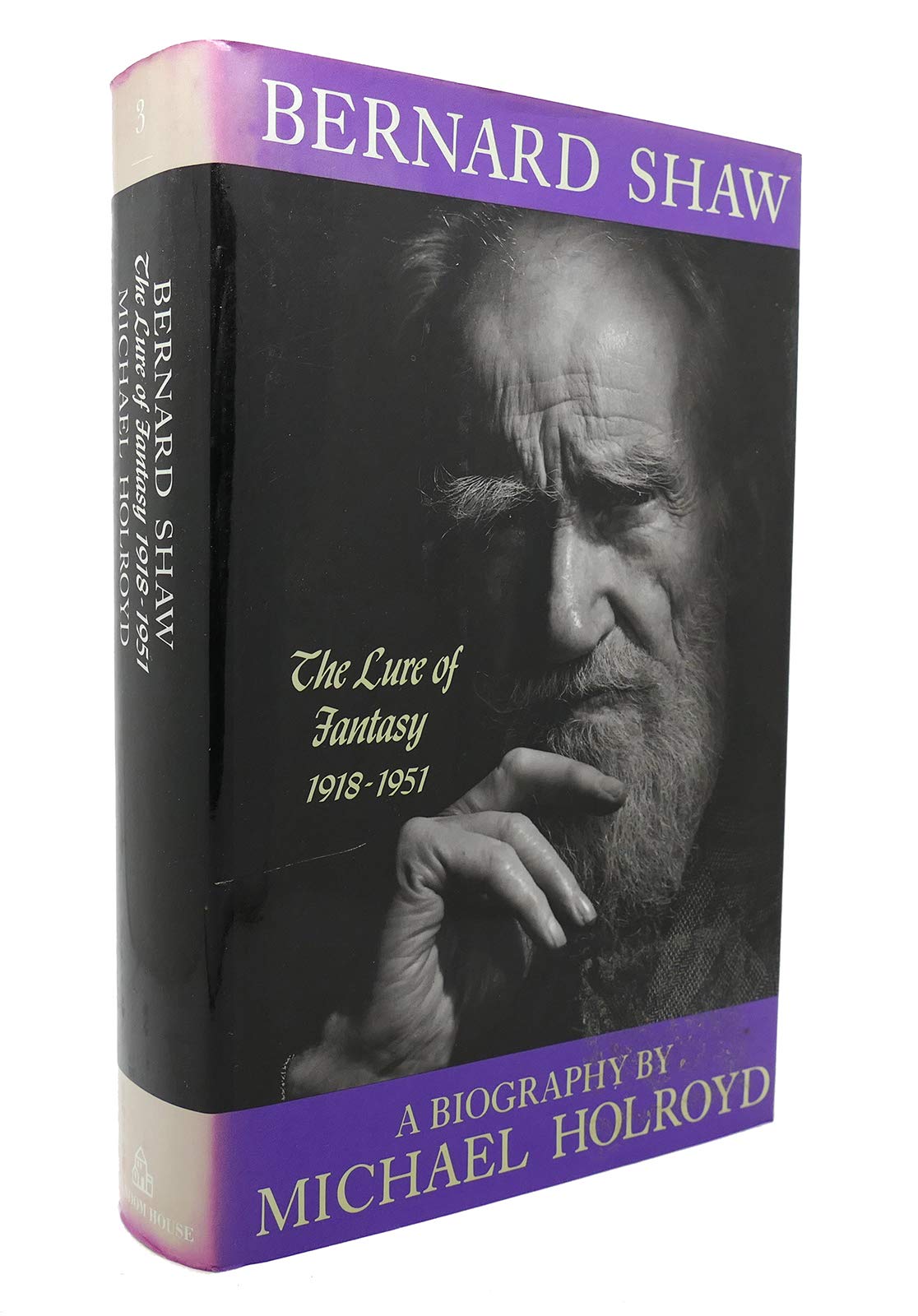



When Michael Holroyd's multivolume life of Bernard Shaw was published, it was hailed as a masterpiece, and William Golding predicted that it would take its place "among the great biographies." Now the biography is available for the first time in a lively and accessible abridgment by the author. This is the quintessence of Shaw. The narrative has a new verve and pace, and the light and shade of Shaw's world are more dramatically revealed as Holroyd counterpoints the private and public Shaw with inimitable insight and scholarship. Playwright, wit, socialist, polemicist, vegetarian, and irresistible charmer, Bernard Shaw was the most controversial literary figure of his age, the scourge of Victorian values and middle-class pretensions. Born in Dublin in 1856, he grew up there, a lonely child in an unsettling ménage à trois. His father, George Carr Shaw, had turned to drink, and his mother was muse to a Svengali-like music teacher whom she followed to London. The young Shaw, anxious to escape his heritage, also left for London to reinvent himself as the legendary G.B.S.--novelist, lover, politician, music critic, and finally playwright. From his first passionate affair with a beautiful middle-aged widow, he moved on to flirtations and liaisons with young actresses and socialists before finally settling into marriage in 1898. At the turn of the century, Shaw was in his prime, a theatrical impresario and author of those great campaigning plays--Man and Superman, Major Barbara, The Doctor's Dilemma, and John Bull's Other Island--that used laughter as an anesthetic for the operation he performed on British society. By 1914 the author of Pygmalion was the most popular writer in England, and increasingly recognized throughout Europe and America. Though ready with advice to others on how to stay married, he fell painfully in love with two of the most dazzling actresses of the age, Ellen Terry and Mrs. Patrick Campbell. The reluctant recipient of a Nobel Prize for literature and an Academy Award for his screenplay for Pygmalion, Shaw became an international icon between the two world wars, feted from China and Soviet Russia to India and New Zealand, though still contriving to provoke the establishment in the United States, South Africa, and Ireland. In old age he was vigorous and prolific, espousing many new and quixotic causes. He revealed himself increasingly as conjurer, fabulist, and seer through his powerful late works, including Saint Joan, the Chekhovian Heartbreak House, the modernist fantasy Back to Methuselah, and the imaginative dream plays and political extravaganzas. Covering almost a century, from 1856 to 1950, this unparalleled life of Shaw presents the magnificent double portrait of an age and of a man who was born fifty years too soon. Holroyd magically captures the essence of Shaw's protean genius in a tragicomedy that Holroyd here brings to completion his masterful, definitive Shaw biography. Continuing from Volume 1 ( The Search for Love, 1856-1898 , LJ 10/1/88) and Volume 2 ( The Pursuit of Power, 1898-1914 , LJ 9/15/89), Volume 3 moves from Shaw's political activities following World War I to his death in 1950. It presents the trademark Shaw--the wit, crustiness, socialism, range-of-acquaintance--enhanced by the grace and wit of Holroyd's own writing. A wonderful companion to Shaw's great letters, this is one of the major literary biographies of modern times, at once intuitive, informed, scholarly, and readable. A necessary purchase for academic libraries and public libraries middle-sized and larger; libraries not already owning Volumes 1 and 2 should consider back-buying. Previewed in Prepub Alert, LJ 5/1/91. - Robert Brown, Onondaga Cty. P.L., Syracuse, N.Y. Copyright 1991 Reed Business Information, Inc. Triumphant closing of Holroyd's massive life of George Bernard Shaw (1856-1951), begun with The Search for Love (1988) and The Pursuit of Power (1989)--a work 15 years in the writing. (The notes will be published separately.) Now WW I ends and Shaw, in a Chekhovian mood, writes Heartbreak House, his elegy for prewar England, a ``tragic'' play that he slyly complains has been accepted as ``a bedroom farce.'' Shaw girds himself for his greatest labor, the five-play metabiological history and future of mankind fantasy cycle, Back to Methuselah, an unplayably long philosophical treatise (well appraised by Holroyd) that nonetheless is staged first in Manhattan, then in Birmingham (England), much to Shaw's amaze. Then he refashions into English Jitto's Atonement, a play by his German translator, although Shaw's German is far, far worse than his translator's groping, misspelled English--and it's a hit! But the press is down on him for not being serious, so he accepts his wife Charlotte's urgings and decides to rescue the real Jeanne d'Arc from the cheesy image she's fallen into and once more allow her to be a legitimate heretic in his straightforward