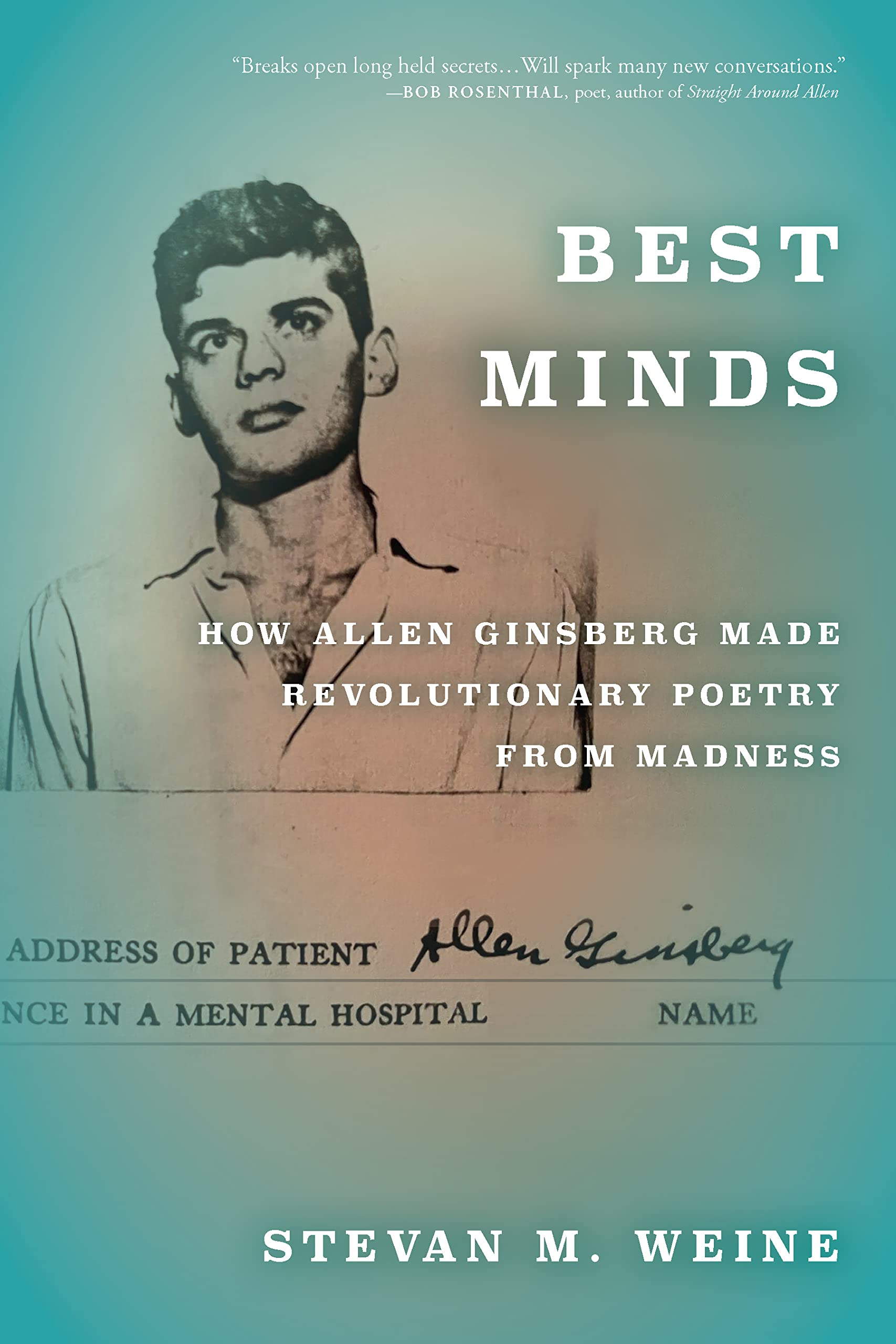
Best Minds: How Allen Ginsberg Made Revolutionary Poetry from Madness
$31.49
by Stevan M. Weine



WINNER, 2024 BEAT STUDIES ASSOCIATION AWARDS A revelatory look at how poet Allen Ginsberg transformed experiences of mental illness and madness into some of the most powerful and widely read poems of the twentieth century. Allen Ginsberg’s 1956 poem “Howl” opens with one of the most resonant phrases in modern poetry: “I saw the best minds of my generation destroyed by madness.” Thirty years later, Ginsberg entrusted a Columbia University medical student with materials not shared with anyone else, including psychiatric records that documented how he and his mother, Naomi Ginsberg, struggled with mental illness. In Best Minds , psychiatrist, researcher, and scholar Stevan M. Weine, M.D., who was that medical student, examines how Allen Ginsberg took his visions and psychiatric hospitalization, his mother’s devastating illness, confinement, and lobotomy, and the social upheavals of the postwar world and imaginatively transformed them. Though madness is often linked with hardship and suffering, Ginsberg’s showed how it could also lead to profound and redemptive aesthetic, spiritual, and social changes. Through his revolutionary poetry and social advocacy, Ginsberg dedicated himself to leading others toward new ways of being human and easing pain. Throughout his celebrated career Ginsberg made us feel as though we knew everything there was to know about him. However, much has been left out about his experiences growing up with a mentally ill mother, his visions, and his psychiatric hospitalization. In Best Minds , with a forty-year career studying and addressing trauma, Weine provides a groundbreaking exploration of the poet and his creative process especially in relation to madness. Best Minds examines the complex relationships between mental illness, psychiatry, trauma, poetry, and prophecy―using the access Ginsberg generously shared to offer new, lively, and indispensable insights into an American icon. Weine also provides new understandings of the paternalism, treatment failures, ethical lapses, and limitations of American psychiatry in the 1940s and 1950s. In light of these new discoveries, the challenges Ginsberg faced appear starker and his achievements, both as a poet and an advocate, even more remarkable. Breaks open long held secrets…Will spark many new conversations. ---Bob Rosenthal, poet, author of Straight Around Allen Stevan Weine’s biography of Allen Ginsberg is a major breakthrough in our understanding of this major American poet. With complete access to Ginsberg’s medical records, alongside interviews and other documents, Weine is able to construct the most complex account we have of Ginsberg’s struggle with madness, both his own and his mother’s, and to frame it within the history of American psychiatry and the pursuit of visionary poetry and experiences throughout Ginsberg’s career. Essential reading for anyone interested in the long history of madness in individuals, families, and cultures. ---W. J. T. Mitchell, Gaylord Donnelley Distinguished Service Professor, English and Art History, University of Chicago, author of Mental Traveler: A Father, a Son, and a Journey through Schizophrenia Allen Ginsberg's decision to allow doctors to lobotomize his mother was a devastating one that he spent a lifetime trying to understand. Stevan Weine's unprecedented access to Allen and Naomi's psychiatric hospital records has provided a fresh understanding of the origins of "Howl" and "Kaddish" and illuminates the great distance that Allen traveled from his uncertain, troubled youth to the acclaimed poet the world came to know. Best Minds is a crucial advancement in Ginsberg and Beat studies. ---Michael Schumacher, author of Dharma Lion Best Minds is an immensely enjoyable and meticulous work of criticism: an investigation by a psychiatrist into a poet's mental illness and his work, informed by access granted by the poet to the records of his 8-month psychiatric hospitalization and those of his mentally ill mother. Best Minds contains startling discoveries and groundbreaking analyses of journals, correspondence, poems, and psychotherapy progress notes. Weine documents Ginsberg's poetic, psychiatric and cultural experiences so thoroughly the reader can participate in evaluating them. As a result, the challenges of mental illness and the poignancy of Ginsberg’s works come through like never before. ---David V. Forrest, M.D., Clinical Professor of Psychiatry; Faculty, Psychoanalytic Institute; Consultant to Neurology, Columbia University Vagelos College of Physicians & Surgeons; Founding Editor, SPRING: The Journal of the E. E. Cummings Society Dr. Weine takes a serious, detailed look at how Allen Ginsberg’s personal encounters with mental illness became integral to his poetry. Best Minds is a unique contribution to the critical and biographical work on this troubled and brilliant Beat Generation poet. The book presents a brisk challenge to 'official' notions of mental illness