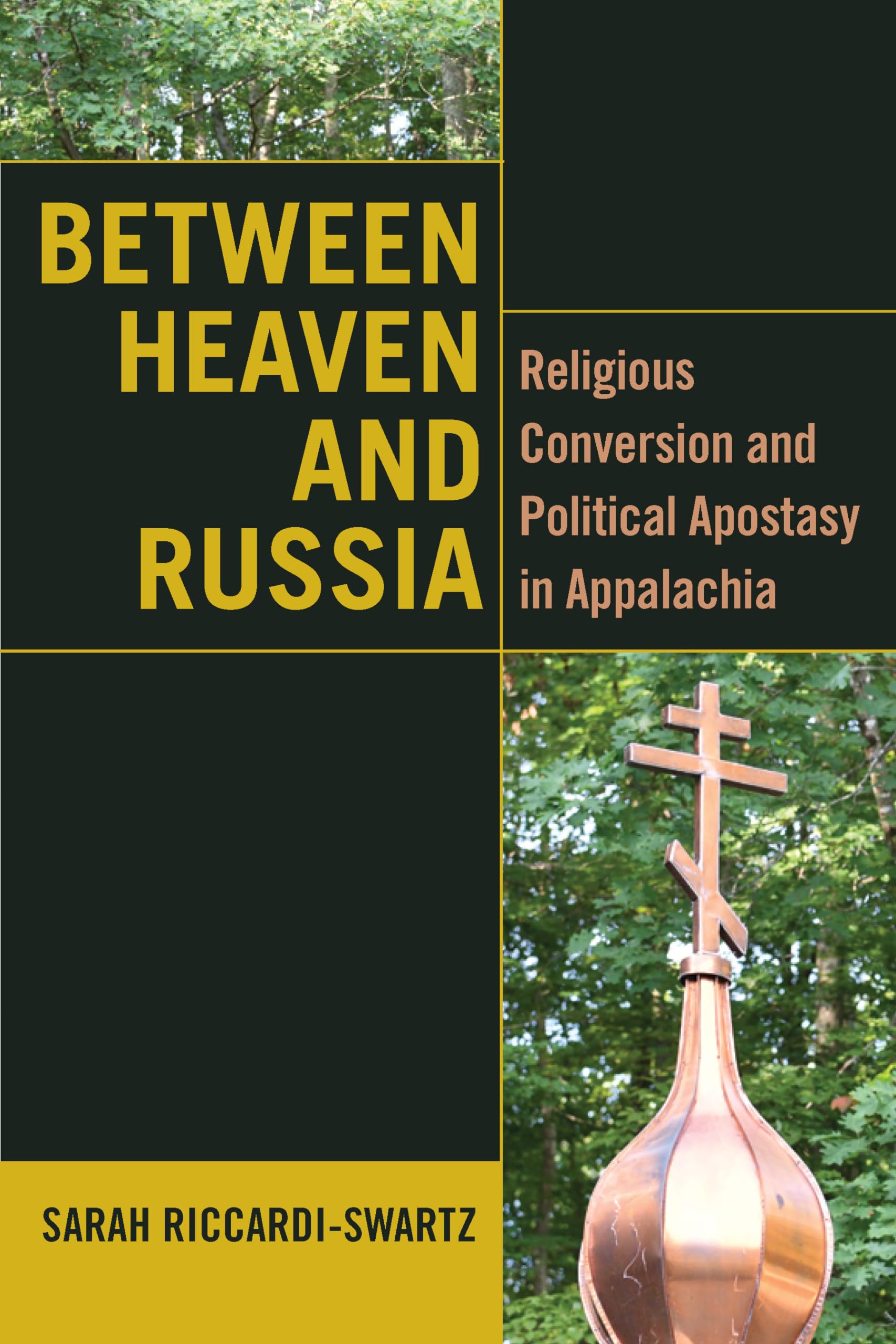
Between Heaven and Russia: Religious Conversion and Political Apostasy in Appalachia (Orthodox Christianity and Contemporary Thought)
$20.19
by Sarah Riccardi-Swartz



How is religious conversion transforming American democracy? In one corner of Appalachia, a group of American citizens has embraced the Russian Orthodox Church and through it Putin’s New Russia. Historically a minority immigrant faith in the United States, Russian Orthodoxy is attracting Americans who look to Russian religion and politics for answers to Western secularism and the loss of traditional family values in the face of accelerating progressivism. This ethnography highlights an intentional community of converts who are exemplary of much broader networks of Russian Orthodox converts in the United States. These converts sought and found a conservatism more authentic than Christian American Republicanism and a nationalism unburdened by the broken promises of American exceptionalism. Ultimately, both converts and the Church that welcomes them deploy the subversive act of adopting the ideals and faith of a foreign power for larger, transnational political ends. Offering insights into this rarely considered religious world, including its far-right political roots that nourish the embrace of Putin’s Russia, this ethnography shows how religious conversion is tied to larger issues of social politics, allegiance, (anti)democracy, and citizenship. These conversions offer us a window onto both global politics and foreign affairs, while also allowing us to see how particular U.S. communities are grappling with social transformations in the twenty-first century. With broad implications for our understanding of both conservative Christianity and right-wing politics, as well as contemporary Russian–American relations, this book provides insight in the growing constellations of far-right conservatism. While Russian Orthodox converts are more likely to form the moral minority rather than the moral majority, they are an important gauge for understanding the powerful philosophical shifts occurring in the current political climate in the United States and what they might mean for the future of American values, ideals, and democracy. In this engrossing and revelatory study of what she calls 'Reactive Orthodoxy,' Sarah Riccardi-Swartz finds in a rural West Virginia community of Christian converts to the Russian Orthodox Church Outside of Russia (ROCOR) a key to the emerging shape of contemporary transnational far-right political religion. Her interlocutors say the U.S. is on the eve of destruction, broken by secularism, the betrayal of whiteness, and LGBTQ rights. They look to pre-1917 Tsarist Russia for a model of Christian government and to post-Soviet Russia and Vladimir Putin for protection and hope. Between Heaven and Russia establishes itself immediately as essential reading for understanding religion and politics in the 21st century. It is also a model for studying religion beyond the protective screen of good religion/bad religion. ---Robert Orsi, author of History and Presence Between Heaven and Russia , remarkably, takes us to rural West Virginia, inside a small patriarchal community of American converts to Russian Orthodoxy, who yearn for a restoration of tsarist Russia, and whose admiration of Vladimir Putin is exceeded only by their reverence for Nicholas II. Lest you assume this is a straightforward ethnography of a peculiar Appalachian outpost, think again. Sarah Riccardi-Swartz has crafted a gripping narrative of the American radical right's growing fixation with the fascist ideologues of Eurasia, and their interconnectedness with a global movement that poses a dire threat to secular democracy around the world. ---Sarah Posner, author of Unholy: How White Christian Nationalists Powered the Trump Presidency, and the Devastating Legacy They Left Behind The book Between Heaven and Russia by American anthropologist Sarah Riccardi-Swartz offers fascinating insights into a specific variant of the current Orthodox convert scene in the USA. With many examples and picturesque retellings, Riccardi-Swartz analyzes the Orthodox community in a small town in West Virginia, which has both an Orthodox monastery and an Orthodox congregation. . . It highlights the danger of viewing the partly astonishing growth of the Orthodox Church in the USA through rose-colored glasses. The book is highly recommended, also because of its lively and captivating language. ― Religion & Gesellschaft in Ost und West / Religion & Society in East and West Riccardi-Swartz’s Between Heaven and Russia is a provocative and incredible account of the reimagining of America, in a moment of radical resurgence, through the lens of conversion. ― Journal of Orthodox Christian Studies Sarah Riccardi-Swartz is Assistant Professor of Religion and Anthropology at Northeastern University, where she is also an affiliate faculty member in the Women’s, Gender, and Sexuality Studies Program. Her research focuses on politics, race, media gender and sexuality, and Orthodox Christianity. She is the author of Between Heaven and Russia: Religious Co