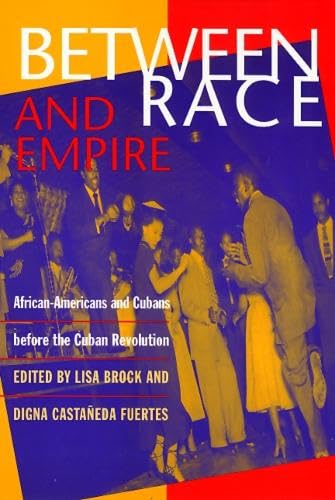
Between Race and Empire: African-Americans and Cubans before the Cuban Revolution
$45.95
by Lisa Brock



This collection traces relations between Cubans and African-Americans from the abolitionist era to the Cuban Revolution of 1959. It aims to expand understanding of history from below and reflect trends in PanAfricanist and African Diaspora by tracing a link between two peoples of African descent. Editors Lisa Brock and Digna Castaeda Fuertes have gathered essays from North American and Cuban scholars which prove that even during slavery and Jim Crow, Black Americans cared about Cuba and vice versa. "Except for Haiti, no New World society received as much attention from Black North Americans in the nineteenth century as did Cuba... This volume of academic essays, written with accessible language, delves into topics such as religion and protest poetry. Layers of history are peeled back, building an understanding of political and racial dynamics between the darker citizens of the United States and Cuba. Between Race and Empire informs readers about a shared history we should know. Writes Castaeda in the epilogue, "In this historical moment, we hope that this book, by looking into our common past, will help us negotiate a common future." -- Emerge Magazine, September 1998 For nearly two centuries, African Americans and Cubans have influenced each other in a number of ways, as shown in this collection of eleven essays. Brock writes, "Although racism and empire thrust African-Americans and Cubans into each other's assigned physical spaces, it was who they were before and after segregation and exploitation that most influenced their cultural relations." The nineteenth-century African American leader Frederick Douglass called for U.S. blacks to volunteer for Cuba's war against Spain. Negro American newspapers supported the Afro-Cuban struggle. Connections were made through sports, specifically baseball. [And] Just as African Americans asserted themselves in the Harlem Renaissance of the twenties, Cubans also articulated their African heritage and quest for equality through the written word. [The authors also show] the Cuban imprint on American musical styles... as far back as 1909. The contributors to this excellent study have uncovered a rich legacy of two peoples who not only fought racism and imperialism but also interacted in the process. -- Hispanic Magazine, October 1998 The rich and complex relationship between Afro-Americans and Afro-Cubans is the theme of the eleven essays gathered in this charming volume. The strength of this anthology is that it explores this relationship from 'below.' The essays focus on music, poetry, literature, and sports as the means which two peoples of color were able to express their uniqueness and develop their parallel race consciousness. The book heightens our appreciation of the similarity in the Cuban North American black experience, mainly the trauma of slavery and the struggle for political power. While, at the same time, reminding us of the vast differences in attitude toward race between Cuba and the United States. It covers new ground not only in PanAfricanist and African Diaspora study but also in history and international relations. This book is well worth a read and it should be valuable to students of Cuba, Africa, and African-American history and politics. -- Ethnic Conflict: Research Digest, February, 1999 [This book] details how blacks from both countries inspired each other through dance, poetry, mambo and jazz. -- Down Beat, Nov. 1998 The relationship between two peoples of color, their similar experiences with slavery, their struggles for political power, and their parallel race consciousness FOR MANY BLACK AMERICANS, the prominence and success of black Cubans in early efforts on the island for independence and abolition highlighted a sense of racial identity and pride, while after U.S. intervention the suppression of Afro-Cuban aspirations created a strong interest among African-Americans concerning Cuban affairs. This collection, edited by a black Cuban and a black American, traces the relations between Cubans and African-Americans from the abolitionist era to the Cuban Revolution of 1959. The eleven essays gathered here, written by scholars from both countries, heighten our appreciation of African-Americans as international actors and challenge the notion that Cubans had little or no race consciousness. This is one of the first studies of the world capitalist system to track the international consciousness of working peoples, peoples of color, and women. With a focus on two sets of peoples not in state power, Between Race and Empire expands our understanding of "history from below, " and reflects current trends in PanAfricanist and African Diaspora studies by tracing a little-studied linkage between peoples of African descent. Lisa Brock is Associate Professor of African History and Diaspora Studies, Department of Liberal Arts, School of the Art Institute of Chicago Digna Castaeda Fuertes is Senior Professor of Caribbean History and Senior Adv