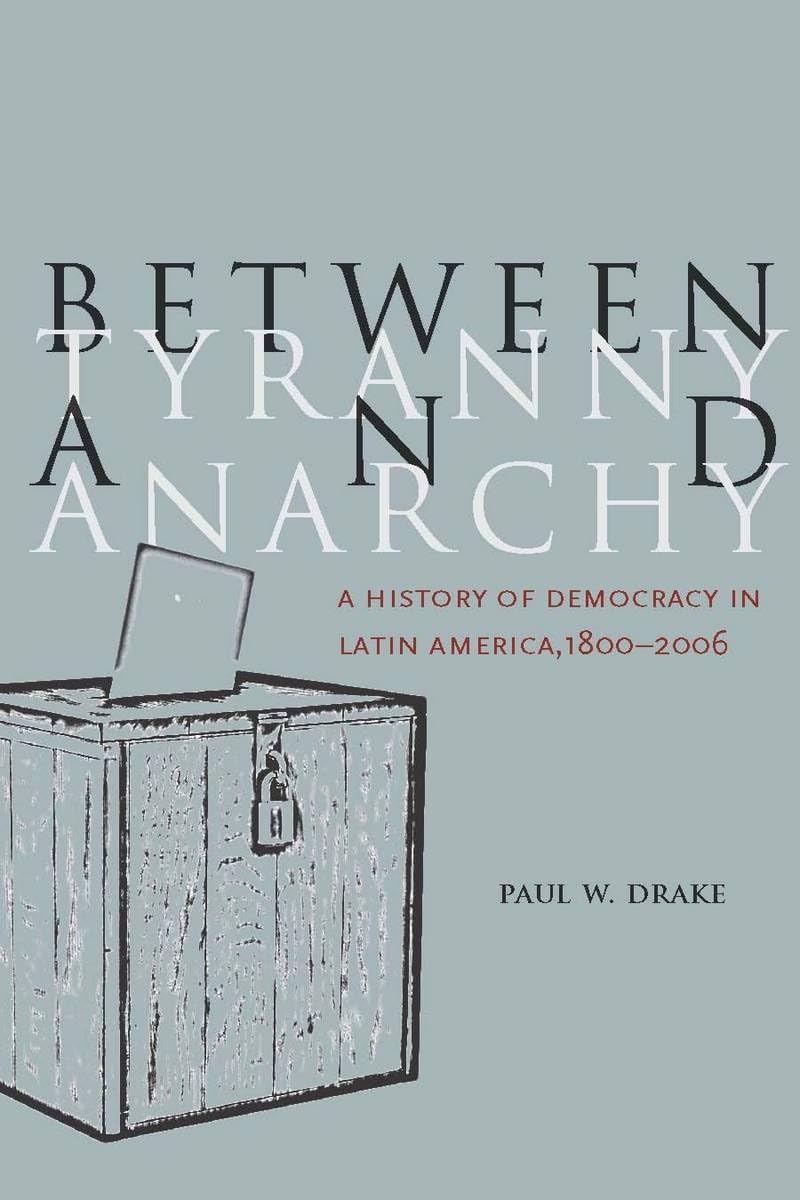
Between Tyranny and Anarchy: A History of Democracy in Latin America, 1800-2006 (Social Science History)
$28.80
by Paul Drake



Between Tyranny and Anarchy provides a unique comprehensive history and interpretation of efforts to establish democracies over two centuries in the major Latin American countries. Drake takes an unusual interdisciplinary approach, combining history and political science with an emphasis on political institutions. He argues that, without a thorough examination of the historical roots and causes of Latin American democracy, most general theories can not adequately explain its failures, successes, and forms. Latin America offers an extraordinary laboratory for the study of democratic experiments. Alongside a well-deserved reputation for authoritarianism, it boasts one of the world's deepest, richest histories of democratic movements, ideas, and institutions. Contrary to conventional wisdom, the region's leading democracies did not lag very far behind the United States and Western Europe in making numerous advances. In comparison with those countries, though, Latin America's democratic history has been distinctive because of its fundamental dilemma: how to reconcile political systems theoretically committed to legal equality with societies divided by extreme socio-economic inequalities. "The book is well written and rich in detail, and is recommended especially for political scientists needing historical background on Latin America and/or interested in the political development of the region." -- A. Siaroff ― Choice. "[The book's] careful consideration of the intricate, unexpected ways in which political, social, economic, ideological, and diplomatic factors play off each other in particular circumstances, enhancing or restricting the effects 'institutional engineering' offers valuable insights to those concerned with constructing substantive and meaningful versions of democracy in the region" -- Erica Gbriela Pani Bano ― The America's. " Between Tyranny and Anarchy offers a sweeping revision of the chronicle of democratic struggles in Latin America, long seen as the region of authoritarian cultures. Paul Drake challenges readers to reconsider the history of Latin American politics and the social actors who shaped it." -- Jeremy Adelman ― Princeton University Paul W. Drake holds the Institute of the Americas Chair, is the Senior Vice Chancellor for Academic Affairs, and is a Distinguished Professor in Political Science at the University of California, San Diego. He has also served as President of the Latin American Studies Association. BETWEEN TYRANNY AND ANARCHY A History of Democracy in Latin America, 1800-2006 By PAUL W. DRAKE STANFORD UNIVERSITY PRESS Copyright © 2009 Board of Trustees of the Leland Stanford Junior University All right reserved. ISBN: 978-0-8047-6002-7 Contents Preface................................................................................................................ixMap of Latin America...................................................................................................xiv1. The Theory and History of Latin American Democracy, 1800-2006.......................................................12. The Historical Evolution of Latin American Democratic Institutions, 1800-2006.......................................233. The Bolivarian Legacy: Struggles Toward Democracy During the Wars for Independence, 1800s-1820s.....................524. The Archaeology of Democracy After Independence, 1820s-1870s........................................................885. Oligarchic Republicanism, 1880s-1920s...............................................................................1266. Populist Democracy, 1930s-1970s.....................................................................................1637. The Tsunami of Neoliberal Democracies, 1970s-2000s..................................................................2018. Two Centuries of Building Democracy in Latin America, 1800-2006.....................................................244Notes..................................................................................................................249Index..................................................................................................................317 Chapter One The Theory and History of Latin American Democracy, 1800-2006 The title of this book comes, appropriately, from Simon Bolvar. In the opening decades of the nineteenth century, the Liberator expressed his exasperation at forging a democratic republic that could withstand the opposing dangers of "tyranny and anarchy." Ever since then, his descendants have grappled with the classic dilemma of crafting a democracy that provides order without dictatorship, and liberty without disintegration. Juxtaposed to its venerable fame as a home for despotism, Latin America also boasts one of the planet's longest, deepest, and richest histories of experiments with democracy. Along with the United States, the region hosts "the oldest continuous republics of the