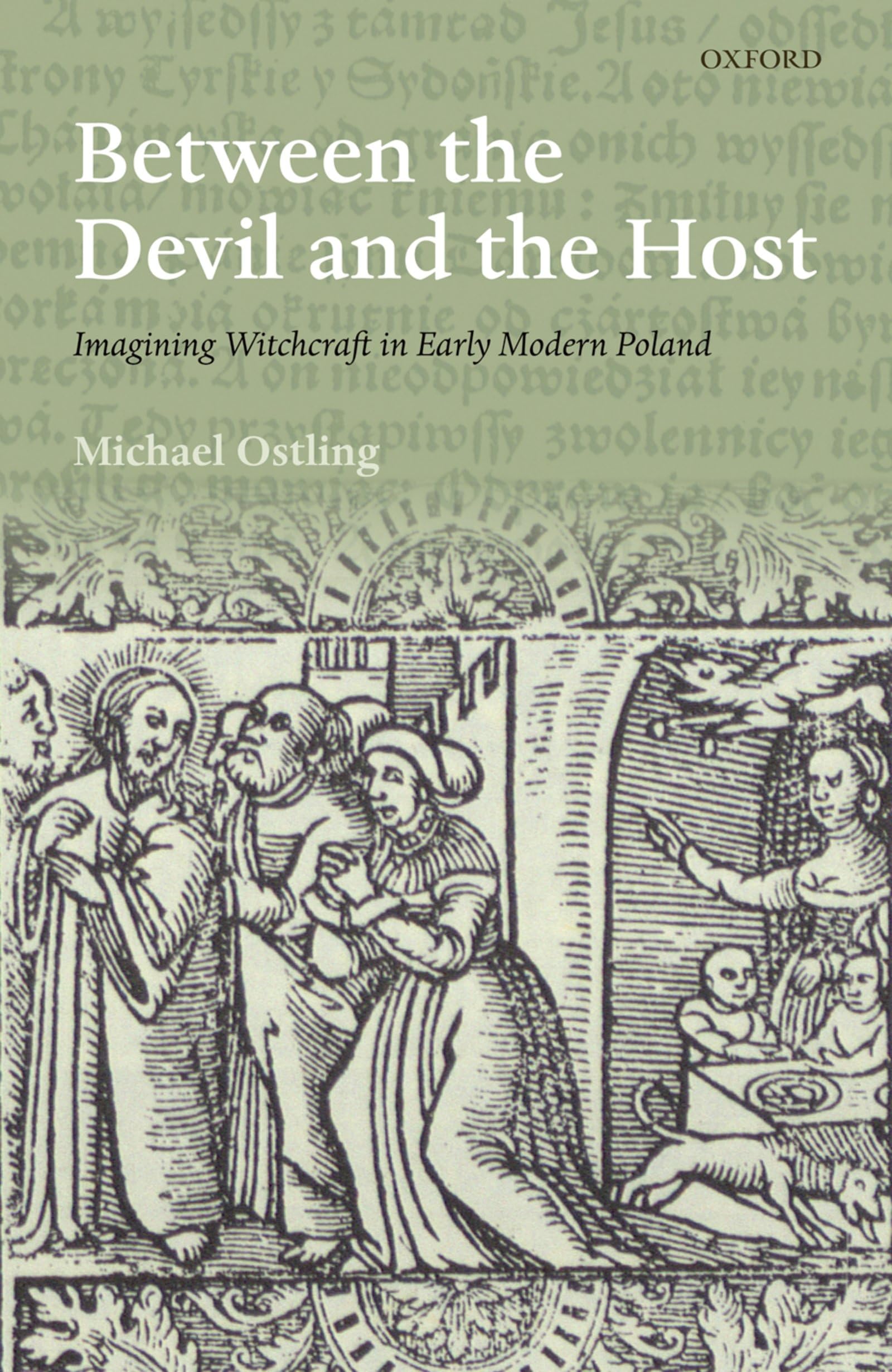
Between the Devil and the Host: Imagining Witchcraft in Early Modern Poland (The Past and Present Book Series)
$136.76
by Dr Michael Ostling



Outside the imagination, witches don't exist. But in Poland and in Europe and its colonies in the early modern period, people imagined their neighbours to be witches, with tragic results. For the first time in English, Michael Ostling tells the story of the imagined Polish witches, showing how ordinary peasant-women got caught in webs of suspicion and accusation, finally confessing under torture to the most heinous of crimes. Through a close reading of accusations and confessions, Ostling also shows how witches imagined themselves and their own religious lives. Paradoxically, the tales they tell of infanticide and host-desecration reveal to us a culture of deep Catholic piety, while the stories they tell of demonic sex and the treasure-bringing ghosts of unbaptized babies uncover a complex folklore at the margins of Christian orthodoxy. Caught between the devil and the host, the self-imagined Polish witches reflect the religion of their place and time, even as they stand accused of subverting and betraying that religion. Through the dark glass of witchcraft Ostling explores the religious lives of early modern women and men: their gender attitudes, their Christian faith and folk cosmology, their prayers and spells, their adoration of Christ incarnate in the transubstantiated Eucharist, and their relations with goblin-like house demons and ghosts. "Michael Ostling's study of witchcraft in early modern Poland explores the murky, productive borerlands between long-established categories of analysis. His work lingers at cultural and geographic crossroads, in the indeterminate zones occupied by the phenomenon of Polish witchcraft itself."-- Slavic Review "This is an invaluable addition to the regional studies of witchcraft in early modern Europe, bringing important recent Polish-language research into contact with interpretations and styles of inquiry currently being developed for other parts of Europe."-- Journal of Ecclesiastical History Michael Ostling, Teaching Professor and Honors Fellow, Barrett, the Honors College, Arizona State University Michael Ostling received his doctorate in Religious Studies from the University of Toronto. Widely published on the topics of witchcraft, magic, other-than-human persons, and ethnobototany, he is co-editor of the internationally recognized journal Magic, Ritual, and Witchcraft and editor of the online Database of Witch Trials in the Polish-Lithuanian Commonwealth, 1500-1800 (forthcoming). Ostling teaches interdisciplinary humanities in the Honors College at Arizona State University, where he attempts to practice a radical pedagogical approach inspired by Polish statesman and philosopher Jacek Kuroń.