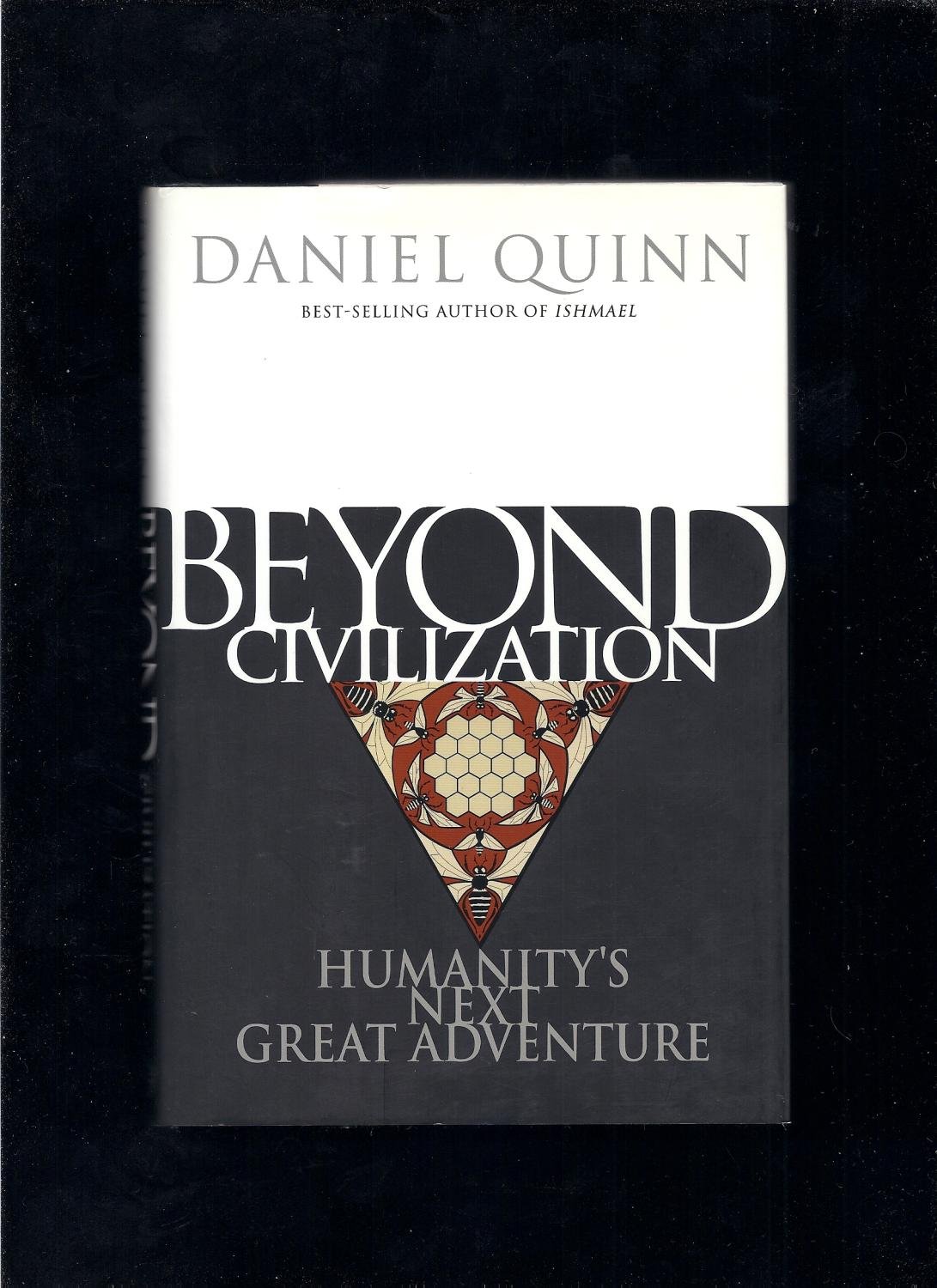



If a team of Martian anthropologists were to study our culture, their initial findings might read something like this: These people have the strange idea that the thing they call civilization is some sort of final, unsurpassable invention. Even though vast numbers of them suffer in this oppressively hierarchical system, and even though it appears to be plunging them toward a global catastrophe, they cling to it as if it were the most wonderful thing (as they quaintly say) since sliced bread. That a more agreeable (and less catastrophic) system exists BEYOND civilization, seems to be entirely unthinkable to them. In Beyond Civilization , Daniel Quinn has made it his task to think the unthinkable. We all know there's no one right way to build a bicycle, no one right way to design an automobile, no one right way to construct a pair of shoes, but we're convinced there must be only one right way for people to live--and the one we have is it, no matter what. Even if we hate it, we must cling to it. Even if it drags us to the brink of extinction, we must not let it go. Many other peoples have built civilizations--and then walked away from them. Quinn examines the Maya, the Olmec, the people of Teotihuacán, and others, who did just that. But they all walked away moving backward--to an earlier lifestyle. Quinn's goal in this book is to show how we can walk away moving forward, to a new lifestyle, one which encourages diversity instead of suppressing it. Not a "New World Order," but rather a New Personal Order. Not legislative change at the governmental level, but rather incremental change at the human level. This is a guidebook for people who want to assert control over their destiny and recover the freedom to live at a scale and in a style of their own choosing--and starting now, today, not in some distant utopian future. Futurist Daniel Quinn ( Ishmael ) dares to imagine a new approach to saving the world that involves deconstructing civilization. Quinn asks the radical yet fundamental questions about humanity such as, Why does civilization grow food, lock it up, and then make people earn money to buy it back? Why not progress "beyond civilization" and abandon the hierarchical lifestyles that cause many of our social problems? He challenges the "old mind" thinking that believes problems should be fixed with social programs. "Old minds think: How do we stop these bad things from happening?" Quinn writes. "New minds think: How do we make things the way we want them to be?" Whether he is discussing Amish farming, homelessness, "tribal business," or holy work, Quinn's manifesto is highly digestible. Instead of writing dense, weighty chapters filled with self-important prose, he's assembled a series of brief one-page essays. His language is down to earth, his metaphors easy to grasp. As a result, readers can read about and ponder Beyond Civilization at a blissfully civilized pace. --Gail Hudson Using parable and dialog, Quinn introduces the reader to some of the philosophical views that have led to our tacit assumption that civilization is the answer to humanity's problems. He offers critical reminders, without being either polemical or technical, that civilization may not be the answer. Rather, he asserts that we should move beyond hierarchy to a new form of tribal livingAnot the communal style of the 1960s but one suffused with conscious, purposeful awareness of each action's greater impact. Quinn notes, "Beyond civilization isn't a geographical space...it's a cultural space that opens up among people with new minds." As is characteristic of his philosophical novels, Ishmael, The Story of B, and My Ishmael, the prose is readable and the sociological discussion unobtrusive. Fans of Quinn's earlier works will welcome this title. Libraries seeking to provide contemporary discussion on human ecology will find this title an asset. -ALeroy Hommerding, Citrus Cty. Lib. Syst., Inverness, FL Copyright 1999 Reed Business Information, Inc. Martian anthropologists were to study our culture, their initial findings might read something like this: These people have the strange idea that the thing they call civilization is some sort of final, unsurpassable invention. Even though vast numbers of them suffer in this oppressively hierarchical system, and even though it appears to be plunging them toward a global catastrophe, they cling to it as if it were the most wonderful thing (as they quaintly say) since sliced bread. That a more agreeable (and less catastrophic) system exists BEYOND civilization, seems to be entirely unthinkable to them. In Beyond Civilization , Daniel Quinn has made it his task to think the unthinkable. We all know there's no one right way to build a bicycle, no one right way to design an automobile, no one right way to construct a pair of shoes, but we're convinced there must be only one right way for people to live--and the one we have is it, no matter what. Even if we hate it, we must cling to DAN