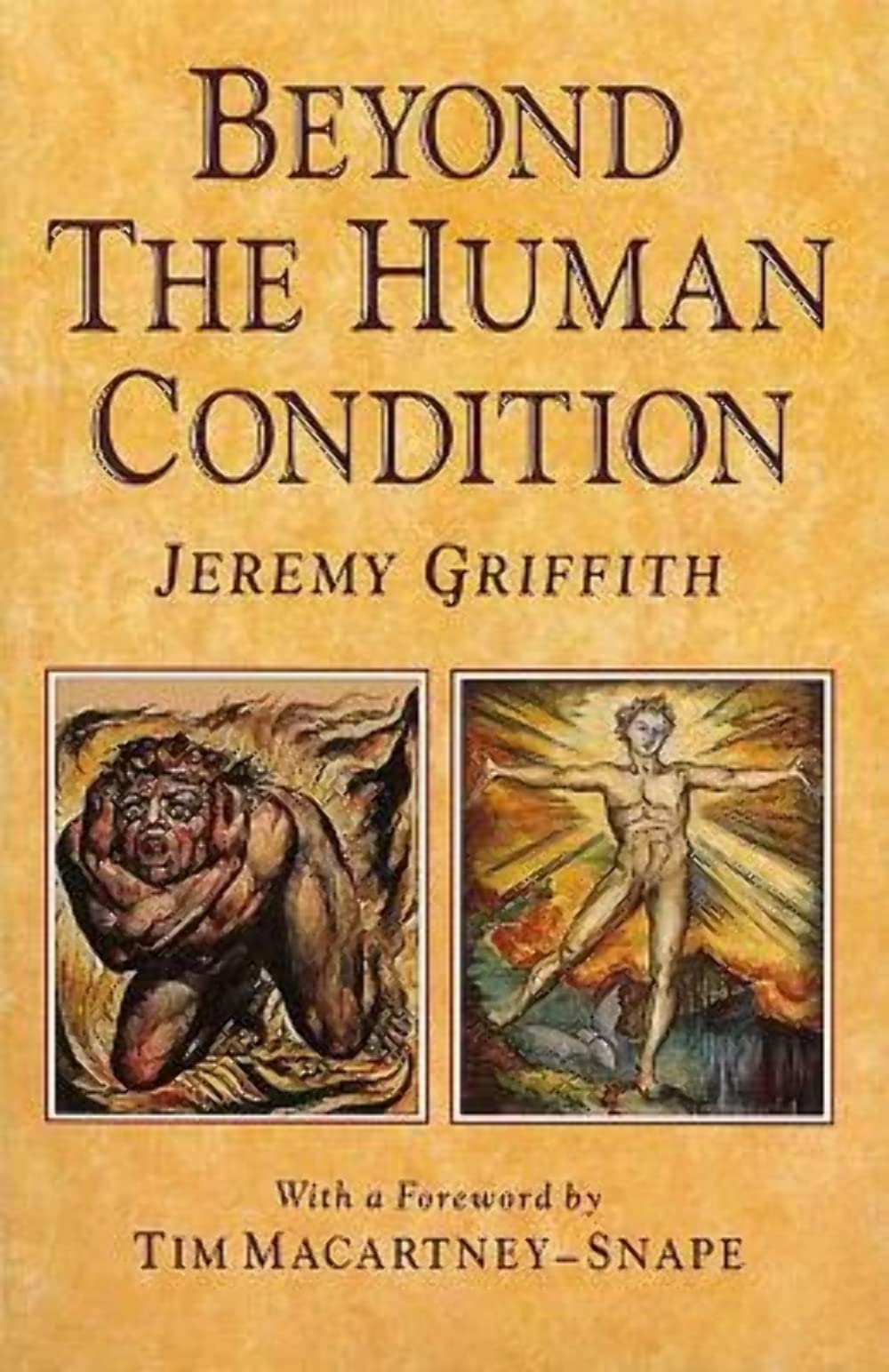



Beyond The Human Condition (1991) is Jeremy Griffith 's second book. In it, he gives a detailed account of the biology underpinning his explanation of the human condition. Beyond examines issues such as science & religion, politics and psychiatry. Griffiths treatise defends and dignifies humans, it lifts the burden of guilt, making possible our species psychological rehabilitation. With a Foreword by twice-honoured Order of Australia recipient and renowned mountaineer Tim Macartney-Snape AM OAM, who says of the book: "Griffiths explanations have clarified so much that was inexplicable about myself and what goes on in the world. It is like having mist lift from country you've never seen in clear weather. This book could well have as much impact on humanity as the Bible." 'These writings in many ways further basic evolutionary concepts and thus are seen by some as controversial, but the majority of scientists, anthropologists and sociologists whom I know to have considered these works have become very excited...the scientific validity of Mr Griffith's work is supported in every way possible, from archaeology, primatology, genetics and evolutionary facts...In my opinion, Mr Griffith's work is of the highest scientific merit.' -- Dr Harry Prosen , Professor of psychiatry and former President of the Canadian Psychiatric Association 'On 29 Sept 1992, Jeremy Griffith presented his new book, Beyond The Human Condition, at a special Kenya Museum Society lecture. Once in a long while you come across an "aha" book. Every few pages of Jeremy Griffith's biological synthesis of human behaviour stretching back millions of years, I found myself, a scientific layman, saying, "aha, that makes sense!"' -- Doug Rigby , Swara, East African Wildlife Society magazine 'I found Beyond interesting and logical but there is much to think about.' -- Professor Shirley Strum , Professor of Anthropology at San Diego University 'It is your [the listeners'] responsibility as citizens to read Beyond The Human Condition.' -- Brian Carlton (Spoonman), Australian radio personality ' 'Mr Griffith's work is extraordinarily insightful and I am quite pleased to have the benefit of his wisdom.' -- James Balog , an award-winning photographer for National Geographic magazine 'I too have always been puzzled by the innate cruelty that seems to be incorporated in much of human nature, particularly in our dealings with the other creatures of the earth. I commend you for probing this phenomenon.' -- Daphne Sheldrick , renowned African conservationist and founder of the David Sheldrick Wildlife Trust, Nairobi '...It is a book which touches the core of our existence, probing and forcing the reader to address the human condition--why we are who we are. Highly recommended for those who choose to ask that question.' -- Elaine Briggs , Portfolio, Executive women's magazine 'Your book is certainly thought-provoking and will no doubt be the subject of much debate within the scientific and general communities. My congratulations.' -- R. J. L. Hawke , Prime Minister of Australia 'Fortunately, there are also some thinkers of such stature that their thoughts may genuinely change the way of the world. With his new book Jeremy Griffith is seeking to join these ranks...like many significant works, it [Beyond] prompts responses from the reader like "why didn't I think of that?"...It is a bold and inspiring work.' -- Mark Thornton , The West Australian newspaper ‘Beyond…contains an interesting and thoughtful combination of materials and I hope it will be successful and widely read.’ -- Professor Adrienne Zihlman , Professor of Anthropology at UCLA Santa Cruz (15 Jan 1992) ‘[Griffith] gives us a genuinely original and inspiring way of understanding ourselves and our place in the universe.’ -- Professor Charles Birch , Templeton-prize winner and world-renowned biologist This book is dedicated to the vision of Sir Laurens van der Post: '... for I had a private hope of the utmost importance to me. The Bushman's physical shape combined those of a child and a man: I surmised that examination of his inner life might reveal a pattern which reconciled the spiritual opposites in the human being and made him whole ... it might start the first movement towards a reconciliation.' Laurens van der Post, The Heart of the Hunter, 1961. And that of Sir James Darling who acknowledged that: '...the future lies not with the predatory and the immune but with the sensitive who live dangerously...the truly sensitive mind is both susceptible and penetrating: it is open to new ideas, and it seeks truth at the bottom of the well. It is the development of this sort of mind which it should be the object of the educational process to cultivate.' James Darling, The Education of a Civilized Man , 1962. And that of Dr Louis Leakey who believed: '... that knowledge of the past would help us to understand and possibly control the future.'