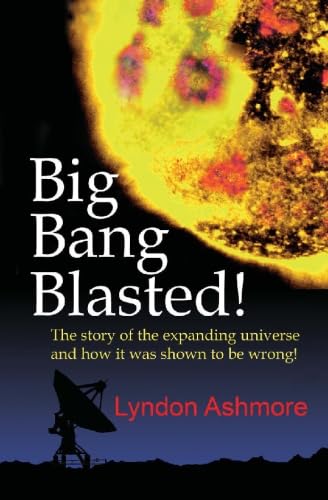



The story of the expanding universe and how it was shown to be wrong! Is the Universe really expanding? When the Big Bang Theory was first conceived it looked good - but since then, result after result has gone against the theory. Instead of rejecting the model, as we are told 'real Science' should do, mainstream scientists have continued to invent patch after patch in a bid to save it - but in doing so, the theory has lost its experimental support. What the author has done here is to go back to the beginning and start again. He follows the history of the Big Bang and the characters involved - explaining at every step how it was done. He then introduces 'Ashmore's Paradox' and shows that after all these years of searching for the Hubble constant, all they ended up with was something any schoolchild could have found by recalling three very common physical constants from their calculator memory! Lyndon explains that redshift - originally thought to show that the Universe is expanding, is just an effect caused by photons travelling through space and losing energy to electrons. From this, he goes on to explain the CMB and other observations normally associated with an expanding Universe. Lyndon Ashmore is a Physics teacher. He has an honours degree in Physics from the University of York (specialising in theoretical Physics) and an M. Phil research degree from what is now the University of Central Lancashire. His research project was in solid state Physics (solar cell technology in particular) and it was when he applied these laws of Physics to the Universe that he realised that observations normally associated with an expanding Universe could be better explained by the Physics of light interacting with matter. In particular this led to him showing that the important cosmological constant, the 'Hubble constant,' is just a combination of three well known constants found on any schoolchild's calculator - Ashmore's Paradox. In the Summer of 2006, the theory itself - in the form of a scientific paper, was published in the peer reviewed scientific journal "Galilean Electrodynamics."