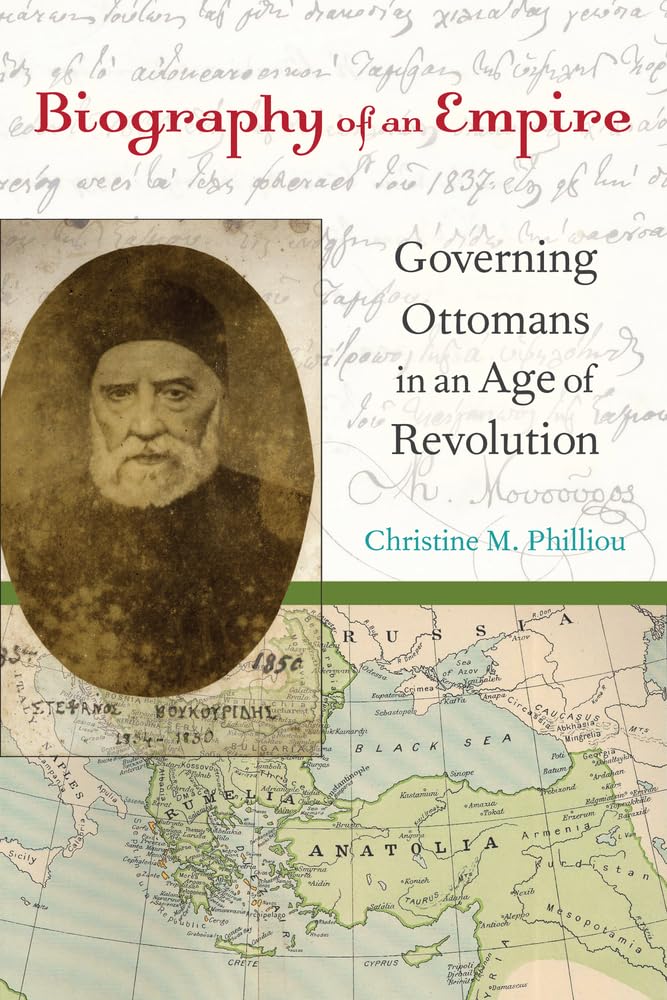
Biography of an Empire: Governing Ottomans in an Age of Revolution
$29.95
by Christine M. Philliou



This vividly detailed revisionist history opens a new vista on the great Ottoman Empire in the early nineteenth century, a key period often seen as the eve of Tanzimat westernizing reforms and the beginning of three distinct histories―ethnic nationalism in the Balkans, imperial modernization from Istanbul, and European colonialism in the Middle East. Christine Philliou brilliantly shines a new light on imperial crisis and change in the 1820s and 1830s by unearthing the life of one man. Stephanos Vogorides (1780–1859) was part of a network of Christian elites known phanariots, institutionally excluded from power yet intimately bound up with Ottoman governance. By tracing the contours of the wide-ranging networks―crossing ethnic, religious, and institutional boundaries―in which the phanariots moved, Philliou provides a unique view of Ottoman power and, ultimately, of the Ottoman legacies in the Middle East and Balkans today. What emerges is a wide-angled analysis of governance as a lived experience at a moment in which there was no clear blueprint for power. “In terms of its scholarship, there is no doubt that this is an excellent,groundbreaking work. Not only will it quickly become the standard reference for any further study of the Phanariots, but it should also be essential reading for any historian of the Late Ottoman Empire and its successor states in the Balkans and Middle East.” ― International Journal of Turkish Studies “Highly recommended to scholars concerned with theoretical questions of identity, agency, and the eclipse of the past through the constructions of the present.” ― Journal of Interdisciplinary History “Imaginative. . . . Philliou’s prose is masterful, and her command over diverse sources, primary and secondary, is exceptional. Biography of an Empire i s an original and substantial contribution to late Ottoman history.” ― The Historian Christine M. Philliou is Assistant Professor of History at Columbia University. Biography of an Empire Governing Ottomans in an Age of Revolution By Christine M. Philliou UNIVERSITY OF CALIFORNIA PRESS Copyright © 2011 The Regents of the University of California All rights reserved. ISBN: 978-0-520-26635-3 Contents List of Illustrations, ix, Note on Transliteration, xi, Preface: The View from the Edge of the Center, xvii, Stephanos Vogorides' Apologia, November 1852, 1, 1. The Houses of Phanar, 5, Biography of an Empire I: Becoming, 38, 2. Volatile Synthesis, 41, Biography of an Empire II: New Orders, 61, 3. Demolitions, 65, Biography of an Empire III: Threads, 82, 4. Phanariot Remodeling and the Struggle for Continuity, 85, Biography of an Empire IV: Persistence and the Old Regime, 105, 5. Diplomacy and the Restoration of a New Order, 107, Biography of an Empire V: The Second Ascendancy: Prince Vogorides, Also Known as Istefanaki Bey, 136, 6. In the Eye of the Storm, 152, Afterlives, 170, Appendix A: Genealogies of the Vogorides, Musurus, and Aristarchi Families, 177, Appendix B: Phanariot Dignitaries in the Four High Offices of Dragoman (Grand Dragoman; Dragoman of the Fleet) and Voyvoda (of Wallachia and Moldavia), 1661–1821, 183, Notes, 187, Bibliography, 243, Acknowledgments, 265, Index, 269, CHAPTER 1 The Houses of Phanar It was with difficulty that I could collect my scattered senses when the time came to step into the nut-shell, all azure and gold, which waited to convey the [dragoman]'s suite to the [Phanar].... Each stroke of the oar, after we had pushed off from the ship, made our light caick [T. kayik ] glide by some new palace, more splendid than that which preceded it; and every fresh edifice I beheld, grander in its appearance than the former, was immediately set down in my mind as my master's habitation. I began to feel uneasy when I perceived that we had passed the handsomest district, and we were advancing toward a less showy quarter. My pangs increased as we were made to step ashore on a mean-looking quay, and to turn into a narrow, dirty lane; and I attained the acme of my dismay, when, arrived opposite a house of a dark and dingy hue, apparently crumbling to pieces with age and neglect, I was told that there lived the [phanariot] lord.... A new surprise awaited me within. That mean fir-wood case, of such forbidding exterior, contained rooms furnished in all the splendor of eastern magnificence. Persian carpets covered the floors, Genoa velvets clothed the walls, and gilt trellis work overcast the lofty ceilings. Clouds of rich perfumes rose on all sides from silver censers.... The persons of [phanariot] grandees were of a piece with their habitations. Within doors, sinking under the weight of rich furs, costly shawls, jewels, and trinkets, they went forth into the streets wrapped in coarse, and dingy, and often thread-bare clothing. Orientalist hyperbole aside, phanariots were engaged in a paradoxical imperial enterprise from the late seventeenth century until 1821. They