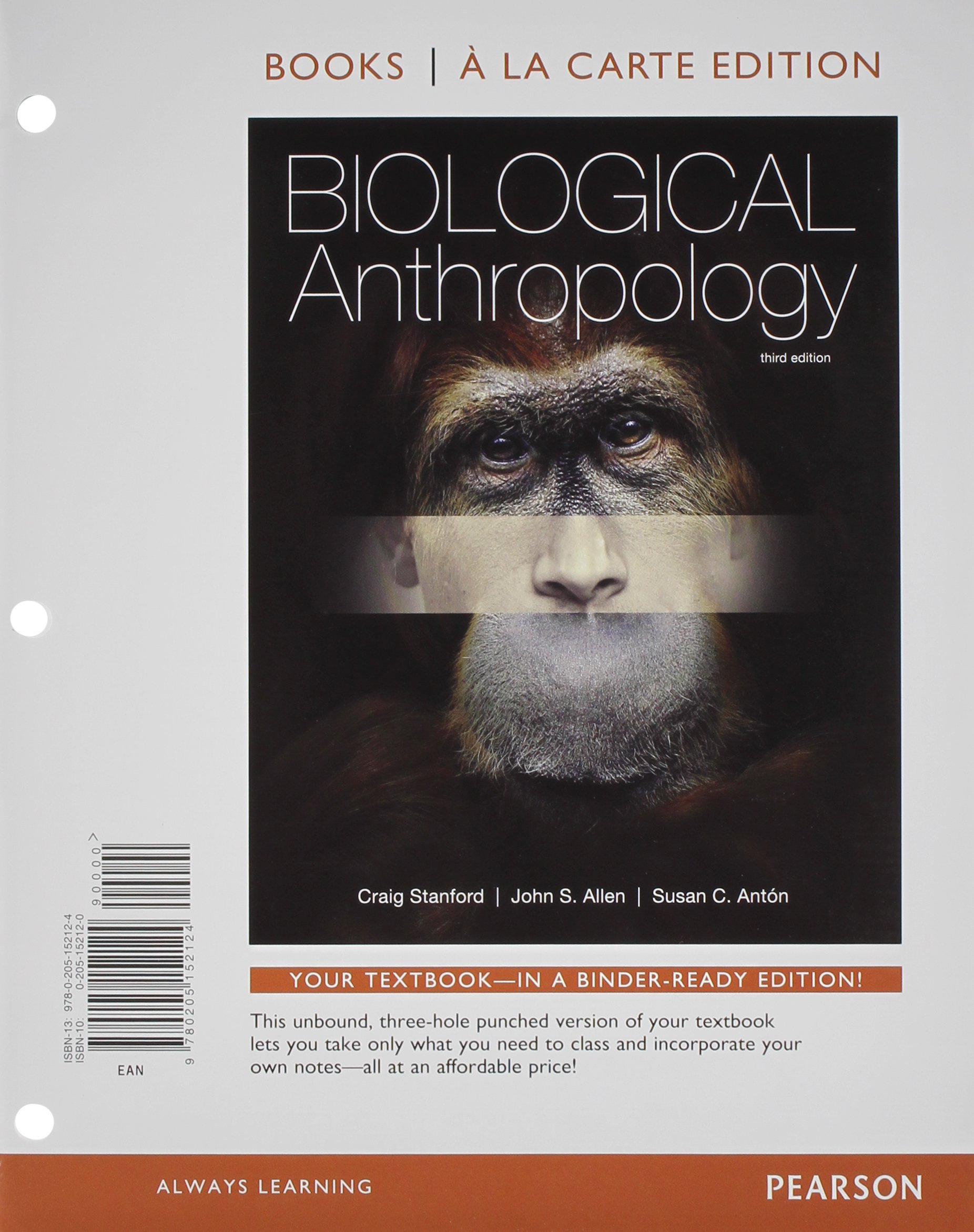



Biological Anthropology, Books a la Carte Plus MyAnthroLab with eText -- Access Card Package “The material and issues included are terrific - I could even say of all of the texts on the market, this book is the most appropriate and includes the most interesting material and topics. It's really innovative in this area.” Professor Mary Willis, University of Nebraska — Lincoln “It is evident that the authors have written this text after their experiences of teaching an introductory course, it appears they definitely had students' interests in mind when developing this text.” Professor Kathleen Rizzo, University of Illinois — Chicago “The examples make the material "real" for the students, rather than memorizing dry definitions.” Professor Samantha Hens, University of California Sacramento In This Section: I. Author Bio II. Author Letter I. Author Bio Follow Us On Twitter: @BioAnthroSAA Craig Stanford is a professor of anthropology and biological sciences at the University of Southern California, where he also directs the Jane Goodall Research Center. He has conducted field research on primate behavior in south Asia, Latin America, and East Africa. He is well known for his long-term studies of meat-eating among wild chimpanzees in Gombe, Tanzania, and of the relationship between mountain gorillas and chimpanzees in the Impenetrable Forest of Uganda. He has authored or coauthored more than 120 scientific publications. Craig has received USC’s highest teaching awards for his introductory biological anthropology course. In addition, he has published eleven books on primate behavior and human origins, including Significant Others (2001), Upright (2003) and Beautiful Minds (2008). He and his wife, Erin Moore, a cultural anthropologist at USC, live in South Pasadena, California, and have three children. John Allen is a research scientist in the Dornsife Cognitive Neuroscience Imaging Center and the Brain and Creativity Institute at the University of Southern California. Previously, he was a neuroscience researcher at the University of Iowa College of Medicine and a faculty member in the Department of Anthropology at the University of Auckland, New Zealand, for several years. His primary research interests are the evolution of the human brain and behavior, and behavioral disease. He also has research experience in molecular genetics, nutritional anthropology, and the history of anthropology. He has conducted fieldwork in Japan, New Zealand, Papua New Guinea, and Palau. He has received university awards for teaching introductory courses in biological anthropology both as a graduate student instructor at the University of California and as a faculty member at the University of Auckland. In addition to BiologicalAnthropology , he is also the author of Medical Anthropology: A Biocultural Approach (with Andrea S. Wiley; 2009) and The Lives of the Brain (2009). John and his wife, Stephanie Sheffield, have two sons, Reid and Perry. Susan Antón is a professor in the Center for the Study of Human Origins, Department of Anthropology at New York University, where she also directs the M.A. program in Human Skeletal Biology. Her field research concerns the evolution of genus Homo in Indonesia and human impact on island ecosystems in the South Pacific. She is best known for her work on H. erectus in Kenya and Indonesia, for which she was elected as a fellow of the American Association for the Advancement of Science (AAAS) in 2008. She is past editor of the Journal of Human Evolution. She received awards for teaching as a graduate student instructor of introductory physical anthropology and anatomy at the University of California, was Teacher of the Year while at the University of Florida, and a Golden Dozen teaching award recipient at NYU. She has been twice elected to Who’s Who Among America’s Teachers . Susan and her husband, Carl Swisher, a geochronologist, raise Anatolian shepherd dogs. II. Author Letter Dear Colleague, It is our pleasure to be able to bring you the third edition of our textbook Biological anthropology: the natural history of humankind.We are writing to you to share some highlights from the new edition. We have done our best to keep the book comprehensive, cutting edge, and accessibly readable. Over the past three years, new fossil discoveries, new revelations about primate behavior, and new breakthroughs in molecular biology have made an update of our previous edition essential. As always, we have endeavored to provide students and instructors with the very best coverage of these issues, and also the best photographs and images available. We believe that Biological anthropology offers you an outstanding choice in its comprehensive coverage of topics as well as its clarity, originality, critical-thinking approach, and presentation of beautifully done artwork and photography. All the traditional topics covered in other introductory biological anthropology texts are cover