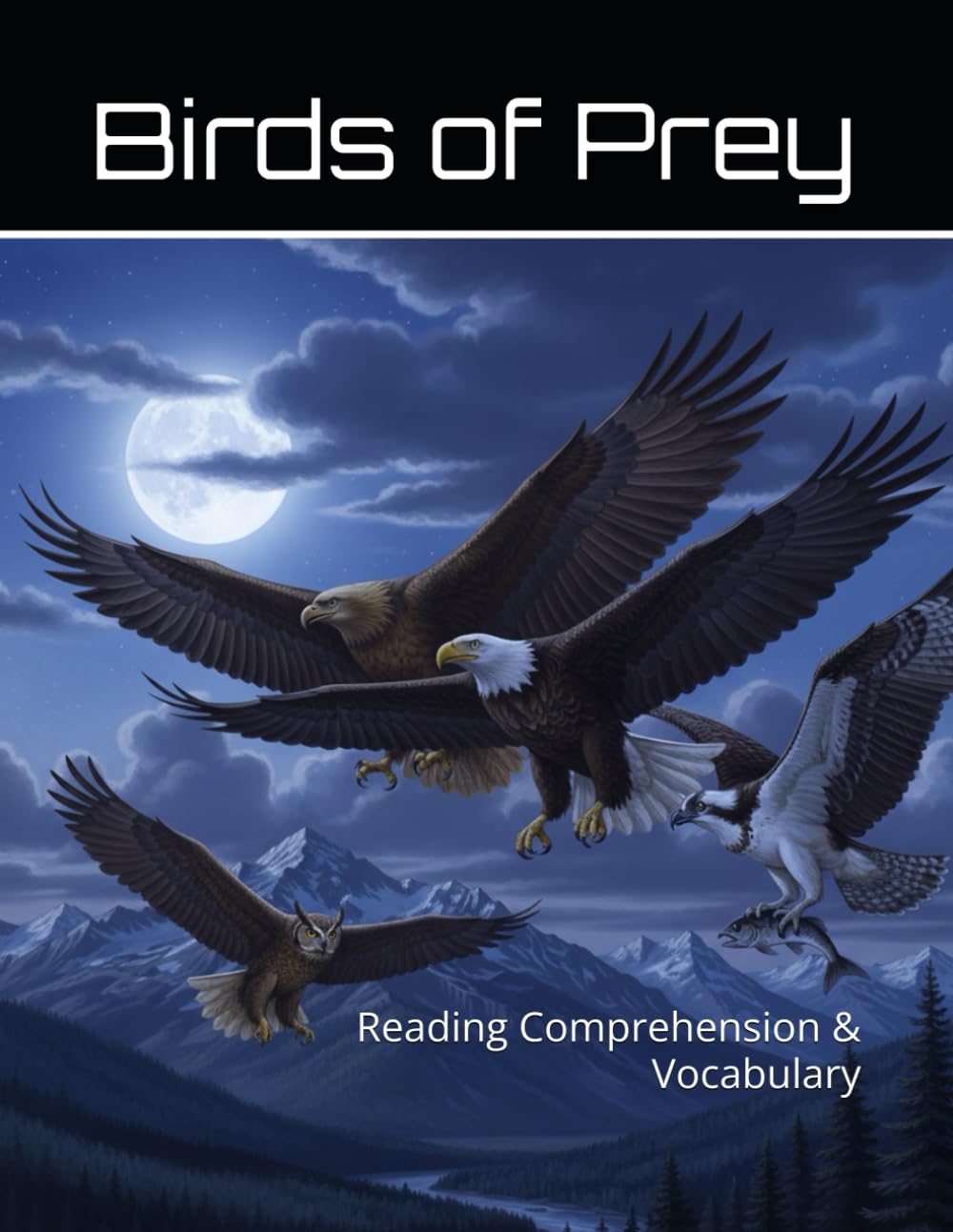
Birds of Prey Workbook: Reading Comprehension & Vocabulary (Reading Comprehension & Vocabulary Workbook)
$17.50
by Academic LInks



These articles on birds of prey are designed to make learning about nature engaging while supporting reading and comprehension skills. Each article is about 630 words, written in short, clear paragraphs, and includes five bold vocabulary words with context clues to help students learn new terms naturally. Embedded questions after each section encourage active reading, recall, and critical thinking. For general education students, the articles provide rich content that builds vocabulary, understanding of text, and knowledge about wildlife. Students with ADHD benefit from the structured format, chunked text, and frequent questions, which help maintain focus and engagement. Struggling readers gain from the clear sentences, repeated key ideas, and guided questions, improving comprehension and confidence. Special education students also benefit because the articles break information into manageable pieces, provide visual cues through bold words, and allow practice in reading, answering questions, and connecting ideas. Overall, these articles make learning accessible, interactive, and motivating for a wide range of learners. Assignments Included: Bald Eagle – A symbol of the United States, known for its white head and powerful hunting skills. Golden Eagle – A large raptor with impressive speed and sharp talons, often hunting mammals. Peregrine Falcon – The fastest bird in the world, capable of diving at over 200 mph to catch prey. Red-tailed Hawk – Common in North America, recognized by its reddish-brown tail and soaring flight. Osprey – A fish-eating bird of prey with reversible toes for gripping slippery fish. Harpy Eagle – One of the largest and strongest eagles, with massive talons to hunt monkeys and sloths. Snowy Owl – A striking white owl adapted to Arctic regions, hunting primarily at night. Barn Owl – Known for its heart-shaped face and silent flight while hunting rodents. Great Horned Owl – A powerful owl with tufts resembling horns, capable of hunting a wide variety of prey. Eurasian Eagle-Owl – One of the largest owls, with piercing orange eyes and strong hunting abilities. Cooper’s Hawk – A medium-sized hawk that uses speed and agility to hunt smaller birds. Sharp-shinned Hawk – The smallest North American hawk, known for quick, precise attacks. Red-shouldered Hawk – A forest-dwelling hawk with distinctive rufous shoulders and loud calls. Kestrel – A small falcon that hovers in the air while scanning for prey. Secretary Bird – A tall, long-legged raptor from Africa that hunts snakes and other ground prey. Gyrfalcon – The largest falcon, adapted to Arctic regions with incredible hunting power. Northern Harrier – Recognizable by its low, gliding flight over fields and marshes. Swallow-tailed Kite – A graceful raptor with a distinctive forked tail, feeding on insects and small animals. Martial Eagle – Africa’s largest eagle, capable of hunting large mammals like antelopes. Black Kite – A widespread scavenger and hunter, often seen soaring near human settlements. Condor – A massive bird of prey found in South America with broad wings that allow it to soar high over mountains and valleys. Albatross – A large sea bird known for gliding over oceans for days using its long, graceful wings. Vulture – A scavenging bird that feeds on animal remains and helps keep the environment clean.