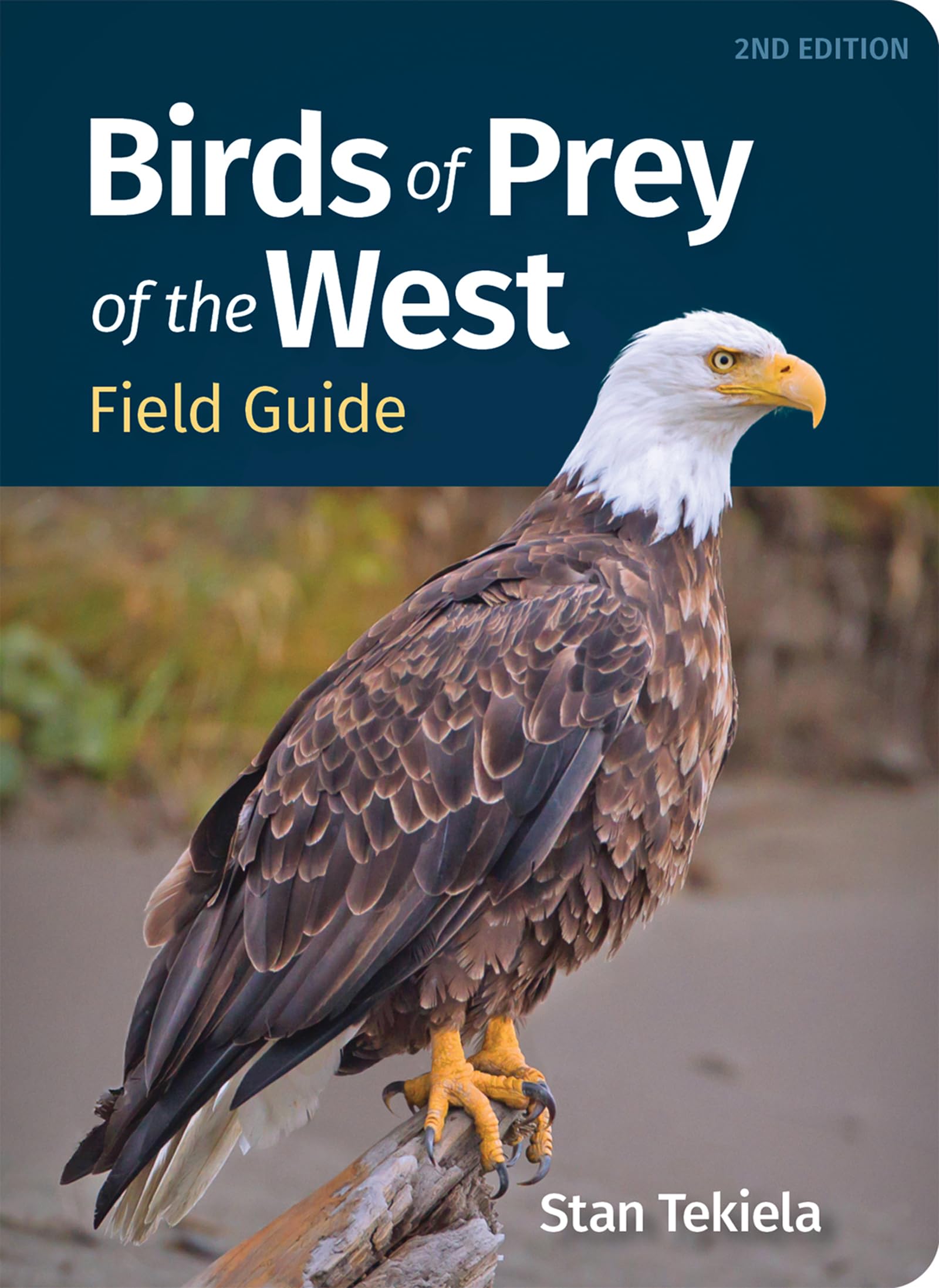



Identify raptors in the western United States with this easy-to-use field guide, organized by group and featuring full-color photographs and helpful information. Make birdwatching even more enjoyable. With Stan Tekiela’s famous field guide, raptor identification is simple and informative. There’s no need to look through dozens of photos of birds that don’t live in your area. The Birds of Prey of the West Field Guide features 47 species—every type of raptor found in the region. For ease of use, the guide is organized by group: eagles, falcons, hawks, kites, osprey, owls, and vultures. When you see a bird of prey, you can determine its group by common visual characteristics. Then turn to the corresponding section to find out what it is! This second edition includes updated photographs and range maps, expanded information, and even more of Stan’s expert insights. So grab the Birds of Prey of the West Field Guide for your next birding adventure—to help ensure that you positively identify the raptors you see in Alaska, Arizona, California, Colorado, Idaho, Montana, Nevada, New Mexico, Oregon, Utah, Washington, and Wyoming. Inside you’ll find: Only raptors of the region: every species found in the West - Simple organization: identify species by group and then by size - Quick-compare section: sketches, silhouettes, and photos for side-by-side comparisons - Stan’s Notes: naturalist tidbits and facts - Professional photos: crisp, stunning images Naturalist, wildlife photographer, and writer Stan Tekiela is the author of more than 190 field guides, nature books, children’s books, and playing cards, presenting many species of birds, mammals, reptiles, amphibians, trees, wildflowers, and cacti in the United States. With a Bachelor of Science degree in Natural History from the University of Minnesota and as an active professional naturalist for more than 30 years, Stan studies and photographs wildlife throughout the United States and Canada. He has received various national and regional awards for his books and photographs. Also a well-known columnist and radio personality, his syndicated column appears in more than 25 newspapers and his wildlife programs are broadcast on a number of Midwest radio stations. Barn Owl Tyto alba Family: Owls (Tytonidae) Size: L 16-19" (40-48 cm); WS 3-3.5' (.9-1.1 m) Weight: 1-1.25 lb. (.5-.6 kg) Male: A non-eared owl. Rusty tan on the back of head, back, wings, and tail. Heart-shaped white facial disk, outlined in darker rusty brown. White breast and belly with many scattered tiny dark marks. Dark eyes. Long gray legs and gray feet. Ivory bill. White wing linings. Female: slightly larger than male, with a rusty wash over a spotted breast and belly Juvenile: fuzzy-looking with light-gray-to-white plumage and a distinct heart-shaped face Habitat: farm fields, woods, cliffs, semi-wooded areas, suburban areas, prairies Food: mice and other small animals, birds, snakes Sounds: harsh hissing any time of year; female call is more quiet than the male; juvenile call is hoarser Compare: Easily identified by the white heart-shaped facial disk and dark eyes. The Snowy Owl (pg. 233) is much larger, has white plumage and lacks a heart-shaped face. Slightly larger than Short-eared Owl (pg. 213), which has a streaked chest and belly, dark marks around each eye and a less defined facial disk. Flight: long broad wings, rounded at the tip and cupped or bowed downward during flight; slow, shallow wing beats with silent flight Migration: non-migrator to partial; will congregate in groups during winter Nesting: cavity, in a man-made structure such as a barn, other outbuilding, or wooden nest box, occasionally in a tree cavity, cliff crevice, or small cave; 1 brood Eggs/Incubation: 3-7 white eggs; female incubates 30-34 days; male does the most hunting and feeds the nesting female before and after the young hatch Fledging: 52-56 days; male and female feed young; male does the majority of hunting and brings food to the female, who feeds the chicks; upon leaving the nest (fledging), the young continue to beg for food, at first waiting for the parents to bring food, then following them around to be fed; chicks learn to hunt by watching and copying their parents’ behavior, staying with them until the adults prepare for nesting again Stan’s Notes: Well known for nesting in old barns, but also nests in any dark cavity in trees or on cliffs. Readily takes to wooden nest boxes erected by people. Hunts by coursing over open areas after dark, looking and listening for small animals. Employs eyesight mainly, but can hunt in total darkness using its hearing alone. Will sway back and forth with head lowered when confronted. A good friend to farmers. One study showed that over the average 10-year life span of a typical Barn Owl, a single owl will consume approximately 11,000 mice. Based on the amount of food a mouse eats in a day, each year Barn Owls prevent roughly 13 tons of grain and crops from be