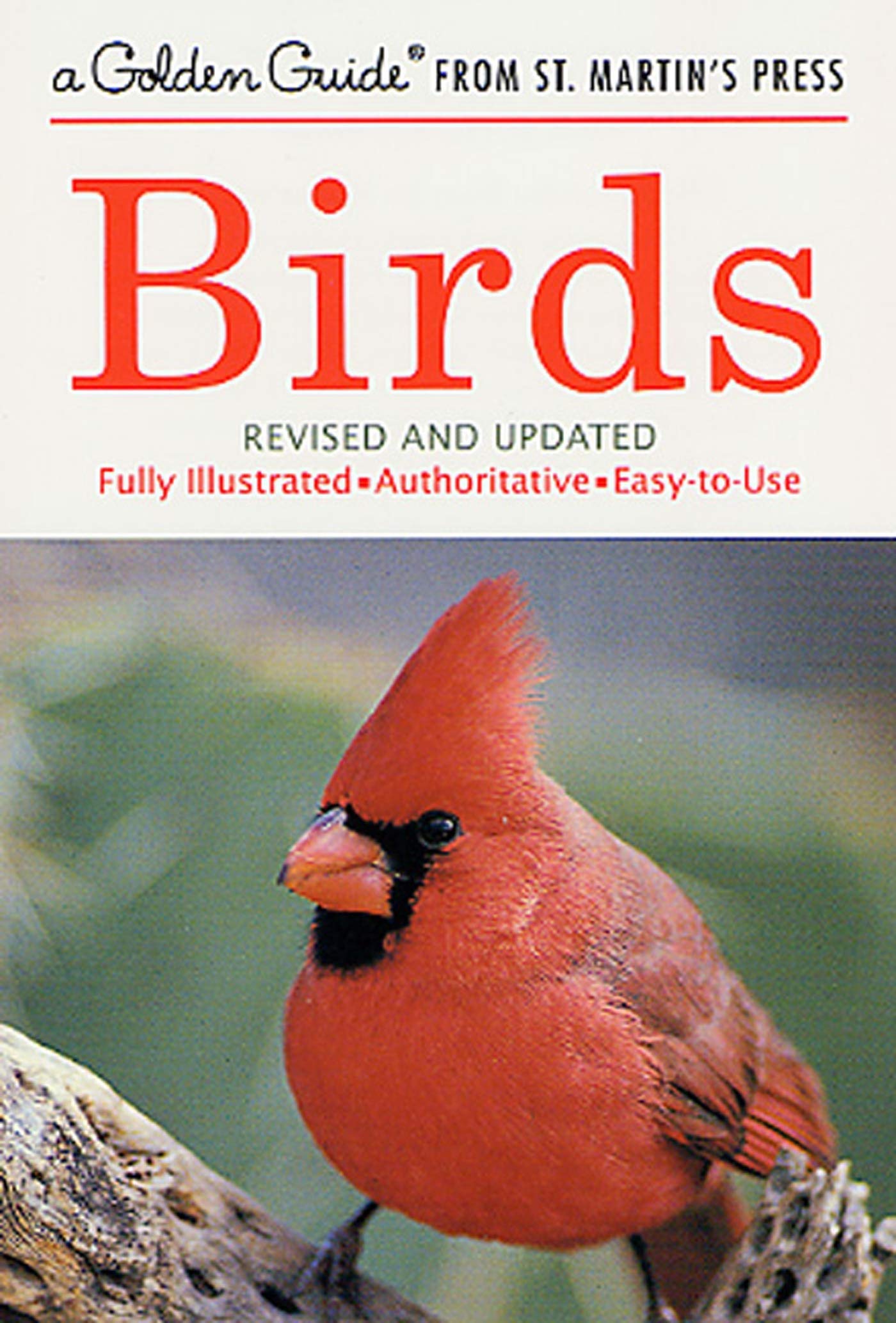
Birds: A Fully Illustrated, Authoritative and Easy-to-Use Guide (A Golden Guide from St. Martin's Press)
$7.83
by Herbert S. Zim



This guide will help you identify-quickly and easily-the birds you are most likely to see. It tells you: What to look for Where and when to look How to attract birds Range maps show where each bird is found, and handy tables at the back of the book contain a wealth of additional information about migration, eggs, nests, and food. This is the perfect bird book for beginners at any age. Herbert S. Zim was a naturalist, author, editor, and educator best known as the founder and editor in chief of the classic, pocket-sized Golden Guides series of nature books. Ira N.Gabrielson contributed to nature guides from Golden Guides and St. Martin's Press. Chandler S. Robbins contributed to nature guides from St. Martin's Press. James Gordon Irving contributed to nature guides from Golden Guides and St. Martin's Press. Birds A Guide to Familiar Birds of North America By Herbert S. Zim, Ira N. Gabrielson, James Gordon Irving St. Martin's Press Copyright © 2001 St. Martin's Press All rights reserved. ISBN: 978-1-58238-128-2 Contents Cover, Title Page, Foreword, How to Use This Book, How to Identify Birds, Parts of a Bird, Bird Classification, A Family Tree of Birds, Adaptations of Birds, Attracting Birds, Birds, Warblers, Sparrows, Migrations of Birds, The Birds at a Glance, Aids for Birding, Index, Copyright, CHAPTER 1 HOW TO IDENTIFY BIRDS While some kinds of guides are arranged by color, bird guides are generally organized so that closely related species — those of similar shape and behavior — are together. Water birds appear first, followed by more primitive land birds; the true songbirds are last. You will quickly learn to sort unknown birds into major categories (called orders) such as herons, ducks, hawks, woodpeckers, and perching birds (see here). For water birds, note whether they wade, swim, or dive; for aerial feeders whether they constantly flap, soar, or hover. For all birds, look closely at the size and shape of their bill (here) and the shape and length of their tail. Compare the total length with that of some familiar species. Is it the size of a sparrow, a robin, or a crow? These characteristics will help place birds in the correct family. Field Marks The next step is to determine the species by looking for the presence or absence of wing bars, tail patterns, eye rings or eye stripes, and color patterns on the head or elsewhere. Is the back plain or streaked? Do the underparts have horizontal bars or longitudinal streaks? Behavior How a bird acts can also provide valuable clues. Does it walk or hop or run? Does it wag its tail? Does it catch insects on the wing like a swift or a swallow? Or does it repeatedly return to an exposed perch to eat insect prey like a flycatcher or a waxwing? Does it climb up a tree trunk like a woodpecker or climb head-down like a nuthatch? Does it eat berries like a thrush or an oriole, or probe in the ground for worms and grubs like a robin, blackbird, or starling? As a help, the principal foods of each species are listed here. EQUIPMENT There are ways to increase your enjoyment of birding — none of which involves much expense. This book is one way, for a guide book is an important tool. As you acquire experience, you will want more advanced books (see here). Rugged clothing, waterproof boots, and mosquito repellent are part of an experienced birder's equipment. Life List Many people keep a list of all the species they have seen, which is known as a life list. A pocket notebook will help you record detailed information, including the date and place you saw a bird. Over time this list will become a valuable tool for reminding you of what you have seen. Binoculars This is the most important and most expensive item of equipment. A good pair of binoculars is a precision tool and should be selected with care. The best glasses are made with prisms to reduce their size and weight. Weight is an important consideration because you will want to be able to hold your binoculars steady or wear them around your neck for long periods of time. The power of the glass tells you how much closer it will make a bird appear. Seen through 6× (6-power) glasses, a bird looks six times as close. Glasses of 6x to 8x are best. Remember, the higher the power, the more limited your field of vision. Glasses that admit the most light are also best. This depends on the width of the front lens (usually measured in millimeters). A 6 × 35 lens admits twice as much light as a 6 × 24. Lightweight 7 × 35 or 8 × 42 binoculars are excellent for birding. Some birders use 10 × 50 binoculars, but they tend to be heavy. Be sure to carefully test a pair of binoculars before you make your purchase. You'll want a comfortable pair that you can focus quickly. WHERE TO LOOK Birds are everywhere, but to see the most birds try looking in the best places — in moist woodlands or perhaps at the edge of a wooded swamp. Young scrubby woods are likely to have