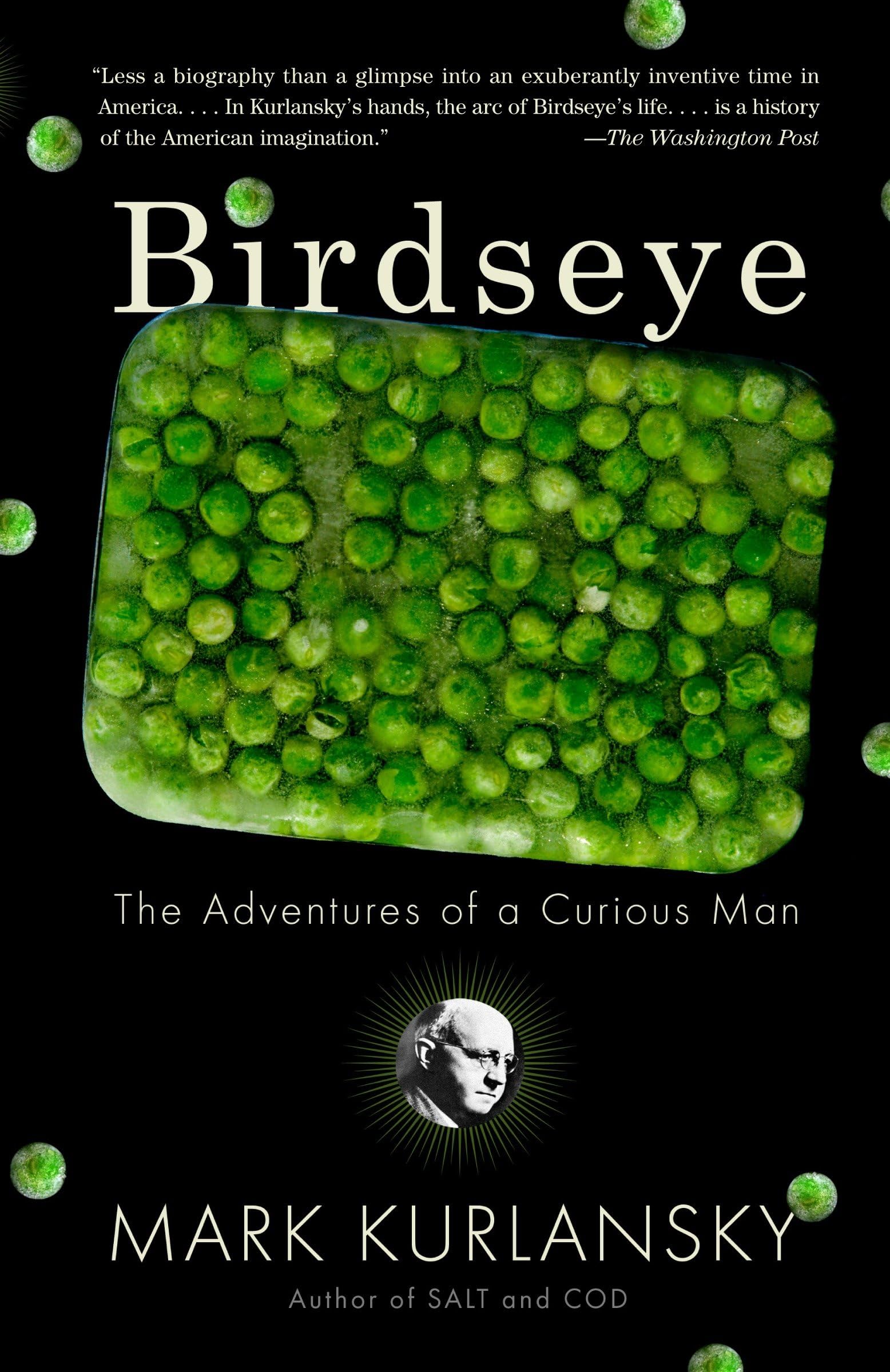



While working as a fur trapper in Labrador, Canada, Clarence Birdseye encountered an age-old problem: bad food and an unappealing, unhealthy diet. However, he observed that fresh vegetables wetted and left outside in the Arctic winds froze in a way that maintained their integrity after thawing. As a result, he developed his patented Birdseye freezing process and started the company that still bears his name. Birdseye forever changed the way we preserve, store, and distribute food, and the way we eat. Mark Kurlansky’s vibrant and affectionate narrative reveals Clarence Birdseye as a quintessential “can-do” American inventor—his other patents include an electric sunlamp, a harpoon gun to tag finback whales, and an improved incandescent lightbulb—and shows how the greatest of changes can come from the simplest of ideas and the unlikeliest of places. “Less a biography than a glimpse into an exuberantly inventive time in America. . . . In Kurlansky’s hands, the arc of Birdseye’s life . . . is a history of the American imagination.”— The Washington Post “[An] intriguing book that . . . coaxes readers to re-examine everyday miracles like frozen food, and to imagine where places with no indigenous produce would be without them.” — The New York Times “Kurlansky’s skilled narration ensures that each detail is salient to the central story of Birdseye and his inventions. . . . [and] reinvigorates the spirit of this most American of entrepreneurs.” — The Boston Globe “A lively . . . biography about one of America’s most unusual innovators.” — Newsday “A delight. . . . Fabulous factoids abound.” — The New York Times Book Review “The master of the food monograph . . . Kurlansky typically begins with a single natural resource and studies its broad impact on humankind. This book flips that model on its head by studying one extraordinary man and the effect of his innovations on a host of commodities. . . . Birdseye was, in his tastes, surprisingly in sync with today’s ethos of locavorism and nose-to-tail eating.” — Businessweek “A key ingredient in the success of Kurlansky’s biography is the mixture of Birdseye the modern man and Birdseye the throwback, who could not understand so much of contemporary society.” — The Houston Chronicle “Having just read Mark Kurlansky’s new biography of Clarence Birdseye, I now see the humble fish fillet in a whole new light. For as Kurlansky tells it, when Clarence Birdseye figured out how to pack and freeze haddock . . . he essentially changed the way we produce, preserve and distribute food forever.” —Alison Richards, The Salt, NPR “Kurlansky brings Birdseye to life. . . . Covering the science behind Birdseye’s . . . inventions along with intimate details of his family life, [he] skillfully weaves a fluid narrative of facts on products, packaging, and marketing into this rags-to-riches portrait of the man whose ingenuity brought revolutionary changes to 20th-century life.” — Publishers Weekly (starred) Mark Kurlansky is the New York Times bestselling author of many books, including The Food of a Younger Land , Cod: A Biography of the Fish That Changed the World , Salt: A World History , 1968: The Year That Rocked the World , and The Big Oyster: History on the Half Shell . He lives in New York City. Chapter 1 A Nineteenth-Century Man Clarence Frank Birdseye II was born in Brooklyn on December 9, 1886. Both the year and the place are significant. In 1886, Brooklyn was a separate city from Manhattan and, in fact, was the third-largest city in America and one of the fastest growing. Between 1880 and 1890 the population grew by more than a third to 806,343 people. One of the forces that made this dramatic growth possible in Brooklyn and neighboring Manhattan was refrigeration. Because of this new technology a large population could live in an area that produced no food but rather brought it in and stored it. Natural ice, collected in large blocks from the frozen lakes of New England and upstate New York, was stored in sawdust-insulated icehouses built along the Hudson that shipped all year long. New York City used more than one million tons of natural ice every year for food and drink. While the pleasure of iced drinks in the summer had been a luxury of the wealthy ever since Roman times, in New York at the time of Birdseye’s birth it had become commonplace. Almost half of all New Yorkers, Manhattanites and Brooklynites, kept food in their homes in iceboxes—insulated boxes chilled by blocks of natural ice. A few even had artificially chilled refrigerators, dangerous, clumsy electric machines with unpredictable motors and leaking fluids. No place else in the world was using this much ice. Birdseye was born into a world of refrigeration and would find it lacking when he left the New York City area. It was one of those things that New Yorkers took for granted. People are mostly formed over their first dozen years; Birdseye, having been born in 1886, was a