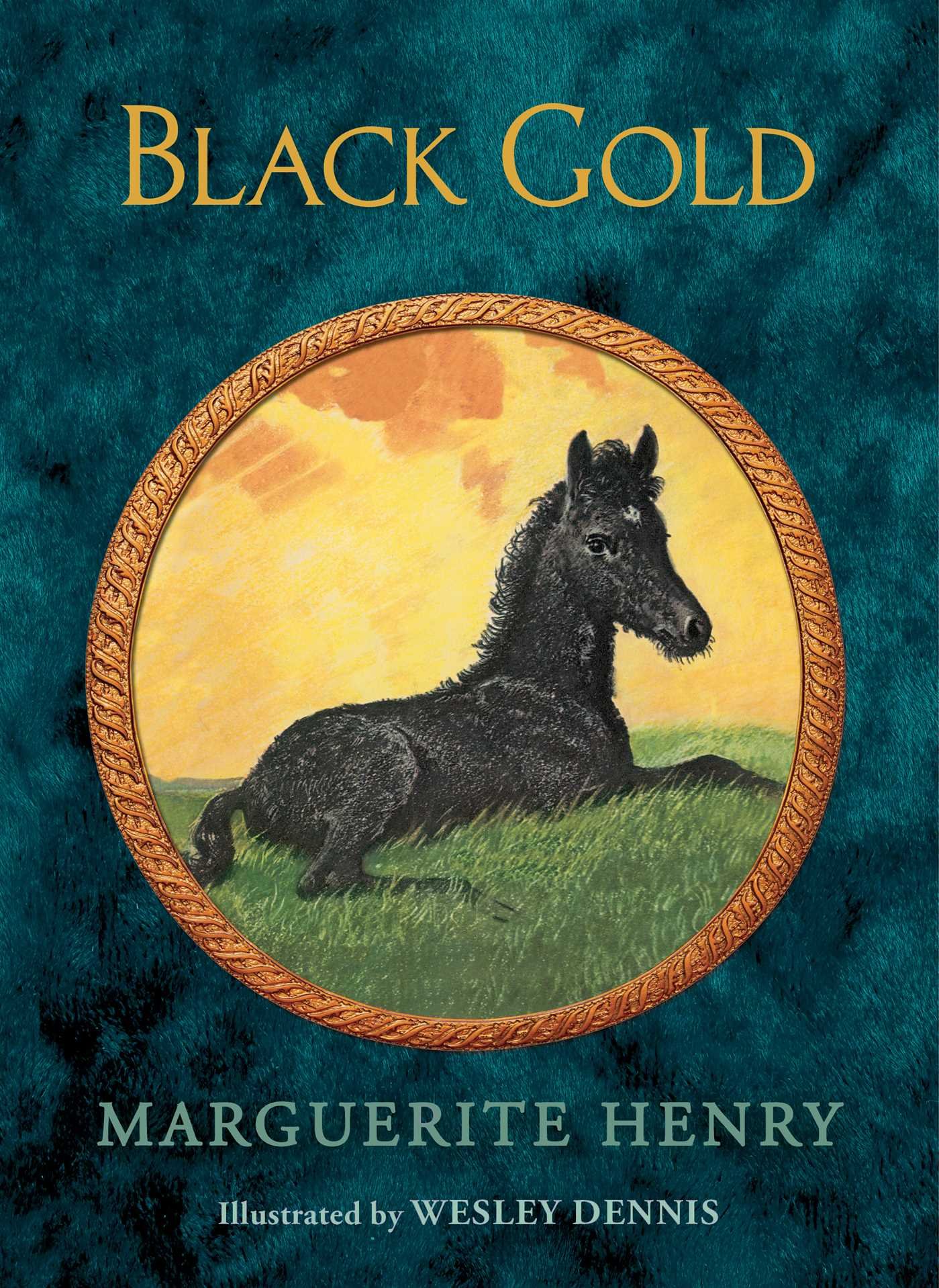



Newbery Award–winning author Marguerite Henry’s beloved novel about a legendary horse and his determined jockey is now available in a collectible hardcover gift edition. No one thinks much of Black Gold because he is so small. But Jaydee sees something special in his eyes. He knows that Black Gold would be a winner if only he were the horse’s rider! Finally, Jaydee gets his wish, and Black Gold grows strong and fast under his careful hands. Soon it will be time for the most important race in America. Do they have what it takes to win? Black Gold’s inspirational story proves that the power of love and dedication can make any dream come true. Set amidst the thrilling and colorful world of Thoroughbred horses, this classic equestrian tale from Newbery Award–winning author Marguerite Henry features the original text and illustrations in a gorgeous collectible hardcover edition. Marguerite Henry (1902–1997) was the beloved author of such classic horse stories as King of the Wind , Misty of Chincoteague , and Stormy, Misty’s Foal , and her work has won several Newbery Awards and Honors. Wesley Dennis was best known for his illustrations in collaboration with author Marguerite Henry. They published sixteen books together. Black Gold 1. A Haunt in the Wind THE MORNING is fair and filled with the smells of spring. It is the year 1909, and the young Indian community of Chickasha, in the new state of Oklahoma, is stirring with excitement. The day of the long-postponed race has come at last—the match race between the big-striding Missouri mare, Belle Thompson, and an untried filly named U-see-it. The time of year is May, and already the bluestem grass is nearly stirrup high. On either side of the Chisholm Trail it ripples across the broad grazing grounds on its way to meet the sky. On this clear spring morning the wind is livelier than usual, swirling the grasses into sea-green whirlpools, now pale, now dark. Quail scuttle and bob along, making whispers in the grass. And wild turkeys fly above the fields, squawking their praise to the morning. Today the old Chisholm Trail has suddenly come to life. The dust that had settled when the new railroad was built is boiling and billowing again. But it is a different kind of dust, not a steady-flowing cloud as in the days when steers slow-footed their way from Texas to the corn belt in Kansas. Today there are joyous spurts of dust caused by quick-stepping horses pulling buggies, spring wagons, runabouts, surreys, and even shiny hearses with dark-eyed Indian children peeking out the windows. People from everywhere—from Comanche, from Empire City, and as far away as Red River Station—are on their way to a full day of merrymaking. They are hard-working farmers and grocers, butchers and printers and carpenters who need a holiday. Their women have vied with each other in preparing hampers of fried chicken and apple and berry pies. The children have been up since long before dawn, grooming the horses, doing their chores in double-quick time, singing as they worked: “Hook up, hook up the one-hoss shay, And away we’ll go to Chickasha!” By midmorning the trail is alive with horses trotting, wheels rumbling, people shouting—all moving toward the neat half-mile track in Chickasha. Right here the excitement begins. A long freight train comes chuffing by, smokestack belching, bell ringing. A few daring drivers try to race the train, their horses wild with fright, snorting, rearing up on their hind legs. The engineer, leaning out his window, toots his whistle and laughs to see the horses bolt like scalded cats. As the trail nears the town, excitement mounts. Wags of Indians come streaming in to join the procession. At the helm of each wagon sits an Indian brave, tall and solemn; behind him his squaw and children, bright-eyed. They have just left the government warehouse, where new farm implements were being parceled out—rakes and plows, discs and harrows. But today is the match race! Spring planting can wait! Now the trail takes a quirly turn and the whole parade is fanning out around the race course. Horses are blown, men and children calling to each other, women sighing in relief that the trip is safely made. In the more orderly activity near the track, two men are talking earnestly before an open shed. Within it stands the lone filly, U-see-it, still as a little wood carving. She is studying the two men with her big wide-set eyes, and they in turn are studying her. The shorter of the men is saying, “Far as I can see, Al, the postponement hasn’t done a thing for Halcomb’s U-see-it. He must’ve thought a little more time was all his filly needed, but,” he paused, “it don’t appear so to me! My Belle Thompson is fit as a fiddle, and knows how to run. Sort of embarrasses me to match her against this poor little greenhorn.” It is Ben Jones speaking, young Ben Jones who has a knack of getting speed out of his horses. The other man is Al Hoots—tall, dark-e