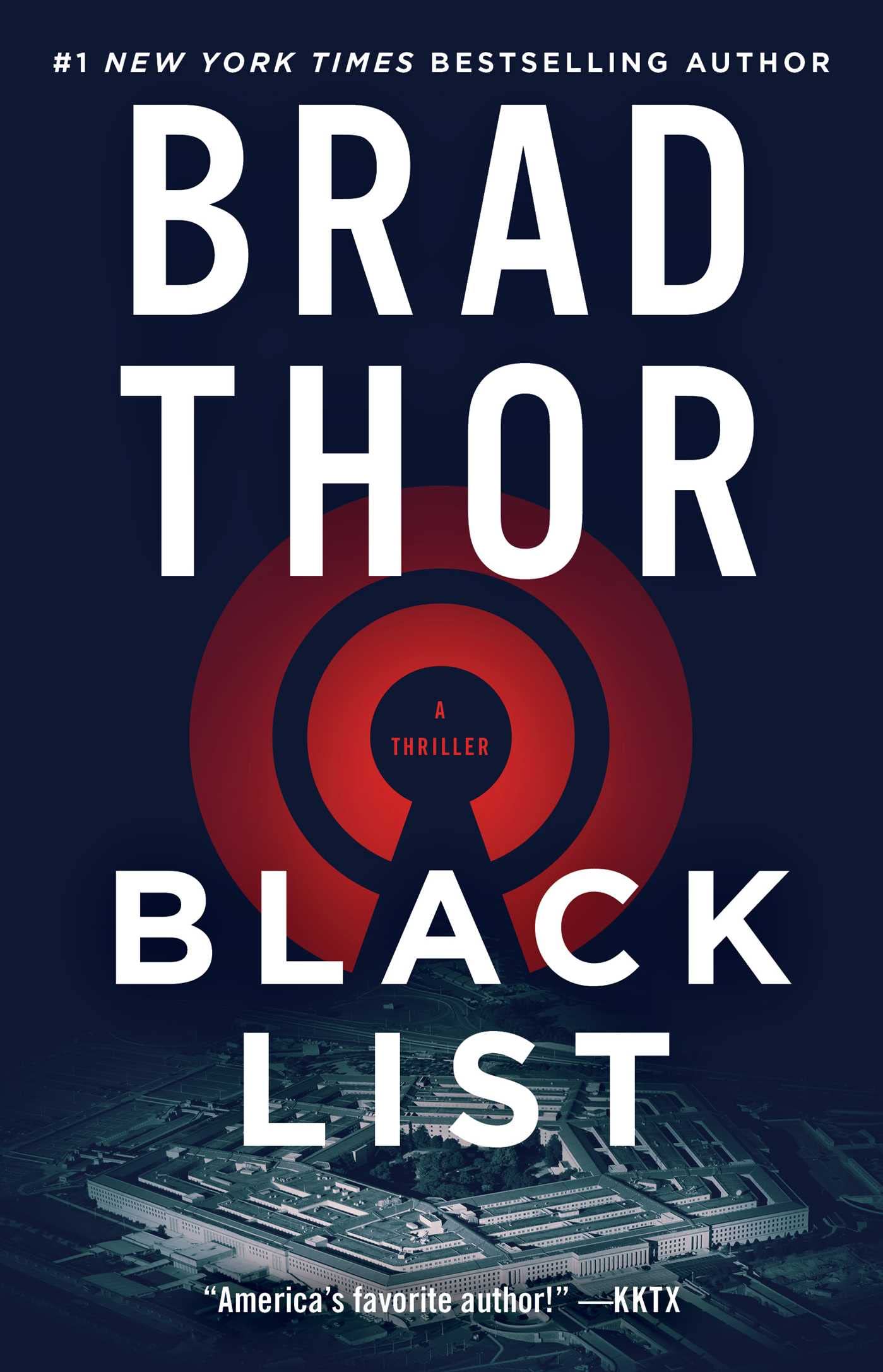



#1 New York Times and #1 Wall Street Journal bestselling author Brad Thor returns with his most explosive thriller ever. Somewhere deep inside the United States government is a closely guarded list. Members of Congress never get to see it—only the President and a secret team of advisors. Once your name is on the list, it doesn’t come off…until you’re dead. Someone has just added counterterrorism operative Scot Harvath’s name. Somehow Harvath must evade the teams dispatched to kill him long enough to untangle who has targeted him and why they want him out of the way. Somehow, somewhere, someone can put all the pieces together. The only question is, will Harvath get to that person before the United States suffers the most withering terrorist attack ever conceived? Brad Thor is the #1 New York Times bestselling author of twenty-five thrillers, including Edge of Honor , Black Ice ( ThrillerFix Best Thriller of the Year), Near Dark (one of Suspense Magazine ’s Best Books of the Year), Backlash (nominated for the Barry Award for Best Thriller of the Year), Spymaster (“One of the all-time best thriller novels” — The Washington Times ), The Last Patriot (nominated Best Thriller of the Year by the International Thriller Writers association), and Blowback (one of the “Top 100 Killer Thrillers of All Time” —NPR). Visit his website at BradThor.com and follow him on Facebook @BradThorOfficial, on Instagram @RealBradThor, and on X @BradThor. Chapter 1 CHAPTER 1 RURAL VIRGINIA FRIDAY FORTY-EIGHT HOURS LATER Kurt Schroeder glanced down at his iPhone while his Nissan subcompact crunched across the estate’s pebbled motor court. No signal. It was the same with his navigation system. He didn’t need to turn on his satellite radio, it wouldn’t have a signal either. Everything had been blacked out about a mile before the gates— just as it was supposed to be. None of the locals had ever made a connection between the signal loss and the fact that it only happened when the owners of the estate were in residence. Some blamed atmospheric conditions, while a few local conspiracy theorists pointed to the government, as neighbors laughed them off. Little did those neighbors know how close to the truth the conspiracy theorists were. A company called Adaptive Technology Solutions had developed the signal-blocking technology for the use of the U.S. military in Afghanistan and Iraq. ATS was one of the most successful American tech companies most people had never heard of. Practically an arm of, and indistinguishable from, the National Security Agency, ATS also conducted highly sensitive work for the Office of the Director of National Intelligence, the Central Intelligence Agency, the Defense Department, the State Department, the Federal Bureau of Investigation, the Department of Homeland Security, the Treasury Department, the Department of Justice, and a host of other agencies, including the little-known United States Cyber Command—the group in charge of centralizing U.S. cyberspace operations. Whether via software, hardware, personnel, or training, there wasn’t a move the United States government made in relation to the Internet that didn’t somehow involve ATS. So intertwined was it with America’s political, military, and intelligence DNA, that it was hard to discern where Uncle Sam stopped and ATS began. Very little was known about the organization, which was exactly what ATS wanted. Had its board of directors ever been published, it would have read like a who’s who of D.C. power. In addition to two former intelligence chiefs, it included a former Vice President, three retired federal judges, a former Attorney General, a former Secretary of State, a former Federal Reserve Chairman, two former Secretaries of the Treasury, three former Senators, and a former Secretary of Defense. Some believed that ATS was a front for the NSA, while others speculated that the CIA might have been involved in its creation. All, of course, pure speculation. Anyone who knew anything about ATS only really knew about that particular facet they were dealing with, and even then, they didn’t know much. The highly secretive company had worked for decades concealing its true breadth and scope. What was visible above the waterline was only the tip of the iceberg. The organization was also exceedingly careful about whom they brought inside. Nowhere was the selection process as rigorous as at ATS. Its members shared a very particular worldview, along with a deeply held belief that not only could they shape domestic and international events, it was their duty to do so. Their goals were not the kinds of things they wanted discussed in newspapers and on the Internet. They took great pride in their anonymity. The corporation’s retreat, with its sophisticated countersurveillance and anti-eavesdropping measures, sat on more than two hundred rural Virginia acres of rolling green countryside. It featured a clutch of build