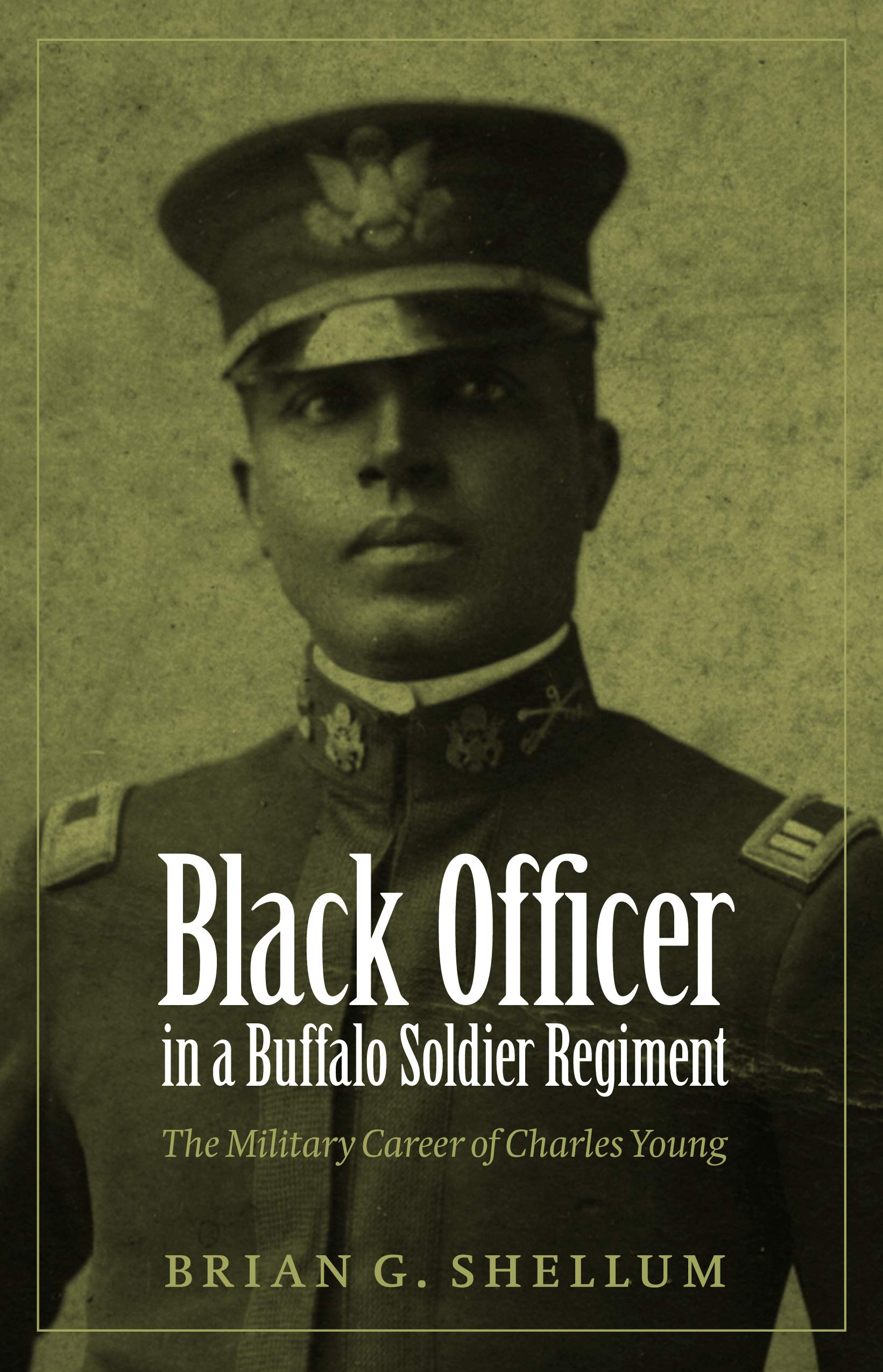
Black Officer in a Buffalo Soldier Regiment: The Military Career of Charles Young
$17.99
by Brian G. Shellum



"A valuable read for anyone with an interest in the final years of the frontier Army, American imperialism, African-Americans in military service, and American military history in general." —A.A. Nofi, Strategypage.com Shellum’s book seeks to restore a hero to the ranks of military history; at the same time, it informs our understanding of the role of race in the history of the American military. An unheralded military hero, Charles Young (1864–1922) was the third black graduate of West Point, the first African American national park superintendent, the first black U.S. military attaché, the first African American officer to command a Regular Army regiment, and the highest-ranking black officer in the Regular Army until his death. Black Officer in a Buffalo Soldier Regiment tells the story of the man who—willingly or not—served as a standard-bearer for his race in the officer corps for nearly thirty years, and who, if not for racial prejudice, would have become the first African American general. Brian G. Shellum describes how, during his remarkable army career, Young was shuffled among the few assignments deemed suitable for a black officer in a white man’s army—the Buffalo Soldier regiments, an African American college, and diplomatic posts in black republics such as Liberia. Nonetheless, he used his experience to establish himself as an exceptional cavalry officer. He was a colonel on the eve of the United States’ entry into World War I, when serious medical problems and racial intolerance denied him command and ended his career. "With quiet dignity and determination, Charles Young skillfully negotiated incredible obstacles to reach the rank of colonel. Brian G. Shellum has succeeded in capturing Young's courage and the shameful milieu of America's Jim Crow army." -Gregory J. W. Urwin, professor of history at Temple University "Extensively researched and clearly written, Black Officer in a Buffalo Soldier Regiment places Charles Young back where he belongs, among the important figures of African Americans during the Progressive Era. --Mark Benbow, former resident historian of the Woodrow Wilson House "Using solid research and little-used documentary sources, Shellum brings into sharp focus a man and officer of whom too little is known, and not near enough is remembered." --William W. Gwaltney, former president of the Association of African American Museums "Brian Shellum traces the development, experiences, and extraordinary accomplishments of a pioneering black officer who broke through one racial barrier after another in the decades straddling the turn of the twentieth century. --Floyd Thomas, curator at the National Afro-American Museum and Cultural Center Barring the discovery of significant new documents related to Charles Young's career, Shellum's two volumes will undoubtedly stand as the definitive biography of that fine officer for many years to come--Roger D. Cunninghame, Journal of America's Military Past An unheralded military hero, Charles Young (1864-1922) was the third black graduate of West Point, the first African American national park superintendent, the first black U.S. military attaché, the first African American officer to command a Regular Army regiment, and the highest-ranking black officer in the Regular Army until his death. Black Officer in a Buffalo Soldier Regiment tells the story of the man who--willingly or not--served as a standard-bearer for his race in the officer corps for nearly thirty years, and who, if not for racial prejudice, would have become the first African American general. Brian G. Shellum describes how, during his remarkable army career, Young was shuffled among the few assignments deemed suitable for a black officer in a white man's army--the Buffalo Soldier regiments, an African American college, and diplomatic posts in black republics such as Liberia. Nonetheless, he used his experience to establish himself as an exceptional cavalry officer. He was a colonel on the eve of the United States' entry into World War I, when serious medical problems and racial intolerance denied him command and ended his career. Shellum's book seeks to restore a hero to the ranks of military history; at the same time, it informs our understanding of the role of race in the history of the American military. Brian Shellum is currently a senior intelligence analyst with the Joint Improvised Explosive Device Defeat Organization with the U.S. Department of Defense. He worked as a historian at the Defense Intelligence Agency (DIA) for the 12 years from 1994 to 2006. Prior to that he served in the U.S. Army as an armor officer and West European foreign area specialist before retiring in 1994. His military career highlights include various troop assignments with tank units, a tour as an army attaché in Bonn, Germany, Gulf War I service on the staff of the 2nd Brigade, 1st Armored Division, and work as a senior intelligence analyst at DIA. He lived and studied for eleven yea