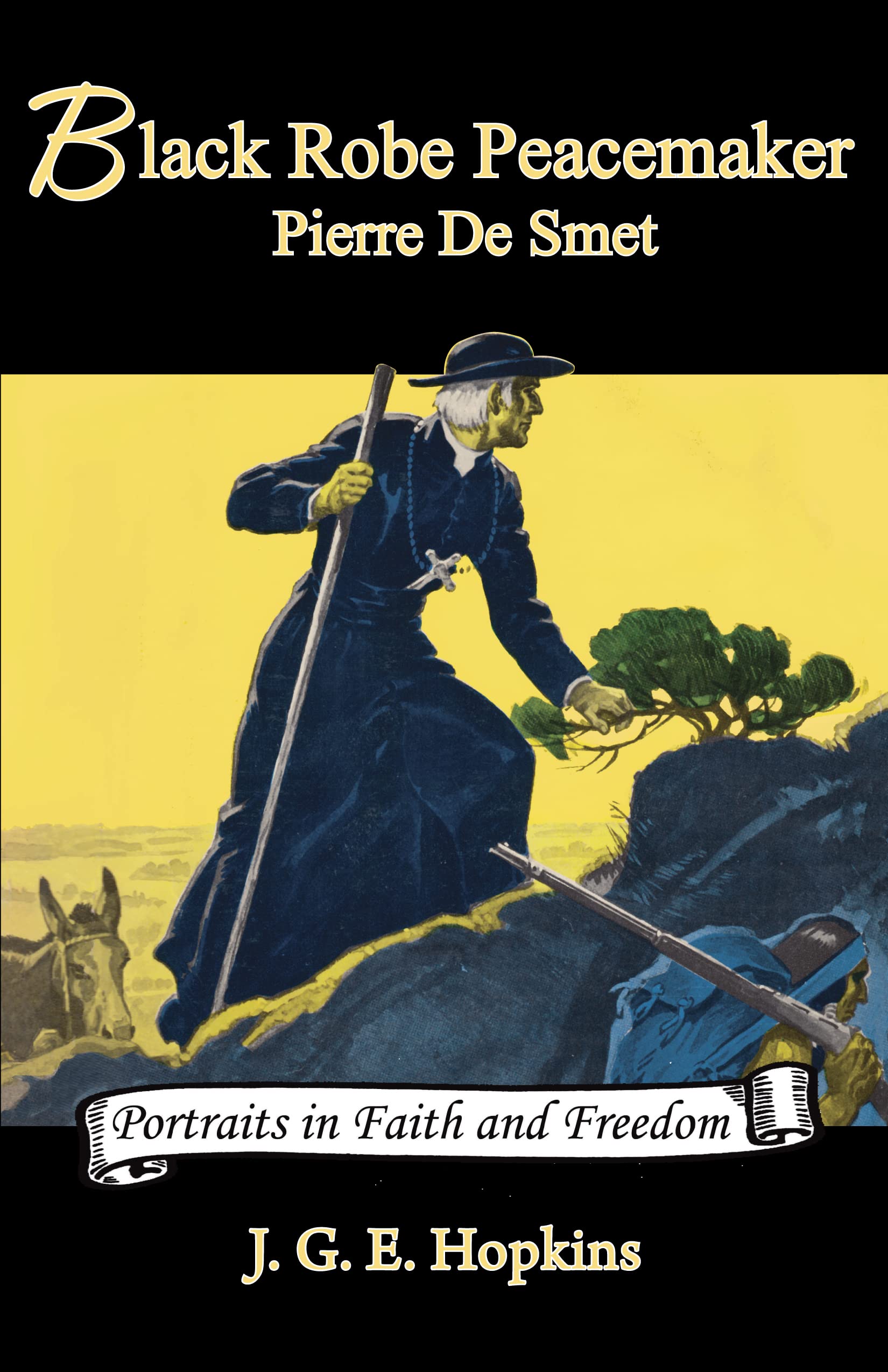
Black Robe Peacemaker: Pierre De Smet (Volume 4) (Portraits in Faith and Freedom, Set 5: Missionaries on the Frontier)
$15.95
by J.G.E. Hopkins



In 1867 the President of the United States set up a commission of three generals to end the wars with the Sioux Indians for good—he hoped!—through a just treaty. Only one person in all the United States, the commissioners thought, just might be acceptable by the Sioux for parley: the priest- missionary, Fr. Pierre De Smet. Black Robe Peacemaker relates Father De Smet’s story, his fearless character, remarkable encounters and depth of love for the tribes he served. As a restless young Belgian, Pierre’s vocation is triggered by the testimony of Fr. Charles Nerinckx, a Jesuit missionary. In 1821 De Smet joins the pioneering Jesuits in America to bring the Gospel to the Indians. His great chance to reach the Native Americans begins in earnest when two tribesmen from the northern Rockies beg for a "Black Robe" to teach them. Fr De Smet comes, and his courage and honesty quickly earn him the Indians’ respect and admiration. He touches the hearts of many natives and brings them to faith in the Triune God. Conflicts between white settlers and the Indian nations increase, yet he, the Black Robe, is one man both sides listen to. Though Fr De Smet’s heroic work is threatened with destruction, we glimpse, amidst man’s wickedness, the mysterious power of God’s purposes in the life of this great servant of Christ. United States, 1800s. RL7.3 Of read-aloud interest ages 9-up J. G. E. Hopkins , a man who loved to delve into America’s past and a collector of rare Americana, lived in Larchmont, New York with his wife and four children at the time of writing Black Robe Peacemaker —in the late 1950s. From that vantage point he conducted his activities; in New York City he edited the historical research division of Charles Scribner’s Sons and made contributions to a notable series of volumes on American history. He helped start and then served as vice president of the Catholic Poetry Society of America and as associate editor of its magazine, Spirit. Among Mr. Hopkins’ published works is another biography for young people, Colonial Governor: Thomas Dongan of New York . The life of this governor, appointed in the late 17th century by King James II of England, portrays a fascinating, not-so-well-known colonial Catholic man and the equally fascinating early New York City of his day. Also, as an editor of fiction, Hopkins was responsible for such works as The Scribner Treasury: 22 Classic Tales. EARLY one springtime morning in the year 1812, the good people of Termonde—a Belgian town about twenty-five miles southwest of the great port of Antwerp—woke up to a noise of cheering and shouting. A crowd of schoolboys had gathered in one of the town squares, and a stocky, blue-eyed, broad-shouldered lad was making them a speech.“We’ll take the town before they know we’re there,” he cried. “They won’t have guards out this early in the morning. On to victory!” “Hooray,” the boys shouted. “Hooray for General Samson!” For weeks this exciting game of war had been going on. The boys of Grembergen, a neighboring village, were the Russian and Austrian enemy; the Termonde boys (in their imaginations, at least) were the invincible grenadiers of the Emperor Napoleon. Older and wiser people might hate Napoleon Bonaparte for the bloodshed and ruin he had brought on Europe, but Belgian boys felt that they shared somehow in the military glory of his victories. They had listened to the stories told by fellow townsmen who’d followed the imperial eagles through Italy and Spain and Germany, and they longed for the day when they’d be grown up and could put on a uniform. With whoops and shouts they followed “General Samson” headlong down the Grembergen road. Just as they reached a line of hills outside that village, the “Russians and Austrians” fell on them from ambush. Spies had been at work. The surprise attack was no surprise. For a minute or two the battle was even. Fists and sticks were busily at work. Then the Grembergen boys broke and ran up the winding main street to the church square. “Samson” and his men pursued them with cries of victory, but not for long. It was a Sunday morning, and out of the church poured the fathers, uncles and big brothers of the defeated force. They didn’t stop to ask questions. With clubs and pitchfork handles they beat such a tattoo on the heads and shoulders of “Samson’s” army that it turned tail and ran. The sting of defeat and a large lump on his head weren’t all that poor “Samson” had to suffer. As he and his troops entered Termonde on the double, the first man he met was a very angry father; for the next ten days he was forbidden to leave the house. “Samson’s” real name was Pierre Jean de Smet. At the time of the great battle of Grembergen he was eleven years old, the strongest and most daring boy of his age in Termonde. No one could beat him at wrestling or foot racing. He loved to climb tall trees and swing himself down from limb to limb; he was a leader in the dangerous game of leaping from boat to boat in m