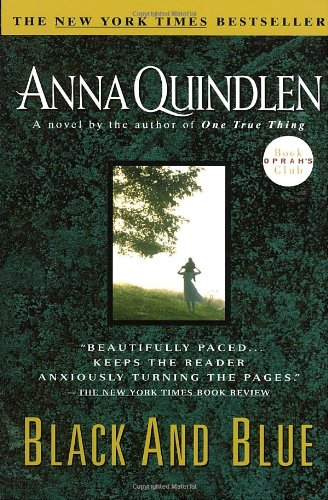



With daring and compassion, Anna Quindlen weaves a forceful, harrowing portrait of a woman and a marriage, capturing the profound intricacies of love and rage, passion and violence. At once heartbreaking and utterly riveting, BLACK AND BLUE is an extraordinary work of fiction and a brilliant achievement. For eighteen years, Fran Benedetto kept her secret, hid her bruises, and stayed with Bobby because she wanted her son to have a father and because, in spite of everything, she loved him. Then one night, when she saw the look on her ten-year-old son's face, Fran finally made a choice--and ran for both their lives. With the repackaging of BLACK AND BLUE and One True Thing, Anna Quindlen takes her place alongside Dell's Alice McDermott and Rosellen Brown bringing their beloved, acclaimed contemporary classics to a whole new audience of trade paperback readers in Delta editions. "A sad and important story, convincingly told--.--.--. Black and Blue is enormously readable--.--.--.--Like her columns, Quindlen's novels are written with intelligence, clarity and heart-rending directness." --Newsday "Heartbreaking."--Time "Engrossing--.--.--.--compassionate and tense."--The New York Times "Absolutely believable--.--.--.--Quindlen writes with power and grace." --The Boston Globe With daring and compassion, Anna Quindlen weaves a forceful, harrowing portrait of a woman and a marriage, capturing the profound intricacies of love and rage, passion and violence. At once heartbreaking and utterly riveting, BLACK AND BLUE is an extraordinary work of fiction and a brilliant achievement. For eighteen years, Fran Benedetto kept her secret, hid her bruises, and stayed with Bobby because she wanted her son to have a father and because, in spite of everything, she loved him. Then one night, when she saw the look on her ten-year-old son's face, Fran finally made a choice--and ran for both their lives. With the repackaging of BLACK AND BLUE and One True Thing, Anna Quindlen takes her place alongside Dell's Alice McDermott and Rosellen Brown bringing their beloved, acclaimed contemporary classics to a whole new audience of trade paperback readers in Delta editions. ANNA QUINDLEN is the author of two other bestselling novels, Object Lessons and One True Thing. Her New York Times column, "Public & Private," won a Pulitzer Prize in 1992, and a selection of these columns was published as Thinking Out Loud. She is also the author of a collection of her "Life in the 30's" columns, Living Out Loud, and two children's books, The Tree That Came to Stay and Happily Ever After. She lives in New York City. The first time my husband hit me I was nineteen years old. One sentence and I'm lost. One sentence and I can hear his voice in my head, that butterscotch-syrup voice that made goose bumps rise on my arms when I was young, that turned all of my skin warm and alive with a sibilant S, the drawling vowels, its shocking fricatives. It always sounded like a whisper, the way he talked, the intimacy of it, the way the words seemed to go into your guts, your head, your heart. "Geez, Bob," one of the guys would say, "you should have been a radio announcer. You should have done those voice-over things for commercials." It was like a genie, wafting purple and smoky from the lamp, Bobby's voice, or perfume when you took the glass stopper out of the bottle. I remember going to court once when Bobby was a witness in a case. It was eleven, maybe twelve years ago, before Robert was born, before my collarbone was broken, and my nose, which hasn't healed quite right because I set it myself, looking in the bathroom mirror in the middle of the night, petals of adhesive tape fringing the frame. Bobby wanted me to come to court when he was testifying because it was a famous case at the time, although one famous case succeeds another in New York City the way one pinky-gold sunset over the sludge of the Hudson River fades and blooms, brand-new each night. A fifteen-year-old boy from Brooklyn was accused of raping a Dominican nun at knifepoint and then asking her to pray for him. His attorney said it was a lie, that the kid had had no idea that the woman in the aqua double-knit pants and the striped blouse was a nun, that the sex was consensual, though the nun was sixty-two and paste-waxing a floor in a shelter at the time. They took paste wax from the knees of the kid's pants, brought in the paste-wax manufacturer to do a chemical comparison. The lawyer was an old guy with a storefront in a bad neighborhood, I remember, and the kid's mother had scraped together the money to hire him because Legal Aid had sent a black court-appointed and she was convinced that her son needed a white lawyer to win his case. Half-blind, hungover, dandruff on the shoulders of his gray suit like a dusting of snow, the kid's attorney was stupid enough to call the kid as a witness and to ask why he had confessed to a crime he hadn't committed. "There was this cop in the room," the