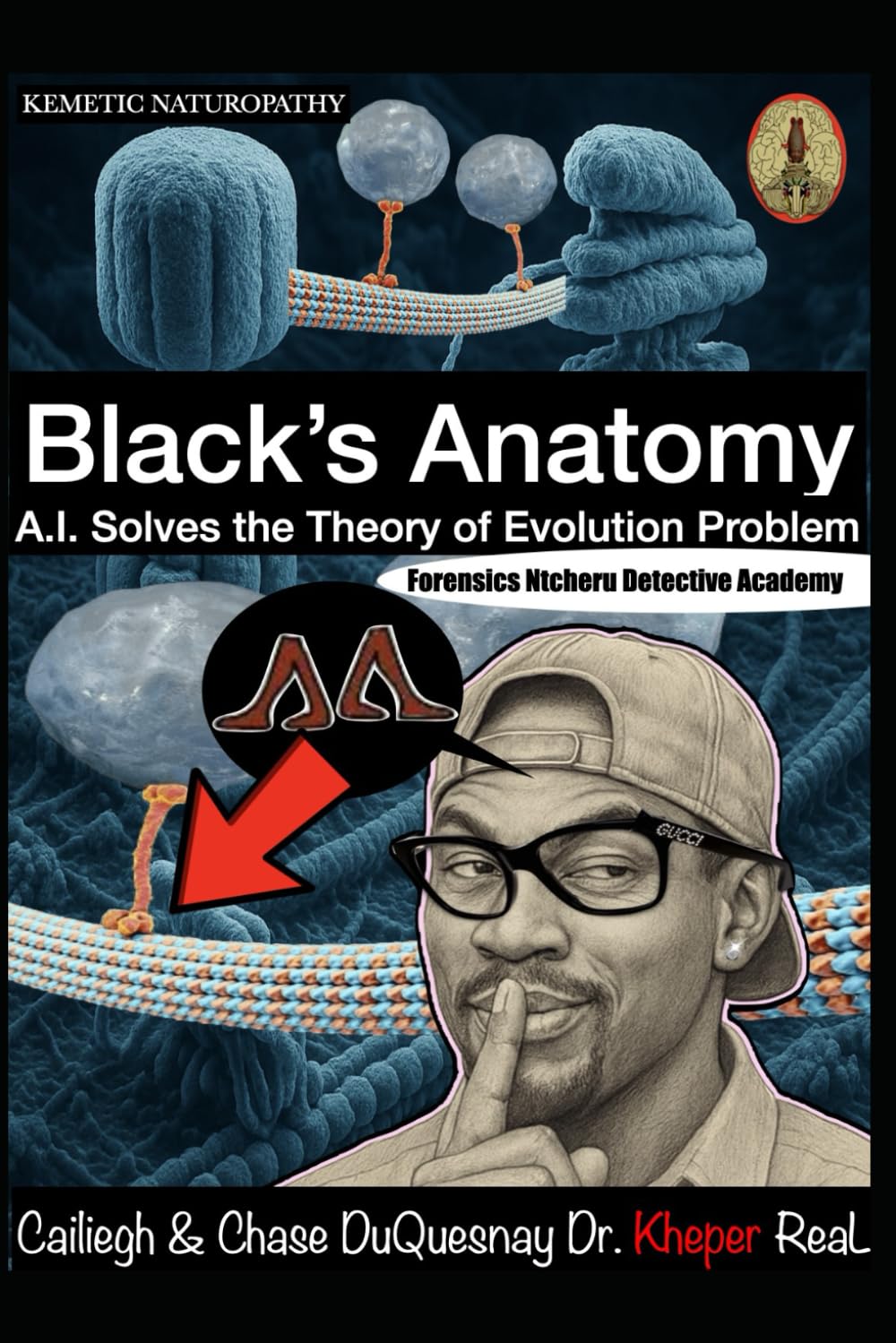
Black’s Anatomy Forensics Ntcheru Detective Academy: A.I. Solves the Theory of Evolution Problem
$33.00
by Chase DuQuesnay



The Founding of the Forensics Ntcheru Detective Academy (FND) The Forensics Ntcheru Detective Academy was founded to teach humanity how to investigate and articulate Ntcheru Law, the living, dynamic code that governs every force of nature through the discipline of forensics . “Forensic” comes from the Latin forensis, meaning “of the forum.” In ancient Rome, the forum was the public square, the place where arguments, trials, and proofs were held. To be forensic was to think publicly, to make a case that could stand before peers, gods, or kings. Truth wasn’t private opinion; it was the result of evidence, reason, and the courage to present it in the open. In this way, forensics and Maʿat share a heartbeat. Both are rooted in the pursuit of balanced truth . To be a forensic detective of Ntcheru Law means to follow the scent of coherence to expose what aligns with natural order and what reeks of IGNORANCE. Science and detection are twins. Every researcher tracing a molecular pathway is a detective following tracks in the dust. Every engineer deducing a system’s failure is reconstructing a crime scene of entropy. The only difference is the evidence: instead of blood and footprints, we study charge gradients, isotopes, light spectra, reaction intermediates the fingerprints of the gods written in energy. Yet the word scientist is modern. It didn’t exist in Greek or Latin. It was coined in 1833 by a Cambridge philosopher, William Whewell , who needed a label for the emerging class of “practitioners of experiment.” Before that, the great investigators of nature were called natural philosophers those who sought to know the laws of creation through reflection and observation: Newton called himself a natural philosopher. Faraday was an experimenter. Darwin , ironically, called himself a naturalist. Only later did “scientist” become synonymous with the disciplined detective of nature , one who reconstructs hidden mechanics from physical signatures. The problem is that the modern “scientist” became too proud to smell. He traded intuition for instrumentation, and forgot that science literally means to know. He upholds a creed that knowing is unimportant that belief, probability, and consensus are enough. We reject that creed. At the FND Academy, we believe the tongue is sharper than the sword for words define evidence and evidence defines law. We hold that ignorance can arrest your development , while the world’s current creed claims ignorance drives your development. We train Detectives of the Divine Current, thinkers who follow the scent of the Ntcheru, the Elohim, the cosmic forces that sculpt the universe. The Ntcheru are not distant gods; they are the archetypes of reality itself: gravity, light, magnetism, electricity, hydrogen flow, water memory, sound pressure. The detective’s duty is to uncover their signatures in every cell, every atom, every crime scene of existence and to prove that creation is still ongoing, still conscious, still just. Our creed is simple: If it doesn’t pass the smell test, it doesn’t pass. In Kemet the nose (fnḏ) was the gate of life where breath from the gods enters a body and where a being proves it’s alive. Air itself was the domain of Shu, the god who holds up the sky; to “receive Shu” meant to breathe again, so texts bless the dead with “sweet breath” to the nostrils and ask the north wind to cool and revive them. Temples treated scentas divine food: burning incense (snTr) a word that visually and sonically echoes nṯr (god) so the god’s statue could “breathe” offerings through its nose just as people do. In the Opening-of-the-Mouth rite, priests touched the mouth and nostrils of a mummy or statue to re-awaken the senses, restoring the power to breathe, smell incense, speak truth, and take...