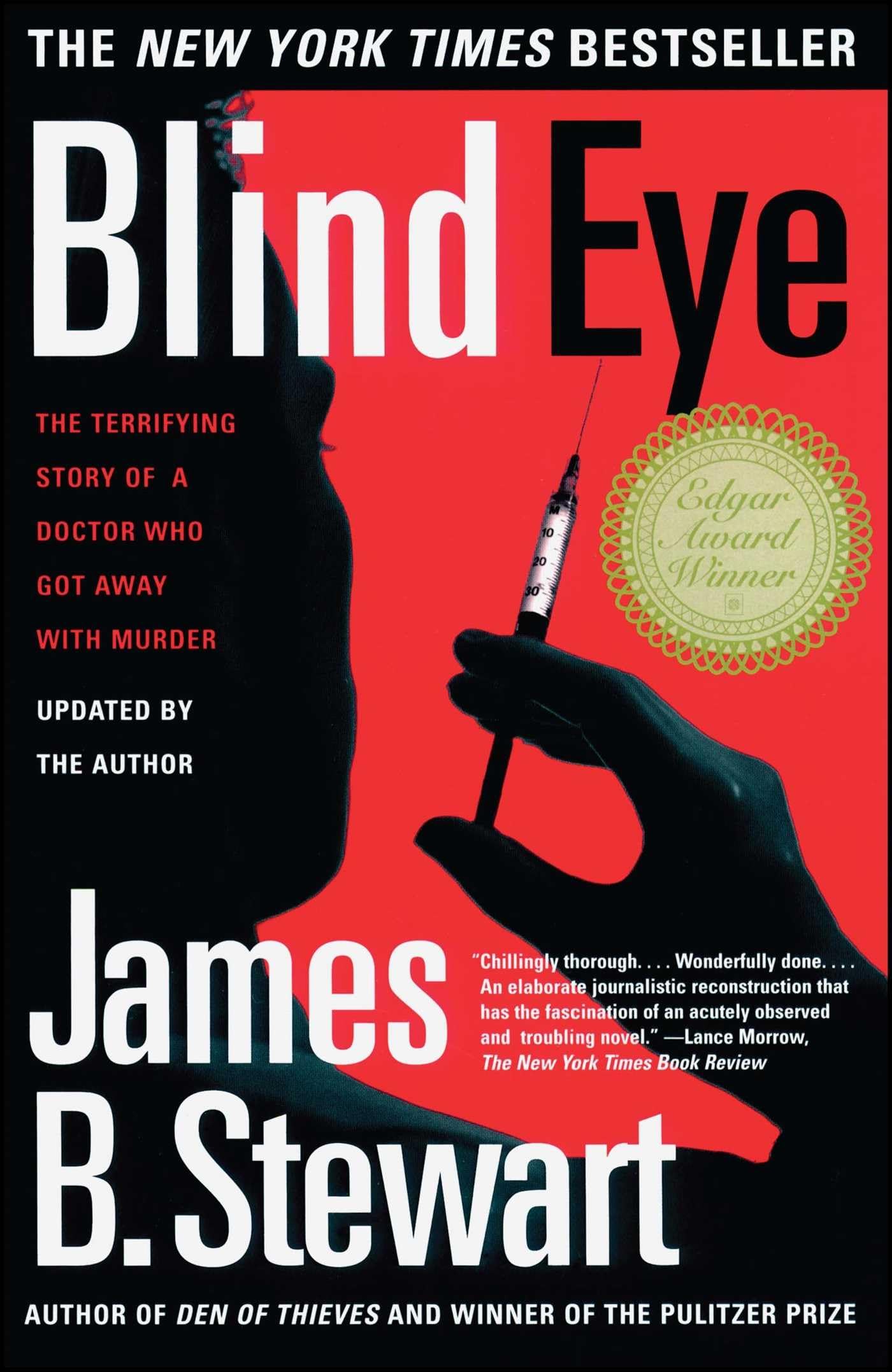
Blind Eye: The Terrifying Story Of A Doctor Who Got Away With Murder
$11.29
by James B. Stewart



A medical thriller from Pulitzer Prize–winning author James B. Stewart about serial killer doctor Michael Swango and the medical community that chose to turn a blind eye on his criminal activities. No one could believe that the handsome young doctor might be a serial killer. Wherever he was hired—in Ohio, Illinois, New York, South Dakota—Michael Swango at first seemed the model physician. Then his patients began dying under suspicious circumstances. At once a gripping read and a hard-hitting look at the inner workings of the American medical system, Blind Eye describes a professional hierarchy where doctors repeatedly accept the word of fellow physicians over that of nurses, hospital employees, and patients—even as horrible truths begin to emerge. With the prodigious investigative reporting that has defined his Pulitzer Prize–winning career, James B. Stewart has tracked down survivors, relatives of victims, and shaken coworkers to unearth the evidence that may finally lead to Swango’s conviction. Combining meticulous research with spellbinding prose, Stewart has written a shocking chronicle of a psychopathic doctor and of the medical establishment that chose to turn a blind eye on his criminal activities. Chillingly thorough....Wonderfully done....An elaborate journalistic reconstruction that has the fascination of an acutely observed and troubling novel. -- Lance Morrow ― The New York Times Book Review A remarkable piece of reporting. -- Scott McLemee ― Newsday Stewart tells a riveting tale of terror, a true page-turner. -- Jerome E. Groopman ― The Wall Street Journal Blind Eye is a flat-out horrifying nonfiction profile of Michael Swango...Stewart is an excellent writer and reporter...This is a brave and passionate book. -- Joan O'C. Hamilton ― Business Week Stewart penetrates the hermetically sealed world of medicine. In the process, he exposes the arrogance and the fraudulent professional courtesies that allowed Swango to move ahead unchallenged. In other words, Stewart does the work that hospital administrators and supervising physicians in Ohio, South Dakota, and New York should have done. -- Ellen Clegg ― The Boston Globe Swango's odyssey is so compelling that I became riveted. I needed to know when and how he would be caught, and what ultimately happened to him. -- Dr. Robert B. Daroff ― The Plain Dealer (Cleveland) Stewart has produced an extraordinary book. -- Steve Twedt ― Pittsburgh Post-Gazette James B. Stewart's Blind Eye is a persuasive case against Dr. Michael Swango. -- R. Z. Sheppard ― Time magazine The facts gathered by Stewart are compelling. [He]...persuasively dissects the medical establishment. -- Steve Weinberg ― Chicago Tribune Is Blind Eye worth reading? Yes, Jim Stewart's books always are. -- Joseph Nocera ― Fortune James B. Stewart is a columnist at The New York Times and the author of numerous books including the blockbuster Den of Thieves, Blood Sport, DisneyWar, and his most recent New York Times bestseller, Unscripted . He won the 1988 Pulitzer Prize for his reporting on the stock market crash and insider trading. He is a regular contributor to SmartMoney and The New Yorker. He is a professor of business journalism at Columbia University and lives in New York. Chapter One Southern Illinois, the triangle of land north of the junction of the Mississippi and Ohio Rivers, 350 miles from Chicago, feels more like the Deep South than like the industrial Midwest. Summers are hot and steamy, and in June 1979, most of the students and faculty members at Southern Illinois University in Carbondale who could get away after graduation had fled, leaving the campus feeling sleepy and underpopulated. An exception was the medical school, whose year-round schedule enabled students to complete the standard four-year medical school curriculum in three years. They began during the summer, spent the first year at SIU's main campus in Carbondale, then moved to SIU's campus in Springfield, the state capital, to complete their degree. Late one June night, James Rosenthal, a newly admitted member of the SIU medical school class of '82, was sitting in a college dorm room, sweating from a combination of the heat and his anxiety over an enormous stack of introductory medical texts: anatomy, physiology, biochemistry....The topics seemed endless, the books huge. He should have been asleep. He turned out the lights and noticed that another window in the adjacent dorm was still brightly lit. It was Rosenthal's classmate Michael Swango, wearing military fatigue pants and doing jumping jacks. Swango was lean and muscled at a time when fitness was far from most students' minds. He'd been in the Marines, and his name was stenciled on the military garb he usually wore to class. It was weird, Rosenthal thought. Many of his classmates had been antiwar protesters. Swango was the only member of the class he knew who had been in the military. Swango's military garb and