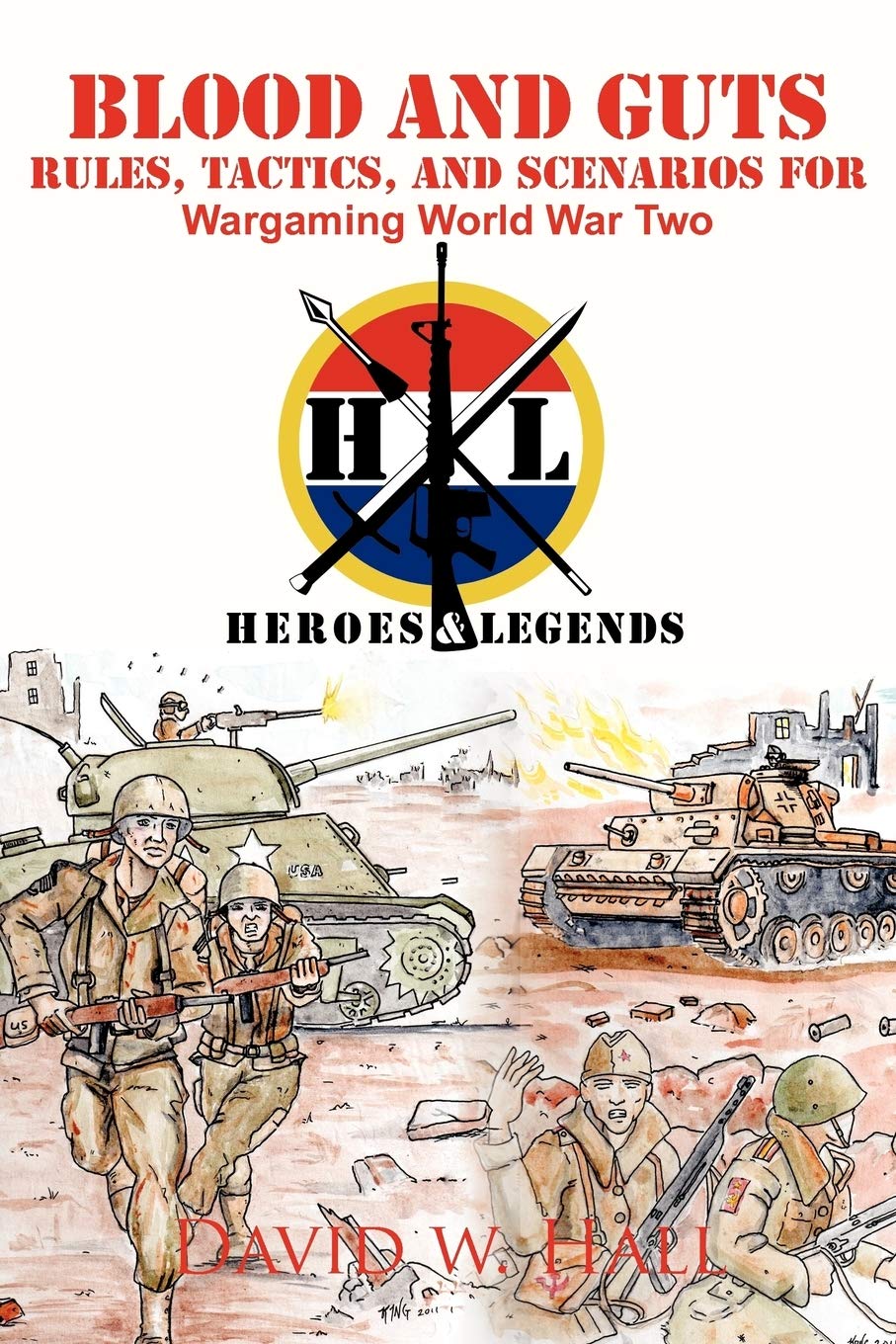
Blood and Guts: Rules, Tactics, and Scenarios for Wargaming World War Two
$20.95
by David W. Hall



United States Marine Corps veteran David Hall presents a new and exciting way to experience the Second World War in Blood and Guts: Rules, Tactics, and Scenarios for Wargaming World War Two. Hall developed his tactical game system through decades of personal wargaming, and he now shares his unique system with readers everywhere. The rules are easy to learn, and the games are fast-paced. The scenarios cover almost all of the major theaters of conflict, including France 1940, the Mediterranean, the South Pacific, and the Eastern Front. A table of organization and equipment is included to assist readers in recreating wargame infantry and armor formations. Hall doesn't simply provide a set of rules; he infuses each chapter with wargame theory, tactics, and tank development. He provides the logic behind each rule and talks about how the rule design plays out the battlefield. He also shares stories and anecdotes about his early "toy soldier" days and about how he developed into a wargamer-stories sure to spark readers' memories of their own first set of soldiers. BLOOD AND GUTS RULES, TACTICS, AND SCENARIOS FOR WARGAMING WORLD WAR TWO By David W. Hall iUniverse, Inc. Copyright © 2011 David W. Hall All right reserved. ISBN: 978-1-4620-2556-5 Contents Acknowledgments.........................................................viiIntroduction............................................................ixChapter 1 Influences and observation of a Wargamer......................1Chapter 2 Wargame theory and Application................................7Chapter 3 Blood and Guts................................................16Chapter 4 summary of Rules..............................................90Chapter 5 Basic table of organization and equipment.....................119Chapter 6 Blood and Guts in Action......................................149Chapter 7 solo Wargaming................................................167Chapter 8 scenarios for Wargaming World War Two.........................173Chapter 9 tactics and theaters of World War Two.........................214Chapter 10 tank Development of World War Two............................272Chapter 11 Childhood Reflections........................................304Chapter 12 Conclusion...................................................325Bibliography............................................................327About the Author........................................................330Index...................................................................331 Chapter One Influences and Observation of a Wargamer The set of rules that I will lay out is entirely different from the set I developed in my childhood and adolescent years. It is a collection of influences and convictions that I have developed over the years. As I have interacted with other wargamers, read different authors, and experienced the games themselves, I have reached my own conclusions about how rules should be designed. I am certainly not advocating that my rules are superior to other sets but simply stating my conclusions has helped me concentrate and produce a set I can call my own. Wargamers are a very diverse group of people with varying backgrounds, influences, understandings, and interpretations of history. However, there is one commonality that unites them: their time is limited. Many of us are still raising families, are committed to support our children's extracurricular activities, and have demanding jobs. We have spouses that require our time and attention. Therefore, we are barely able to squeeze in "hobby time," let alone spend hours each weekend wargaming one game. I have participated in far too many games that were too large in scope for the allotted time given. Either there was an overabundance of units or the rules themselves were overly complicated to allow as mooth game in a four-to-five-hour period. the most frustrating aspect was that a conclusion was never reached. I am sure there are many in this audience of readers that have played an eight-hour game, watched a few gamers come and go with hardly an exciting turn played, only to have the game called a draw. Following that, the "after action reports" from the players were filled with ifs and buts as to the eventual winner. Such things should never happen! this has led me to one of my core principles in game creation and rule design: Can the game be set up and played, with a conclusion, in 5 hours? As for our differences, there are those gamers who relentlessly argue every point. To be kind, it probably stems from an over exuberance and knowledge of period weaponry and tactics. However, the disagreements only add to the length of time needed to play and hopefully reach a conclusion. The best way I have found to solve this issue is to allow each side two objections to either the interpretation of a rule or how the rule should be applied. The player issuing his objection must clearly state his logic and