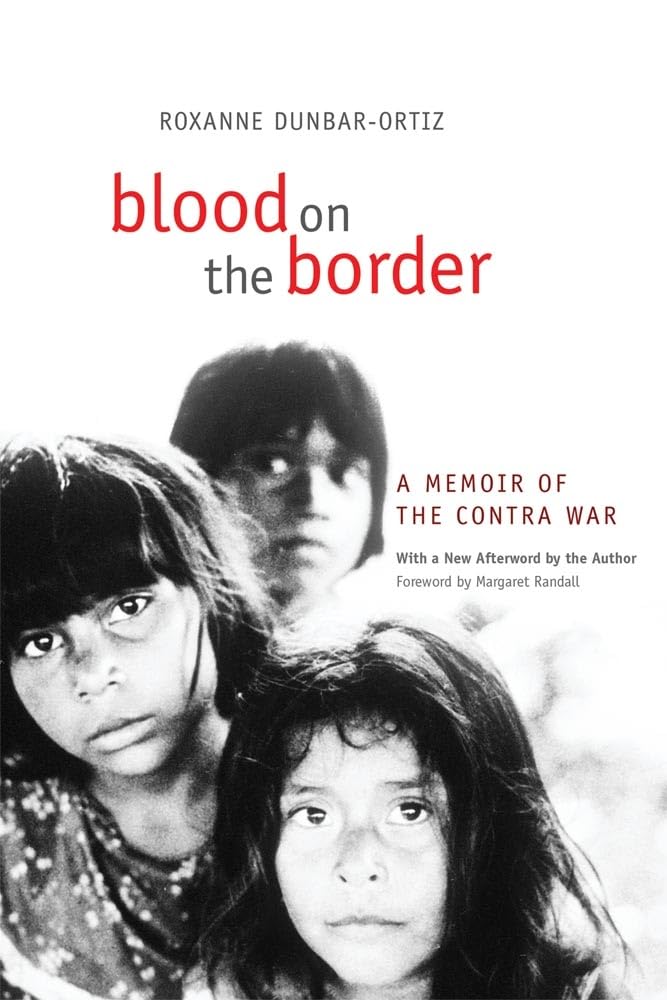



Human rights activist and historian Roxanne Dunbar-Ortiz has been described as “a force of nature on the page and off.” That force is fully present in Blood on the Border , the third in her acclaimed series of memoirs. Seamlessly blending the personal and the political, Blood on the Border is Dunbar-Ortiz’s firsthand account of the decade-long dirty war pursued by the Contras and the United States against the people of Nicaragua. With the 1981 bombing of a Nicaraguan plane in Mexico City—a plane Dunbar-Ortiz herself would have been on if not for a delay—the US-backed Contras (short for los contrarrevolucionarios ) launched a major offensive against Nicaragua’s Sandinista regime, which the Reagan administration labeled as communist. While her rich political analysis of the US-Nicaraguan relationship bears the mark of a trained historian, Dunbar-Ortiz also writes from her perspective as an intrepid activist who spent months at a time throughout the 1980s in the war-torn country, especially in the remote northeastern region, where the Indigenous Miskitu people were relentlessly assailed and nearly wiped out by CIA-trained Contra mercenaries. She makes painfully clear the connections between what many US Americans today remember only vaguely as the Iran-Contra “affair” and ongoing US aggression in the Americas, the Middle East, and around the world—connections made even more explicit in a new afterword written for this edition. A compelling, important, and sobering story on its own, Blood on the Border offers a deeply informed, closely observed, and heartfelt view of history in the making. “This is an impressive, astounding, and truthful historical document. . . . Roxanne Dunbar-Ortiz tells a story that is moving, profoundly human, and enlightening.” — Gioconda Belli , author of The Country under My Skin “Captures a messy snapshot of our country and [Dunbar-Ortiz’s] own life. A living embodiment of the philosophy ‘the personal is poltical,’ she navigates a dense narrative river through her early, youthful enthusiasm for social change, moving upstream toward a hard-edged and realistic perception of the undertows of political waters . . . she reveals an unbowed human spirit—a major ingredient in victory.” — Jewelle Gomez , author of The Gilda Stories “Dunbar-Ortiz is clearly a memoirist of great skills and even greater heart. She’s a force of nature on the page and off.” — Dave Eggers , author of A Heartbreaking Work of Staggering Genius Roxanne Dunbar-Ortiz, a writer, teacher, historian, and social activist, is Professor Emerita of Ethnic Studies and Women’s Studies at California State University, East Bay, and author or editor of numerous scholarly articles and books, including the award-winning An Indigenous Peoples’ History of the United States , as well as two other memoirs. Margaret Randall is a feminist poet, writer, photographer, and social activist who has published more than 80 books, including Sandino's Daughters: Testimonies of Nicaraguan Women in Struggle and To Change the World: My Years in Cuba. Blood on the Border A Memoir of the Contra War By Roxanne Dunbar-Ortiz UNIVERSITY OF OKLAHOMA PRESS Copyright © 2005 Roxanne Dunbar-Ortiz All rights reserved. ISBN: 978-0-8061-5384-1 Contents Foreword, by Margaret Randall, Acknowledgments, Prologue, 1. The Road to Nicaragua Runs through the Black Hills, 2. Starting Over and Finding the Sandinista Revolution, 3. Desaparecidos, 4. A Revolution Is Not a Dinner Party, 5. House Arrest, 6. Culture Shock, 7. Red Christmas, 8. A Cruel Spring, 9. Getting to Know Rigoberta, 10. Drinking for Courage, 11. International Law — and International Lawlessness, 12. Guide, 13. City of Refuge, 14. Missionaries and Mercenaries, 15. Refugees, 16. Quemada, 17. The Final Chapter: Rednecks and Indian Country, Again, Epilogue, Afterword, CHAPTER 1 The Road to Nicaragua Runs through the Black Hills What ended up being my road to Nicaragua began when I was "born again" as an American Indian. That thin red line, inherited from my maternal grandmother, was tapped in 1970 when, following the Alcatraz call to "Indians of all Nations," Wallace "Mad Bear" Anderson, the famed Tuscarora traveling diplomat (and merchant seaman by trade), encouraged me to embrace my Native heritage. I finally did so during the siege of Wounded Knee in February 1973, when I was a functioning alcoholic working in a Nevada casino, burnt out and isolated from the radical movements that had been my family for the previous decade. I always had known that my mother was part Indian of unspecified heritage, most likely Cherokee, although I grew up in west-central Oklahoma, Southern Cheyenne territory. One relative has fantasized that we were from the Nez Perce of Idaho, who had been forced onto a reservation in southeastern Oklahoma following the defeat of the resistance led by Chief Joseph, but that seems unlikely. It was known that my gran