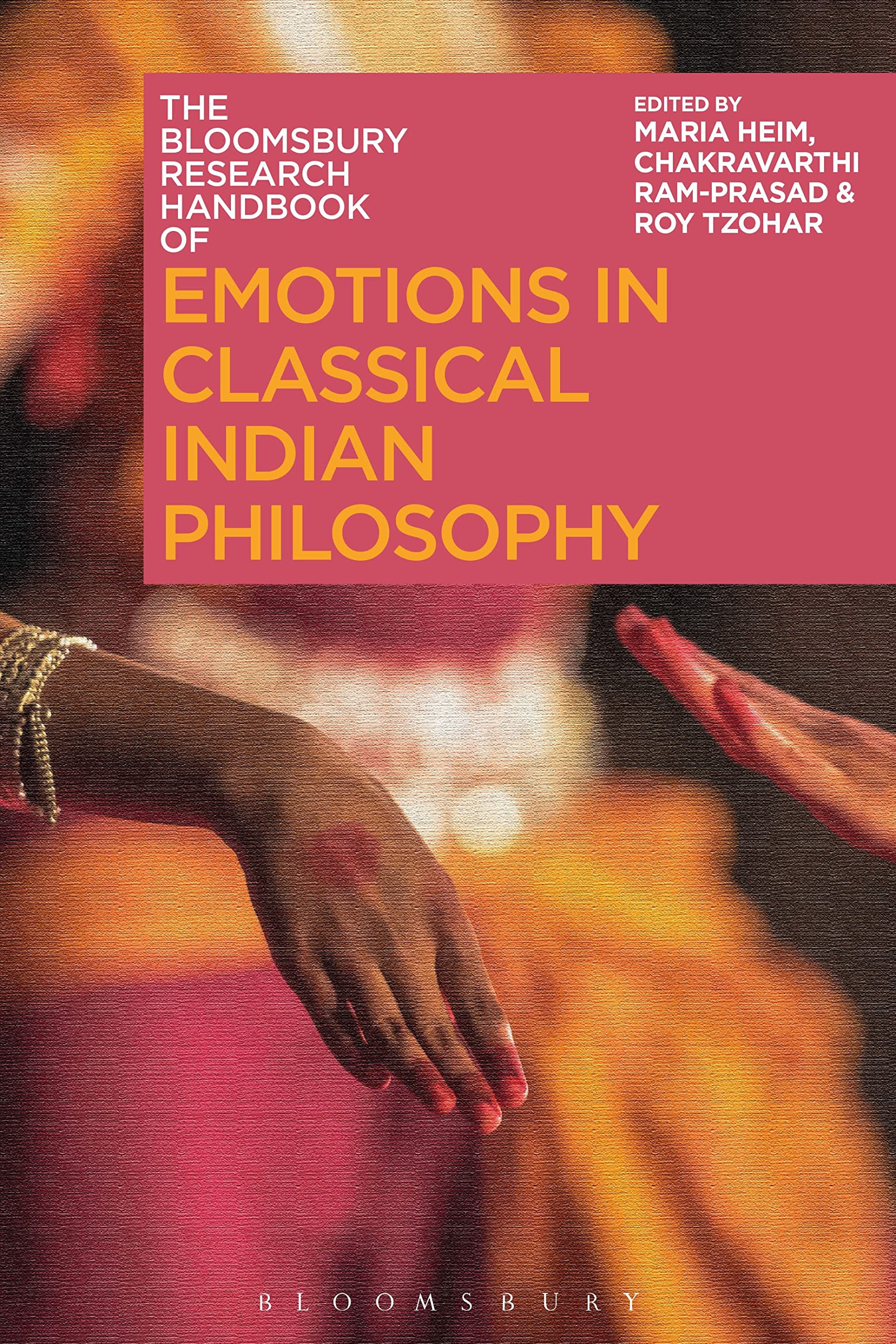
Bloomsbury Research Handbook of Emotions in Classical Indian Philosophy, The (Bloomsbury Research Handbooks in Asian Philosophy)
$57.95
by Maria Heim



Drawing on a rich variety of premodern Indian texts across multiple traditions, genres, and languages, this collection explores how emotional experience is framed, evoked, and theorized in order to offer compelling insights into human subjectivity. Rather than approaching emotion through the prism of Western theory, a team of leading scholars of Indian traditions showcases the literary texture, philosophical reflections, and theoretical paradigms that classical Indian sources provide in their own right. The focus is on how the texts themselves approach those dimensions of the human condition we may intuitively think of as being about emotion, without pre-judging what that might be. The result is a collection that reveals the range and diversity of phenomena that benefit from being gathered under the formal term “emotion”, but which in fact open up what such theorisation, representation, and expression might contribute to a cross-cultural understanding of this term. In doing so, these chapters contribute to a cosmopolitan, comparative, and pluralistic conception of human experience. Adopting a broad phenomenological methodology, this handbook reframes debates on emotion within classical Indian thought and is an invaluable resource for researchers and students seeking to understand the field beyond the Western tradition. “This Handbook is a splendid collection of essays by scholars well-established and some still early in their careers. Resisting the habit of fitting Indian understandings of experience into old or new theories imported from the West, the volume's thirteen essays go deep into South Asia's Sanskrit and vernacular traditions to find and make use of fresh vocabulary and concepts apt to that South Asian context but also, by extension, to bringing fresh insight into conversations about experience in the academy globally. After this volume, we will not want to think of “experience” and “experiences” in the same way again. This is indeed a research handbook that will adorn the bookshelves of scholars and students for a generation and more.” ― Francis X. Clooney, SJ, Parkman Professor of Divinity, Harvard University, USA “This book successfully outlines the pluralistic descriptions of emotions dealt with in Indian texts without categorizing them by Western concepts more dominant in the field. It is a laudable contribution to our understanding of the medieval Indian world of emotions in its own concepts and values.” ― Religious Studies Review Maria Heim is Professor of Religion and Elizabeth W. Bruss Reader at Amherst College, USA. Chakravarthi Ram-Prasad is Professor of Comparative Religion and Philosophy in the Department of Politics, Philosophy and Religion, and Associate Dean for Research, Faculty of Arts and Social Sciences, at Lancaster University, UK. He is the author of Knowledge and Liberation in Classical Indian Thought (Palgrave, 2001), Advaita Epistemology and Metaphysics: An outline of Indian non-realism (Routledge, 2002), Eastern Philosophy (Wiedenfield and Nicholson, 2005), India: Life, Myth and Art (Duncan Baird, 2006), which has been translated into French, Polish and Finnish, and Indian Philosophy and the Consequences of Knowledge (Ashgate, 2007). He is a member of the Academic Advisory Council at the Oxford Centre for Hindu Studies and a regular contributor to BBC Radio 4's Beyond Belief and Sunday Programme. Sor-hoon Tan is Associate Professor in the Department of Philosophy at the National University of Singapore, Singapore. Roy Tzohar is Associate Professor in the Department of East and South Asian Studies at Tel Aviv University, Israel.