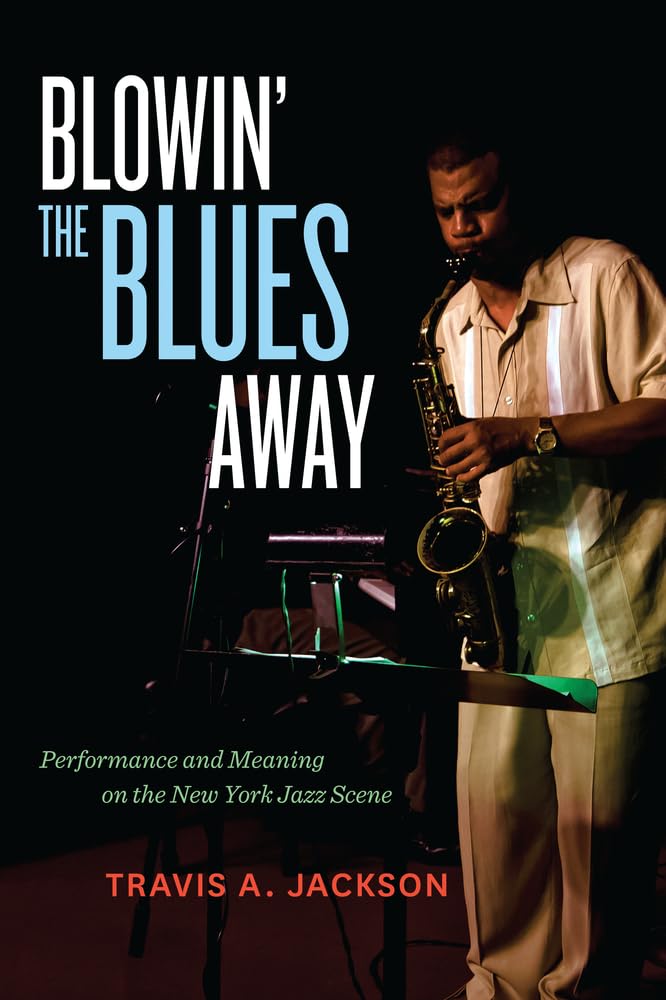
Blowin' the Blues Away: Performance and Meaning on the New York Jazz Scene (Volume 16)
$34.95
by Travis A. A. Jackson



New York City has always been a mecca in the history of jazz, and in many ways the city’s jazz scene is more important now than ever before. Blowin’ the Blues Away examines how jazz has thrived in New York following its popular resurgence in the 1980s. Using interviews, in-person observation, and analysis of live and recorded events, ethnomusicologist Travis A. Jackson explores both the ways in which various participants in the New York City jazz scene interpret and evaluate performance, and the criteria on which those interpretations and evaluations are based. Through the notes and words of its most accomplished performers and most ardent fans, jazz appears not simply as a musical style, but as a cultural form intimately influenced by and influential upon American concepts of race, place, and spirituality. "Blowin' the Blues Away ... is a new landmark in scholarship that uses ethnomusicology to analyze how jazz musicians work and their cultural sources. Throughout the book, Jackson balances his detailed analysis with a wider overview of critical and historic discourse while also providing ample space for musicians to speak for themselves." -- Down Beat Blowin' the Blues Away makes a major contribution to our understanding of the contexts and meanings of jazz performance. Jackson makes his own mark by not only documenting 'the jazz scene' in New York but also by providing a critical vocabulary and methodology for future researchers. As such, Jackson s book provides the most in-depth understanding of the rituals and meanings of jazz performance to date." Farah Jasmine Griffin, author of Clawing at the Limits of Cool: Miles Davis, John Coltrane, and the Greatest Jazz Collaboration Ever “ Blowin' the Blues Away makes a major contribution to our understanding of the contexts and meanings of jazz performance. Jackson makes his own mark by not only documenting 'the jazz scene' in New York but also by providing a critical vocabulary and methodology for future researchers. As such, Jackson’s book provides the most in-depth understanding of the rituals and meanings of jazz performance to date." ―Farah Jasmine Griffin, author of Clawing at the Limits of Cool: Miles Davis, John Coltrane, and the Greatest Jazz Collaboration Ever Travis A. Jackson is Associate Professor of Music and the Humanities at the University of Chicago. Blowin' the Blues Away Performance and Meaning on the New York Jazz Scene By Travis A. Jackson UNIVERSITY OF CALIFORNIA PRESS Copyright © 2012 The Regents of the University of California All rights reserved. ISBN: 978-0-520-27045-9 Contents List of Illustrations, xi, Acknowledgments, xiii, PART ONE. BLACK, BROWN AND BEIGE, 1. Studying Jazz, 3, 2. History and Memory, Pathways and Practices: The African Americanness of Jazz, 24, PART TWO. SCENES IN THE CITY, 3. Jazz and Spatiality: The Development of Jazz Scenes, 51, 4. The New York Jazz Scene in the 1990s, 70, PART THREE. BLOWIN' THE BLUES AWAY, 5. Toward a Blues Aesthetic, 109, 6. Jazz Performance as Ritualized Activity, 136, 7. In the Studio and on Stage, 155, 8. Conclusion, 205, Glossary, 217, Appendix: Excerpt from an Interview with Steve Wilson, 223, Notes, 231, References, 263, Index, 289, CHAPTER 1 Studying Jazz As the second decade of the twenty-first century begins, we are undoubtedly at a pivotal moment in the development of jazz. Major and independent record labels and a number of cultural institutions have, particularly since the early 1980s, presented jazz to varied publics in ways that promote both its essential "Americanness" and its supposed universality. They have devoted considerable resources to preserving and promulgating the music via new recordings, reissues of older ones, sponsorship of concert and lecture series, the mounting of museum exhibits, and the production of documentaries as well as syndicated radio and television programs. Popular publications and their advertisers, moreover, have also shown interest in the music, as evidenced by feature articles on jazz and jazz musicians in periodicals as diverse as the New York Times, the Washington Post, Newsweek, GQ, Essence, Out, and Rolling Stone and by the appearance of jazz musicians in stylish advertisements for Johnston & Murphy shoes and Movado watches, among other products. Two further indicators of the increased importance of jazz have been its designation by the House of Representatives and the United States Senate as a "rare and valuable national American treasure" in 1987 and frequent references to its status as "America's classical music." At the same time, after the high points of the 1980s and 1990s, younger audiences seem less interested in jazz, and the music seems to be receding from mass public consciousness—receding so far, at least in the United States, that commentators such as Stuart Nicholson (2005, xi) have asserted that continued performance of jazz may require the kinds of public s