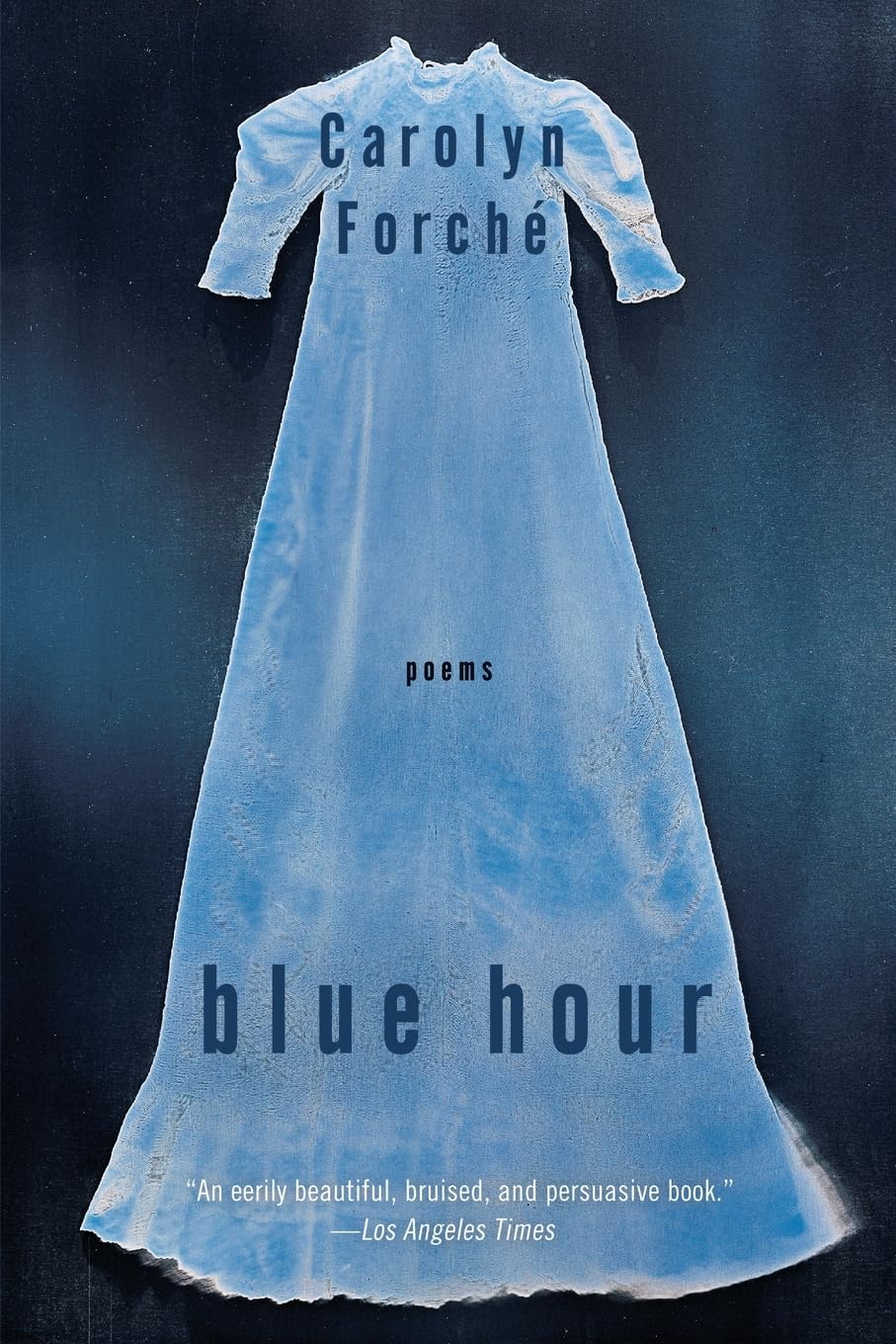
Blue Hour: Poems – Fierce and Elusive Meditations on Memory, Presence, and the Passage into Death
$10.26
by Carolyn Forche



" Blue Hour is an elusive book, because it is ever in pursuit of what the German poet Novalis called 'the [lost] presence beyond appearance.' The longest poem, 'On Earth,' is a transcription of mind passing from life into death, in the form of an abecedary, modeled on ancient gnostic hymns. Other poems in the book, especially 'Nocturne' and 'Blue Hour,' are lyric recoveries of the act of remembering, though the objects of memory seem to us vivid and irretrievable, the rage to summon and cling at once fierce and distracted. "The voice we hear in Blue Hour is a voice both very young and very old. It belongs to someone who has seen everything and who strives imperfectly, desperately, to be equal to what she has seen. The hunger to know is matched here by a desire to be new, totally without cynicism, open to the shocks of experience as if perpetually for the first time, though unillusioned, wise beyond any possible taint of a false or assumed innocence." -- Robert Boyers The title poem of Forché's fourth collection takes the birth of her son as a starting point for contemplation of her own childhood, just after the Second World War, an era when "it was not as certain that a child would live to be grown." The uncertainty of an individual's survival at any given point in history informs the first part of this volume, which mounts a quiet protest against the atrocities of the last century and insists that "even the most broken life can be restored to its moments." In such lines, Forché's persona—unflinching witness and eloquent mourner—prevails, but in the centerpiece of the collection, "On Earth," her obsessive documentation of inhumanity overwhelms her best lyric instincts. Forché cleverly chooses the abecedarian form—where the initial letters of the lines form a progress through the alphabet—to portray the agonal flickers of a dying mind, and yet the poem's collage of horrifying imagery feels gratuitous more often than it does inspired. Copyright © 2005 The New Yorker “And now comes a stunning new work by Carolyn Forche, my hero, because not only does she write beautifully, she has fierce moral principles.” - --Carolyn Kizer “Again Carolyn Forche hovers above the lacerated landscape of history filling the holes ‘between saying and said.’ BLUE HOUR does not console but emboldens. The fear we share is never dodged. This singular voice is writ in bone, snow, coal, stone and sorrow.” - C.D. Wright “Forché, already a master of imagery, creates here a masterwork for the 21st century.” - Jane Miller “To read these poems is an experience as calmly and restfully beautiful as looking at a group of related impressionist canvases, like those of Monet. Especially memorable for me are poems like ‘Refuge’ and above all, the long poem ‘On Earth’” - -- John Bayley “Like the scatter from a fireworks explosion, Forché‘s images float on the currents of the reader’s memory.” - American Book Review “BLUE HOUR blends domestic tenderness with philosophical reverie … It is full of tiny startling detail … celebrating the freedom of imagination and memory.” - Financial Times “Resplendent and solemn … takes readers to similar state of limbo, someplace between the conscious and the intuited.” - Hartford Courant “A ferocious remembering in the face of death, in the face of life.” - North American Review “An eerily beautiful, bruised and persuasive book.” - Los Angeles Times Book Review “Unflinching witness and eloquent mourner.” - The New Yorker ” [An] austerely beautiful gathering of elegiac meditations … Forché [is] a writer exquisitely attuned to the tenderness and awe, violence and grief inherent in human life.” - Booklist “The long poem ‘On Earth’ immediately draws the reader’s attention--it’s such a mysterious catalogue of all the things we know and don’t know: an uncanny mixture of peace, beauty and cruelty. If you ask ‘which country is it?’ the answer is ‘this country is called earth.” - --Adam Zagajewski “Dense, lyrical, mysterious … a poetic journey no reader should miss.” - Library Journal " Blue Hour is an elusive book, because it is ever in pursuit of what the German poet Novalis called 'the [lost] presence beyond appearance.' The longest poem, 'On Earth,' is a transcription of mind passing from life into death, in the form of an abecedary, modeled on ancient gnostic hymns. Other poems in the book, especially 'Nocturne' and 'Blue Hour,' are lyric recoveries of the act of remembering, though the objects of memory seem to us vivid and irretrievable, the rage to summon and cling at once fierce and distracted. "The voice we hear in Blue Hour is a voice both very young and very old. It belongs to someone who has seen everything and who strives imperfectly, desperately, to be equal to what she has seen. The hunger to know is matched here by a desire to be new, totally without cynicism, open to the shocks of experience as if perpetually for the first time, though unillusioned, wise beyond any possible taint o