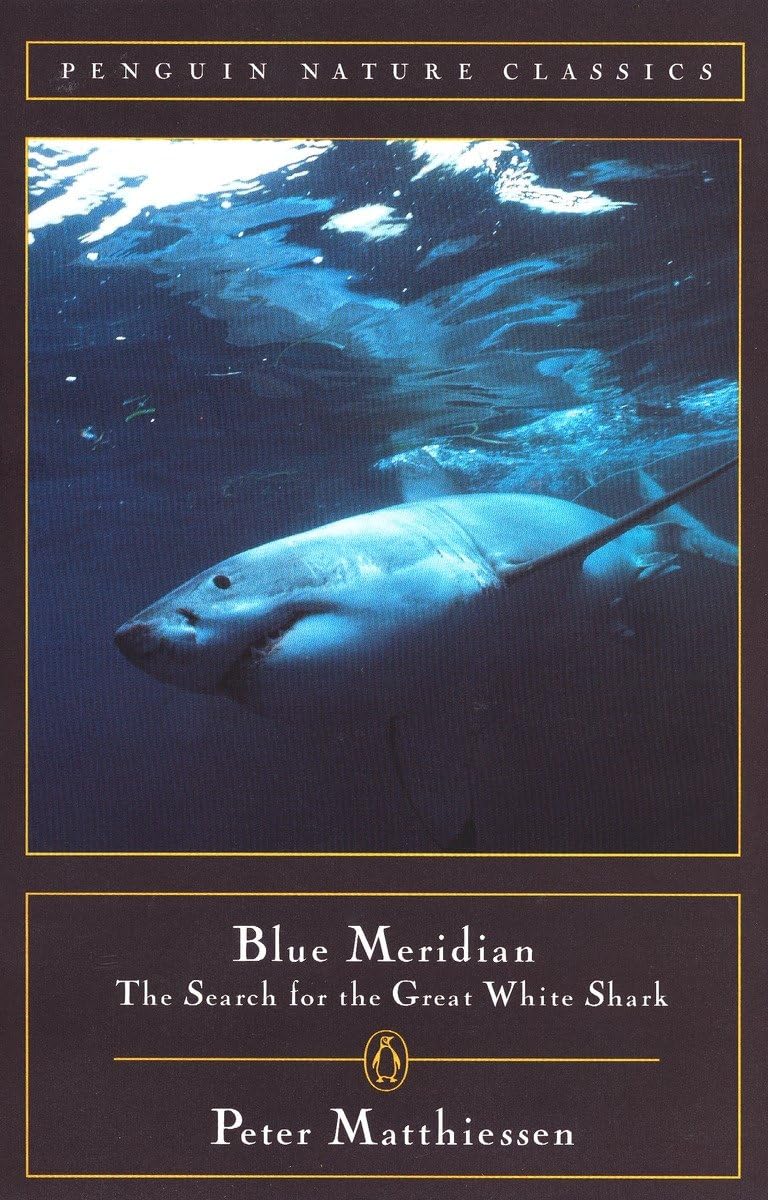



A classic work of nature and humanity, by renowned writer Peter Matthiessen (1927-2014), author of the National Book Award-winning The Snow Leopard and the new novel In Paradise National Book Award-winning author Peter Matthiessen takes readers on an expedition to find the most dangerous predator on Earth—the legendary great white shark. On a trek that lasts 17 months and takes him from the Caribbean to the whaling grounds off South Africa, and across the Indian Ocean to the South Australian coast, Matthiessen describes the awesome experience of swimming in open water among hundreds of sharks; the beauties of strange seas and landscapes; and the camaraderie, tension, humor, and frustrations that develop when people continually risking their lives dwell in close proximity day after day. Filled with acute observations of natural history in exotic areas around the world, Blue Meridian records a harrowing account of one of the great adventures of our time. For more than seventy years, Penguin has been the leading publisher of classic literature in the English-speaking world. With more than 1,700 titles, Penguin Classics represents a global bookshelf of the best works throughout history and across genres and disciplines. Readers trust the series to provide authoritative texts enhanced by introductions and notes by distinguished scholars and contemporary authors, as well as up-to-date translations by award-winning translators. Peter Matthiessen was the cofounder of The Paris Review and is the author of numerous works of nonfiction, including In the Spirit of Crazy Horse , Indian Country , and The Snow Leopard , winner of the National Book Award. Good Friday, 1969. Aboard whale-catcher W-29, Captain Torgbjorn Haakestad, out of Durban. The coast of Natal just emerging from night shadows, twenty miles astern; no birds. Moon high over stern mast, and sun swelling the sky directly ahead, under the low cloud mass of yesterday’s storms. * * * Storm had prevented W-29 from sailing earlier in the week. The wind whirling up the coast in squalls made it certain that the boats would stay in port on Thursday, but the office voice at the Union Whaling Company knew nothing about weather; it thought it best that any passengers should be on hand. And so I arrived at Salisbury Island docks at 3:00 on Thursday morning and sat in the guard’s shack, talking to the gunsmith; he takes this shift so that he can be available in case one of the harpoon guns needs repair. In fair weather, the boats retrieve the buoyed whales at dark and haul them, sometimes a hundred miles or more, to the slipway at Durban, arriving ordinarily after midnight. At 3 A.M., after refueling and taking on water, they are bound offshore again, to be on the whaling grounds at daylight. “Whaling is very interesting,” the gunsmith said. “Very interesting.” He was a short cautious man with white hair and an accent. I asked if he went often to the whaling grounds, and he said never. “I been with this same company twenty-one years and I never been out there yet.” For a moment, he looked surprised himself. “I know it is interesting, but I am not curious, I guess.” He shrugged. “Maybe I afraid I get seasick.” Outside his window was the black harbor, and a light shine on the black blowing water. The water licked at the rusty hulls of idle whale-catchers, ranked four deep along the piers: like most shore whaling operations, this one is dying for want of whales. “Sometimes them big shark come right in here. Big ones. I see them right in here.” Sharks are so numerous in Durban harbor that a shark-fishing club has been set up; its members fish from the long harbor jetties. It was raining. The gunsmith’s clock ticked on in the dead time before dawn; the air turned cold. Periodically, he announced the time, shaking his head as if, after all these years, something was imminent. In a hard chair, the gunsmith slept—an old man in a hard chair by a black window. This was the bad light before dawn, the hour of sick dreams and thick awakenings. But when one has sat up all night, it is the hour when time stops, an hour of intense awareness; the ticking continues but the hands have stopped, and one can stand back and inspect the moment as if its mechanism were encased in glass. The old man coughed. He had dozed like this on countless nights, hands resting mutely on his thighs, side by side like the old feet in the blunt shoes square to the floor; his feet and fingertips pointed straight at me. His stillness filled me with the consciousness of my own name, my age, the small scars and calluses on my life’s hands, my solitude, my transience, and my absurdity. He sighed and so did I. Today or tomorrow I would watch the killing of sperm whales. Later I would go beneath the sea as an observer on an expedition that had come to film the great ocean sharks as they came in to attack the rolling carcasses. Because it is senseless the whale slaughter would be ugly, but the shark’s ba