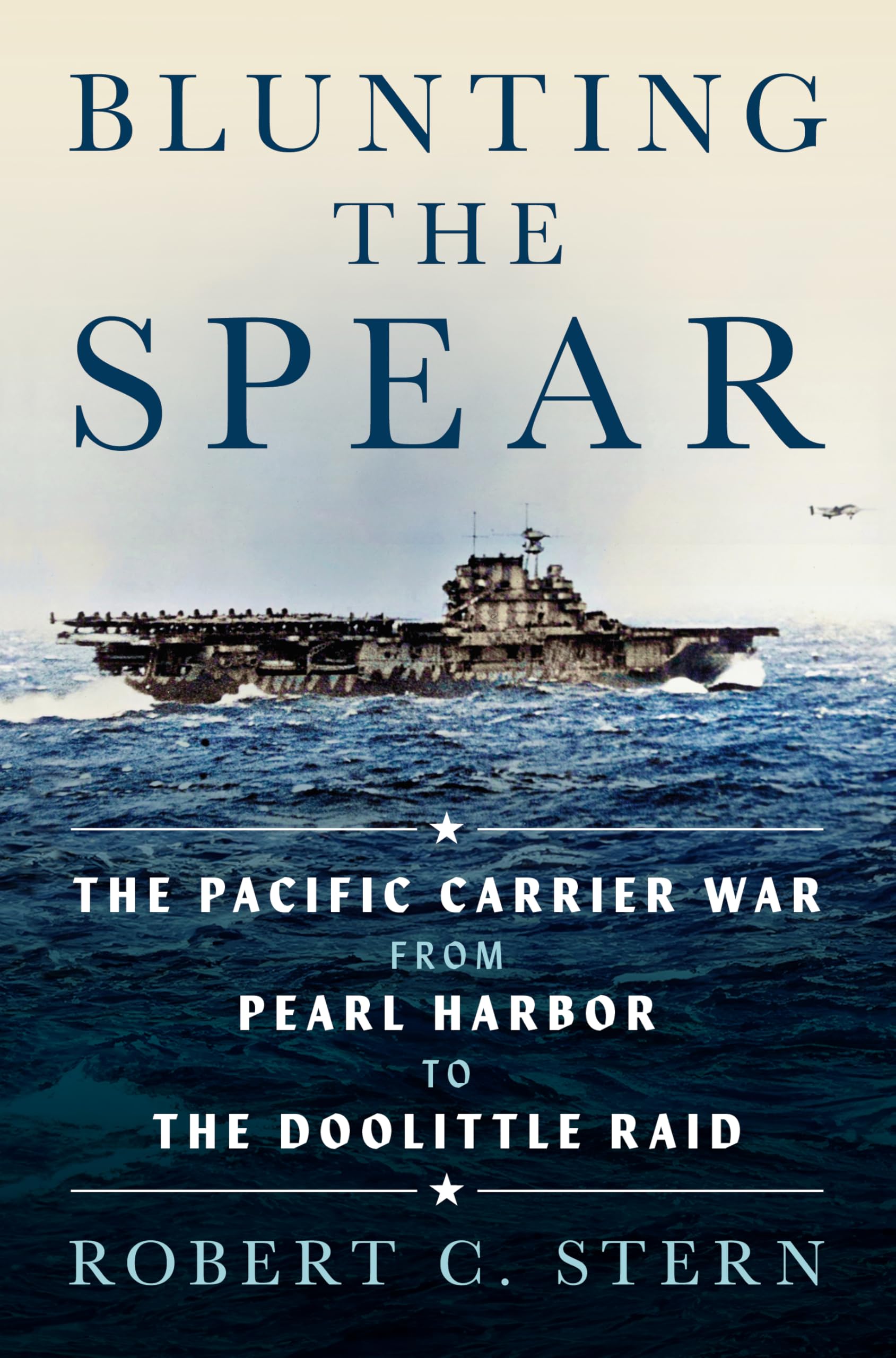
Blunting the Spear: The Pacific Carrier War from Pearl Harbor to the Doolittle Raid
$44.95
by Robert C. Stern



This compelling book explores the first four months of fighting in the Pacific between the United States and its Allies against Japan, focusing mainly on the aircraft carrier action of the respective navies in the Pacific Theater. In the chaotic months after Pearl Harbor, the Pacific War was anything but inevitable. The U.S. Navy, reeling from sudden loss, scrambled to slow Japanese momentum, while the Imperial Japanese Navy pressed outward, convinced that seizing Southeast Asia’s resources was essential to survival. This book captures that dangerous, uncertain moment―from December 1941 through April 1942―when the outcome of the Pacific War remained very much in doubt. Moving across a vast maritime battlefield, Blunting the Spear centers on early carrier operations and surface actions that tested new doctrines, unproven leaders, and their fleets. From American raids on the Marshalls and Gilberts to clashes near Rabaul, Port Darwin, and Lae and Salamaua, the book shows how both sides adapted to fast-moving air-sea combat while operating at the edge of logistical reach. These encounters were improvised, risky, and often misunderstood at the time. The story is driven by the people who shaped these early campaigns. Commanders such as Wilson Brown and William “Bull” Halsey navigated uncertainty, scarce intelligence, and unfamiliar demands of carrier warfare. U.S. Navy aviator Edward “Butch” O’Hare’s lone stand against incoming Japanese bombers demonstrated how individual action could alter events in minutes. Japanese fighter pilot Nagahama Yoshikazu’s combat over Port Darwin reveals the skill and confidence of an adversary still near the height of its power. Author Robert C. Stern also examines the planning and execution of the Doolittle Raid, a strike whose material damage was limited but whose psychological impact reverberated through Tokyo and Washington alike. By connecting early raids, defensive actions, and leadership choices to the larger arc leading toward Coral Sea and Midway, this book reveals how the Pacific carrier war was forged during these early months of uncertainty. Stern offers a tightly drawn account of how momentum shifted in the Pacific and how the earliest battles helped determine the war that followed. Perfect for history enthusiasts, military buffs, and anyone fascinated by the Pacific Theater, Blunting the Spear offers a fresh perspective on the early days of the carrier conflict. “Anyone interested in the first few months of U.S. and Japanese carrier operations in the Pacific War would be well served by reading Blunting the Spear. Robert Stern has an uncanny ability to interweave highly technical and intricate detail with a knowledgeable and profound analysis of the “bigger picture.” The well-selected maps and photos nicely complement the highly readable text, and the notes, references, and index will satisfy even the most demanding academic.” —William Jurens, associate editor of Warship International and co-author of Battleship Bismarck: A Design and Operational History “Robert C. Stern delivers a gripping account that brings to life the often-overlooked U.S. Navy’s struggle to slow the rapid Japanese advance in the crucial early months of the Pacific War. Based on meticulous archival research yet sweeping in scope, Blunting the Spear is a compelling narrative that captures not only critical strategy and innovative tactics but also the personal clashes, rivalries, and dilemmas that set the stage for the decisive naval battles of the Coral Sea and Midway.” — Michał A. Piegzik, author of Gamble in the Coral Sea: Japan's Offensive, The Carrier Battle, and the Road to Midway Robert C. Stern has written more than twenty books on military and naval subjects. His previous books include Scratch One Flattop , which tells the story of the Battle of the Coral Sea, directly following the actions covered in this book, and Knife’s Edge , which continues that story, covering the later South Pacific carrier battles at the Eastern Solomons and Santa Cruz. He resides with his wife in Alameda, California.