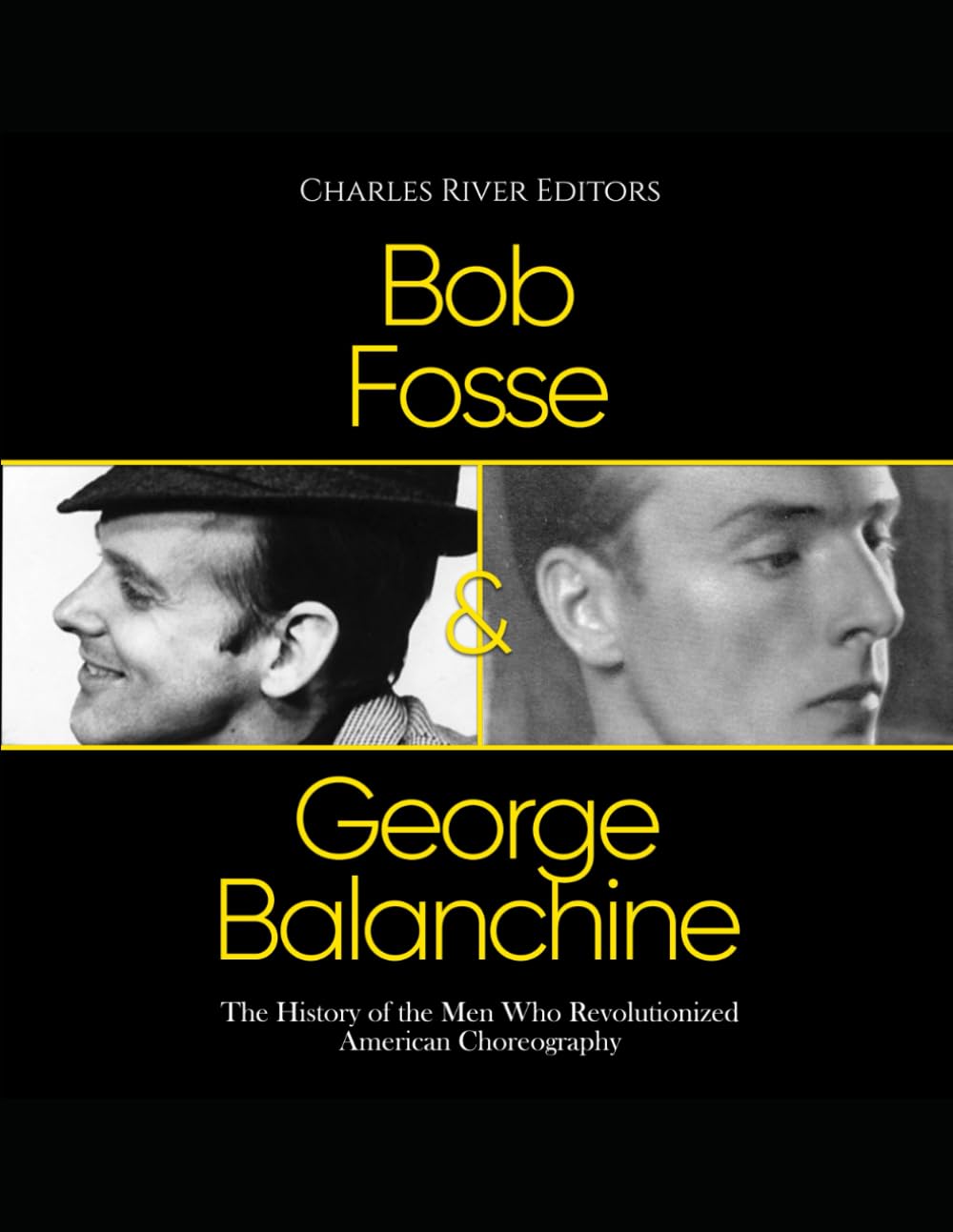
Bob Fosse & George Balanchine: The History of the Men Who Revolutionized American Choreography
$10.99
by Charles River Editors



By the turn of the 20th century, American entertainment was still preoccupied with European-style operetta, as embodied in the works of cellist-composer Victor Herbert. Traditional dance forms moved from European stories to the American prairie in Oklahoma by the late 1940s, and what was once the property of Bavarian princes became the singing standards of cowboys riding through the corn fields in Oh What a Beautiful Morning and Out of My Dreams. At the time, the availability of classical ballet in America was scant. In contrast to the evolution of an American style in musical theater, Broadway, and film, ballet in the United States was ushered in largely through the efforts of an individual who brought with him a strong traditional sense from Russia and the rest of Europe but was intent on producing a distinctly American style. Other experimentalists appeared, such as Isadora Duncan, but it was George Balanchine who managed to institutionalize and fund both a hybrid traditional as well as experimental form. Balanchine, although a dancer as well, is today regarded as the “foremost contemporary choreographer in the world of ballet.” Despite much work in Russia and other parts of Europe, his eventual relocation to the United States made possible the establishment of an American ballet school and an elite ballet company, the New York City Ballet. In contrast to the fiercely guarded Russian classical style of the Bolshoi Theater, the New York City Ballet featured uniquely choreographed performances to previously unfamiliar musical works. These were approached with a uniquely American style of dance, however steeped in tradition the basic steps may have been. In terms of original choreography, it was the age of Jerome Robbins that marked the first real departure from traditional dance on stage and in film. Robbins, born in 1918, became a five-time Tony winner and twice winner of an Academy Award. It was into this environment, featuring his West Side Story, Fiddler on the Roof, The King and I, and countless other productions, that an intriguing new choreographer made his entry riding the advent of American jazz. Only 10 years Robbin’s junior, Robert Louis Fosse, better known as Bob Fosse, followed his colleague’s example by mixing daring new jazz forms with virtually every traditional and popular genre to produce previously unseen modes of dance expression on Broadway and in film. In the 1960s, Fosse emerged as one of the leading dancers, actors, choreographers, directors, screenwriters and film directors on Broadway and in Hollywood. He became famous for conquering several fields on the musical stage and film simultaneously in a way that no one has before or since. It is said that “only Busby Berkeley compares” to Fosse despite the fact that Berkeley was never a dancer, and that Fosse enjoyed eight Broadway hits to Berkeley’s one. Fosse forever changed the way the modern audience viewed dance on stage and film. Coupling his rise with the sexual freedom movement, he is known for an “intense, unbelievably driven, provocative, entertaining…sexual, physically demanding” choreographic style. Difficult for even the best dancers, the range of expression encompasses “joyous humor, as well as bleak cynicism.”