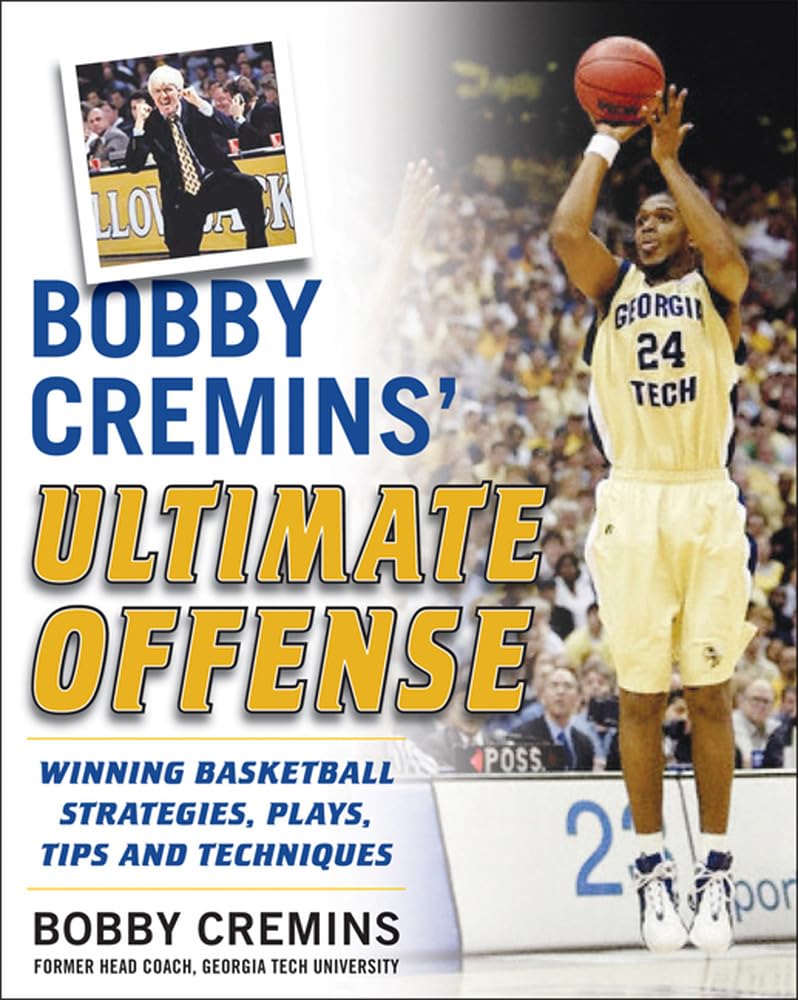
Bobby Cremins' Ultimate Offense: Winning Basketball Strategies and Plays from an NCAA Coach's Personal Playbook
$15.45
by Bobby Cremins



Pick up the pace with Coach Bobby Cremins' secrets for playing up-tempo ball When Bobby Cremins became head coach of Appalachian State University, he was one of the youngest professionals to ever lead an NCAA Division I basketball team. Going to Georgia Tech at 33, he was among the youngest ever in the history of the ACC. Two decades later as Georgia Tech's all-time winningest coach, Cremins had compiled fourteen victorious seasons, six All-Americans, and two National Coach of the Year awards. How did he do it? The answers are here as Coach Cremins reveals the secrets of his powerful, high-pressure playbook for the first time ever. In this action-packed guide for coaches and players, Cremins shares more than 150 super-charged plays and strategies guaranteed to make you rethink your offensive system, along with how he recruited many of the top point guards who played for him, and what he learned from each. You'll learn how to: Implement a fast break that's right for you and your personnel, from missed shots to made baskets. - Attack full- and half-court pressure and get high percentage shots. - Go to your bread and butter plays for your half-court attack. - Develop an aggressive zone offense. - Beat the clock with great last-second shots and all kinds of special situations, including three-point shots, out-of-bounds plays, and much more. Bobby Cremins was the most successful coach in Georgia Tech University history and one of the most successful in Atlantic Coast Conference annals. He is currently the head coach at the College of Charleston. Bobby Cremins was the most successful coach in Georgia Tech University history and one of the most successful in Atlantic Coast Conference annals. He is currently the head coach at the College of Charleston. BOBBY CREMINS' Ultimate Offense Winning Basketball Strategies and Plays from an NCAA Coach's Personal Playbook By BOBBY CREMINS The McGraw-Hill Companies, Inc. Copyright © 2009 bobby cremins All right reserved. ISBN: 978-0-07-147917-2 Contents Chapter One Transition Basketball: Implementing the Fast Break There are two types of fast break to teach: made and missed shots. We start with the made shot for teaching reasons, but obviously we prefer the missed-shot break. There are also two stages of the fast break: primary and secondary. Primary options come early in the break while secondary options take you into offensive sets. LIVE MADE BASKET Teaching made baskets first will provide your offensive foundation, which will then carry over to your missed-shot break. To start with, you must identify your best option for inbounding the ball. Made baskets are usually inbounded by post players 4 or 5. If they're not good in-bounders, it is vital for you to practice teaching them how to inbound, or modify your break and let the 3, 2, or even 1 take it out. This could slow down your break, but first and foremost is inbounding the ball properly. On late-game dead-ball situations, we have our 2 or 3 take it out, which I will demonstrate in Chapter 2 ("Attacking Pressure") and Chapter 5 ("Special Situations"). In all my years of coaching live made baskets, I have allowed our post guys (4 or 5) to take it out. If we played a constant pressing team like Gary Williams's University of Maryland team or Rick Pitino's University of Kentucky team (now University of Louisville), we went to our dead-ball look the entire game where 2 or 3 inbounded. Some years our 5 man was not a good in-bounder and then we specifically wanted our 4 man to inbound on made shots. When I was hired July 3, 2006, by the College of Charleston, I immediately asked Mark Byington, an assistant under the previous staff who I kept on, "Which post men could inbound the ball the best?" Mark's answer quickly made me realize that only our 4 man would inbound on made baskets, while our 5 man would run the middle lane. Another very important point you need to be thinking about is, do you want your trail post to stop above the 3-point circleeither to catch and swing the ball, shoot the 3, or even put it on the flooror do you want your trail post to screen away for the weak side wing? Without a doubt, the best trail post player I ever coached against was Duke University's Shane Battier. He possessed all the key traits. A smart, excellent passer, he could shoot the 3 and put it on the floor. Shane was exceptionally difficult to guard in transition. He's been an undersized 4 man as a pro in the National Basketball Association (NBA), but these qualities have helped him become an excellent NBA player. I always allowed our trail post to stop and catch, but looking back there were a couple of years I wish I had our trail post screen away, especially when our 5 man had trouble swinging the ball and was no threat to shoot the 3. In this case, I basically had our 5 man screen on the ball and roll to the basket. I will show you both ways, but you should do what's best for your