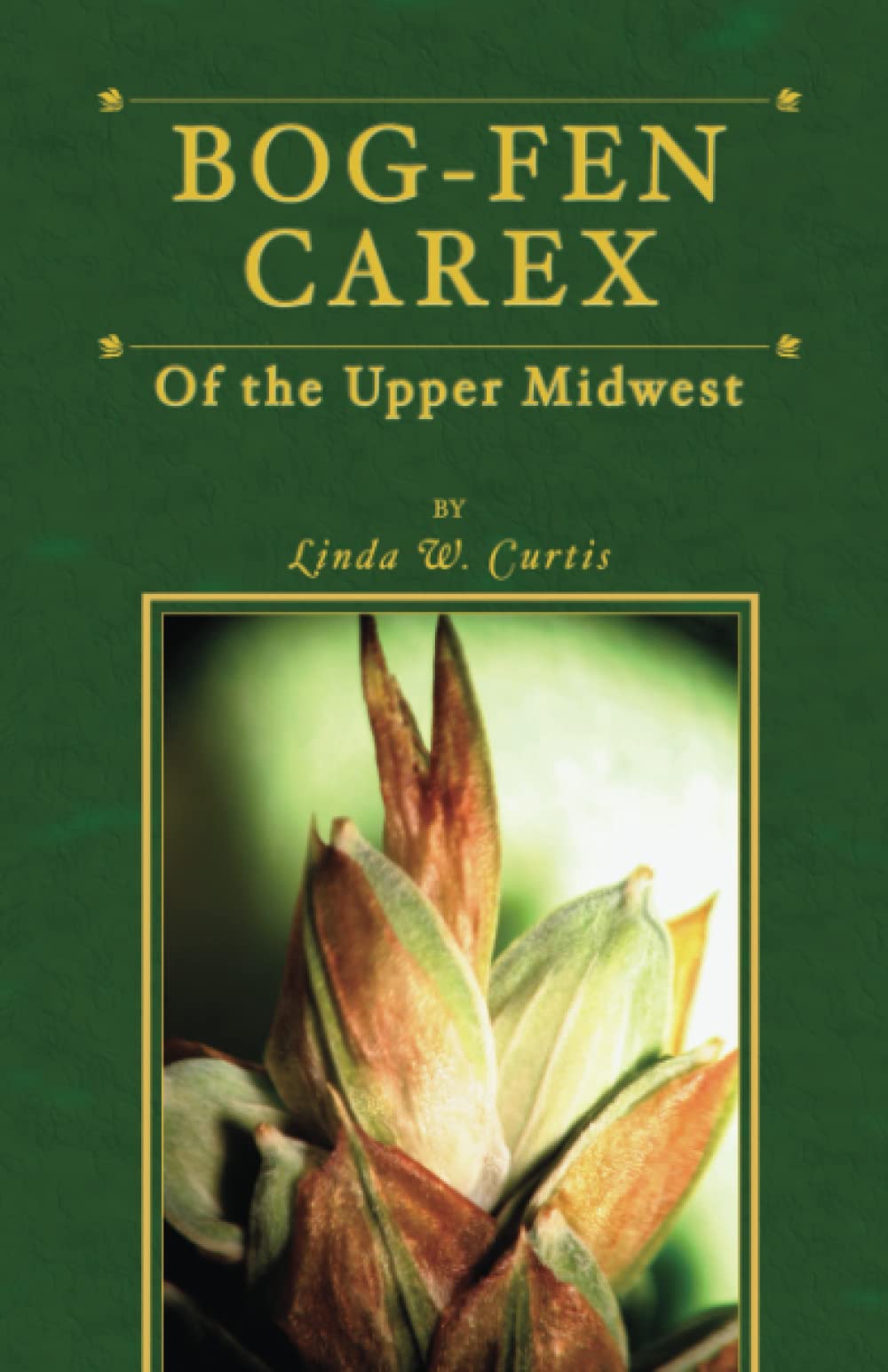



Intended for beginning botanists and naturalists who are in the “gaze in wonder” stage of discovery, this book is an entry-level botany guide. It covers the genus Carex in bogs, bog-fens, fens and surrounding wetlands in the Midwestern Great Lakes region, from central Illinois north through central Wisconsin and Minnesota, and east to Michigan, Indiana and part of Ohio. Although this book covers 73 species, many are habitat specific and grow only in bogs or swamps, or only in fens, sedge meadows, or wet prairies. A swamp has many trees but bogs have few or none. A bog is often defined as a Sphagnum moss peatland, regardless of a source of minerals, but a large bog complex or bog-fen will have both ombrotophic and minerotrophic peatlands. This difference between fens and bogs is defined by the water chemistry. Fens have alkaline minerals, especially calcium from limestone rocks, in seeping or flowing water (minerotrophic) while bogs have mineral-free water as rain and snow in acid water (ombrotrophic). Bogs are also distinguished from seepage slopes and fens in that they are maintained by opposite hydrological processes. A seepage slope is dependent upon water seeping down from an upslope source, whereas a bog is kept moist by rain and snow and also moisture drawn up from below by capillary action. Nature is not neat, and large ecosystems have both lateral and vertical vegetation mosaics. The vertical are due to elevation changes of raised hummocks and depressions. Wetlands have diverse habitats that vary greatly in hydrology, water chemistry, vegetation structure (i.e. forest, shrub, and herbaceous), and species composition. In general, isolated inland wetlands can be classified in four main categories of marsh, swamp, fen, or bog, but the larger wetlands are complexes of these. Some bogs are fens in part, but their former names persist, such as the UW-Milwaukee Field Station in Cedarburg Bog in Wisconsin and Volo Bog State Preserve in Illinois are now reclassified as bog-fens. Even Kent Bog in Ohio is a fen. Why? Water chemistry. Sphagnum bogs are acidic unless neutral to alkaline water flows in. While fens are rare in Wisconsin and Minnesota, Kane County in Illinois has nearly a hundred fens. Fens are common along Lake Michigan’s coast as are sloughs between dunes, and pannes in wet sand depressions. Even dry sand prairies have moisture gradients that allow drought-tolerant plants to grow within meters of obligate wetland species in wet depressions nearby. The Law of Compensating Factors reminds us that microclimates and water level changes allow a species common in one habitat to grow in a different one. While this book should make identification of Carex in bog-fens easier, it requires “thinking outside the sac”. The book has two main divisions. Sections 1–6 are based on sac design and the presence of one or more separate male spikes. Sections 7–8 do not have separate male spikes. All sections have keys with images that work most of the time, but not all the time. This innovative field guide is also a teaching text for sedge workshops and follows the format of Woodland Carex of the Upper Midwest (2006) but has three added sections. The binder form allows students to add their own pages of notes or include pressed or scanned plants. Much of the technical data is on the left pages while the facing right pages have meanings of plant names and history about the botanists who discovered or named them. Each page is an open door to new topics in botany.